Late at night, when the rest of the university campus is dark, Dr. Evelyn Vance stares at a screen displaying absolutely nothing.
To the untrained eye, the data from the infrared telescope is a flatline. A void. But to Vance, and a handful of astrophysicists who spend their lives looking for things that refuse to shine, that void is a question mark. For decades, we believed the universe was a simple ledger of heat and light. Stars burned hot, died slowly, and left behind cold embers.
Then we found the Y dwarfs.
They are called the coldest "stars" in the Milky Way, though the word star feels like a generous stretch. These are cosmic anomalies, celestial bodies with atmospheric temperatures cooler than a cup of freshly brewed coffee. Some are as chilly as a brisk autumn evening. They do not emit visible light. They drift through the ink of interstellar space like planetary ghosts, detectable only by the faint, agonizingly weak heat they radiate into the dark.
For years, the scientific consensus was comfortable. We categorized them as failed stars—brown dwarfs that simply lacked the mass to ignite the nuclear furnaces in their cores. It was a neat, tidy explanation that kept the universe feeling predictable.
But science has a funny way of shattering comfort.
A new hypothesis is quietly rippling through the astrophysical community, transforming these frozen spheres from a astronomical footnote into something deeply unsettling. A few bold theorists are asking a question that sounds like science fiction, though it is rooted in cold, hard physics: What if these objects didn't fail to burn? What if something is actively putting them out?
The Thermostat in the Dark
To understand the sheer strangeness of a Y dwarf, you have to understand how we find them. Imagine walking through a pitch-black forest at midnight. You cannot see your hand in front of your face. You certainly cannot see the wildlife. But if you put on a pair of high-grade thermal goggles, the world changes. The mice in the brush, the deer beneath the canopy—they all glow with the heat of their own biology.
The James Webb Space Telescope is humanity’s ultimate pair of thermal goggles. When it was pointed at coordinates where our optical telescopes saw empty space, it found them.
Consider WISE 0855−0714. It is the coldest known brown dwarf, sitting just over seven light-years away from our solar system. Its temperature is roughly minus ten degrees Fahrenheit. That is colder than a winter night in Chicago.
Under standard astrophysical models, an object with several times the mass of Jupiter should still retain some residual warmth from its gravitational collapse, even after billions of years. It should be lukewarm. Instead, it is a cosmic icebox.
This is where the standard narrative begins to fracture. When scientists analyze the light spectrum shifting off these ultra-cool objects, the chemistry looks bizarre. The atmospheric signatures don't entirely align with the pristine, untouched hydrogen and helium mixtures we expect from primordial gas clouds.
Let us propose a hypothetical scenario to make sense of this cosmic anomaly.
Imagine an advanced civilization. Not a civilization of rockets and rovers like ours, but one that has survived for millions of years. Their energy needs would be catastrophic. Rolling blackouts on a planetary scale cannot be fixed by burning fossil fuels or building a few more solar panels. To survive the slow cooling of the universe, they would need to harvest energy on a scale that boggles the human mind.
They would look to the stars. But not the roaring, unstable giants like our sun, which burn through their fuel in a measly few billion years and end in violent supernovas. They would look to the small, stable, slow-burning embers of the galaxy.
Harvesting the Hearth
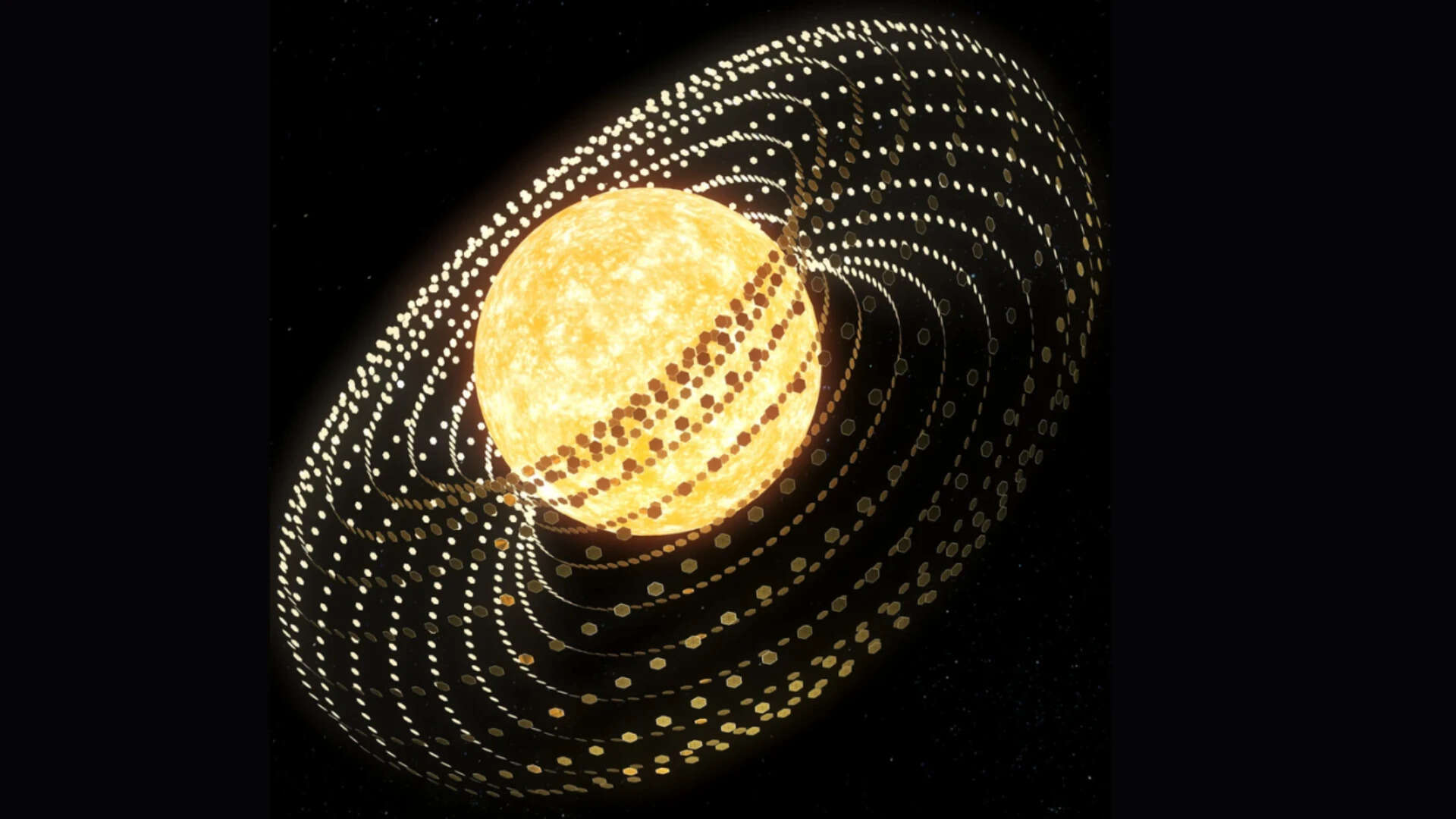
In 1960, physicist Freeman Dyson popularized the concept of a megastructure built around a star to intercept its energy output. We call it a Dyson sphere. For decades, SETI researchers searched for these structures by looking for massive cocoons of infrared radiation surrounding bright stars.
We looked in the wrong place.
If you wrap a raging furnace like our sun in a shell of solar collectors, the structure itself will heat up intensely, radiating a massive, unmistakable signature into the night sky. It is loud. It screams for attention.
But what if you wanted to build something efficient? What if you wanted to capture every single stray watt of energy without wasting a drop to the vacuum of space?
You wouldn't wrap a bonfire. You would wrap a hearth.
If a highly advanced intelligence deployed a swarm of energy-harvesting satellites—a Dyson swarm—around a low-mass star or a heavy brown dwarf, the optical profile of that object would change dramatically. The satellites would absorb the star's light, its heat, its kinetic solar winds. They would convert that raw stellar output into electricity, beams of microwaves, or forms of power we cannot yet fathom, channeling it back to a home planet or a wandering fleet.
The result? To an outside observer thousands of light-years away, the star would appear to vanish. Its visible light would drop to zero. Its thermal output would plummet as the machinery bled the star dry of its natural radiation, leaving only a tiny, freezing residual signature.
It would look exactly like a Y dwarf.
The implications are dizzying. It means the cold, lonely objects we have been cataloging as cosmic duds might actually be the most industrialized zones in the Milky Way. They might not be dead stars at all. They could be power plants.
The Weight of the Silence
Sitting in the quiet of a research lab, looking at these data points, a profound sense of isolation washes over you.
If this hypothesis holds true, it completely refines our understanding of the search for extraterrestrial intelligence. For three-quarters of a century, we have listened for radio signals. We have pointed our dishes at the sky, hoping for a friendly "hello" broadcasted across the cosmic waves.
We assumed alien life would want to talk. We assumed they would be noisy.
But the universe is old, and resources are finite. A civilization that survives long enough to cross the deep tech gap might not care about broadcasting its existence to a primitive species on a rock three planets out from a yellow dwarf. Their primary directive would be thermodynamics. Survival against the encroaching frost of an expanding universe.
When we look at a Y dwarf through this lens, the silence of the universe takes on a different quality. It is no longer the silence of an empty house. It is the muffled hum of a factory working through the night shift.
There is a natural skepticism that arises here, and it is healthy. Extraordinary claims require extraordinary evidence. Astronomers are quick to point out that we don't need aliens to explain why a brown dwarf is cold; gravity and time can do that on their own if given enough billions of years. The math for standard cooling models works, even if it leaves some awkward anomalies at the margins.
Yet, those margins are where the most profound discoveries in human history always hide.
We once thought the erratic blinking of certain stars was a sign of celestial gods; we discovered pulsars. We once thought the universe was static; we discovered it was flying apart. Every time we assume we have reached the edge of what nature can do on its own, the universe reveals a deeper layer of complexity.
Shifting the Lens
How do we prove it? How do we distinguish between a star that was born broken and a star that has been tamed by an alien empire?
The answer lies in the nuance of the thermal waste.
A natural brown dwarf cools uniformly. Its atmosphere swirls with storms of methane and water vapor, radiating heat in a predictable, chaotic pattern dictated by fluid dynamics. A harvested star, however, would possess structural anomalies. There would be hot spots where energy is being directed, or artificial gaps in the infrared spectrum where specific wavelengths are being blocked by metallic alloy swarms rather than gas clouds.
We are currently building the tools to see those gaps. The next generation of giant ground-based observatories, along with advanced space-bound interferometers, will soon allow us to map the surfaces of these ultra-cool objects with unprecedented clarity. We will see the shapes of their shadows.
Until then, we are left looking at the data, feeling a strange mix of awe and existential vertigo.
It forces us to confront our own technological insignificance. We pride ourselves on our global power grids, our orbital satellites, our budding steps into quantum computing. We think of ourselves as a technological species because we can light up our cities at night, visible from orbit like a scattering of cheap rhinestones on black velvet.
But our lights are a waste product. They are energy escaping into the void because we don't know how to catch it.
True technological mastery doesn't glow. It doesn't brag. It doesn't waste.
If the theorists are right, the true masters of the galaxy are sitting in the dark, wrapped in coats of cold steel and silicon, quietly drinking from the coolest cups the universe has to offer, entirely indifferent to whether we ever figure out they are there.