The Concrete Bowl
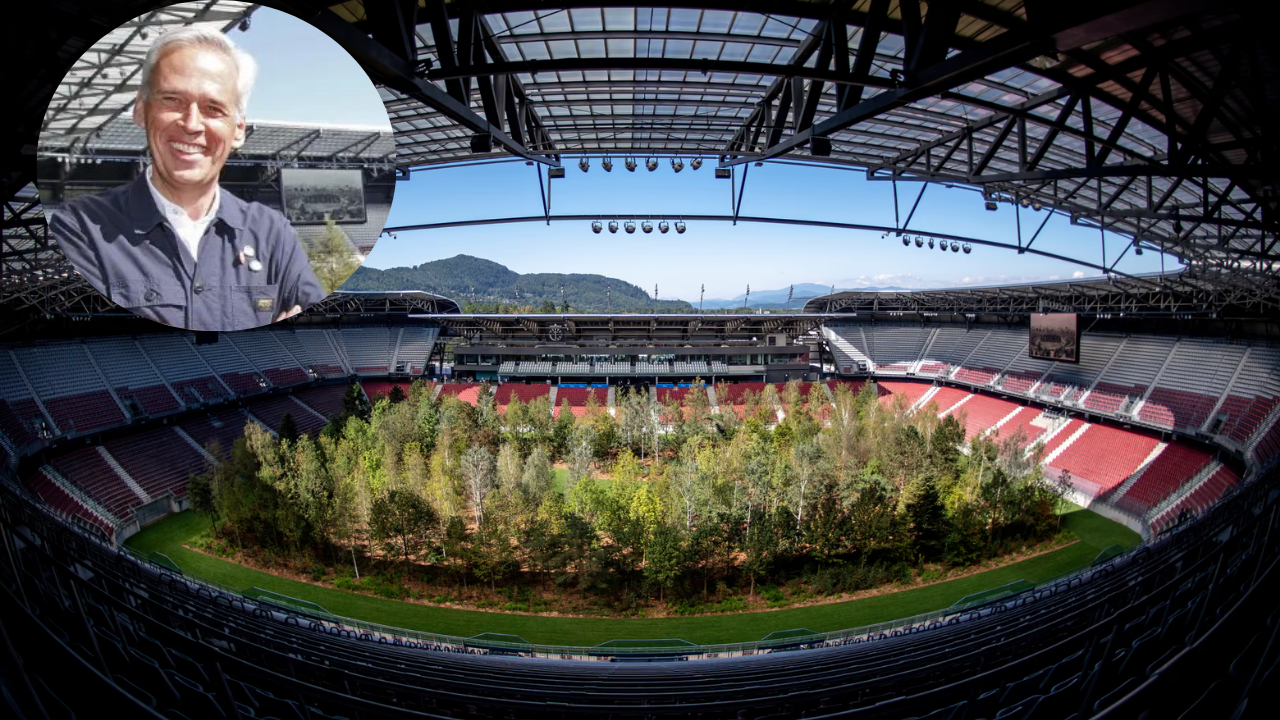
The Wörthersee Stadion in Klagenfurt usually echoes with the raw, tribal roar of soccer fans. In the autumn of 2019, however, it held a different kind of quiet. Two hundred and ninety-nine trees stood shoulder to shoulder on the pristine turf, their autumn leaves catching the Austrian sun.
They did not belong there.
Curator Klaus Littmann had looked at the iconic arena and envisioned a radical displacement. He called the living art installation FOR FOREST – The Attraction for Nature. Millions of viewers across the globe stared at photographs of the project with a strange, tightening sensation in their chests. It looked dystopian. It looked prophetic. A concrete bowl, built to contain human spectacle, had been entirely hijacked by the quiet dignity of a temporary forest.
Trees, displaced from their native soil, had been hauled into a stadium to remind humans what they were slowly losing.
Consider what happens next when the illusion ends. The installation closed. The trees were carefully transplanted across Klagenfurt to live out their natural lives in parks and schoolyards. But the mental image lingered. Why did it hurt to look at a forest inside a stadium? Because it inverted our reality. We are accustomed to seeing nature squeezed into tiny, manicured squares of green within sprawling seas of asphalt. Seeing the reverse—nature taking center stage while the concrete served as the prison—exposed an uncomfortable truth.
We are building a world where a natural ecosystem inside a cage is the only way we notice it anymore.
The Weight of a Leaf
Imagine walking down the aisles of that stadium installation during its run. The scent of damp earth and decaying pine needles fought a losing battle against the smell of hot stadium popcorn from nearby concession stands. Underfoot, the soil was real. The moisture in the air was real. But the blue sky framed by the steel floodlights felt fake.
This was not a mistake. It was a mirror.
Littmann drew his inspiration from a dystopian pencil drawing created thirty years earlier by Austrian artist Max Peintner. In Peintner’s sketch, a massive stadium is packed with mesmerized spectators who have paid admission to gaze down at a solitary, struggling forest—the last of its kind on a scorched Earth.
When Littmann brought that drawing to life in 2019, deforestation was no longer a speculative sci-fi trope. It was happening in real-time across the Amazon, Siberia, and Indonesia. Millions of acres vanishing annually, swallowed by agriculture, logging, and infrastructure.
The human brain struggles with large numbers. Tell someone that twelve million hectares of tree cover vanished last year, and their eyes glaze over. It is an abstraction. A statistic on a glowing screen.
But shrink that statistic down. Put two hundred and ninety-nine full-sized silver birches, oaks, white poplars, and maples onto a soccer pitch. Suddenly, you can count them. You can walk past them. You can press your palm against rough bark and realize that every single one of those trunks represents a living breathing organism that took decades to reach that height, only to become a temporary prop in a human gallery.
Scale matters. We do not mourn the abstract. We mourn the individual.
The Architecture of Absence
There is a specific kind of grief that comes with watching the familiar disappear. Psychologists call it solastalgia—the distress caused by environmental change happening around your home. You drive down a familiar country road, and suddenly the old oak grove is gone, replaced by the skeletal framing of a strip mall. A knot forms in your stomach. Something vital has been stolen from your map of the world.
Littmann understood this better than most. By isolating trees in a stadium, he weaponized our sense of absence.
When you remove a tree from a forest, the ecosystem does not simply lose one plant. It loses a node in an underground internet. Fungal networks, known as mycorrhizal networks, connect trees beneath the soil, allowing them to share nutrients, water, and distress signals. When a tree is ripped from that collective and dropped into a concrete amphitheater in Klagenfurt, it is severed from its community. It is forced to survive in total isolation, sustained by artificial watering schedules and human intervention.
Does that sound familiar?
Human beings spend their lives packing themselves into dense, urban stadiums of glass and steel, cordoned off from the very living systems that sustain our biology. We marvel at nature documentaries while bulldozers idle just beyond city limits. We visit national parks like tourists entering a museum, eager to take a snapshot of a dying world before heading back to the air-conditioned gift shop.
The stadium installation was a physical manifestation of our alienation. It asked a silent, devastating question: When the real forests are gone, will we be satisfied staring at curated substitutes behind turnstiles?
The Return to the Soil
The trees left the stadium. The project ended. The turf was repaired, and soccer matches resumed beneath the floodlights of Klagenfurt.
To the casual observer, everything went back to normal.
Yet, the 299 trees were not thrown away. They found new homes in public spaces throughout the city, rooted deeply into urban earth rather than sitting on top of a temporary scaffolding grid. They became shade trees for children. They became nesting spots for urban birds. They became living monuments to an art piece that refused to end quietly.
Art cannot save a burning planet. A temporary installation of trees cannot reverse the global loss of carbon sinks. Anyone who tells you otherwise is selling a comforting lie.
What art can do, however, is short-circuit our apathy. It can force us to look up from our screens and smell the pine sap in the middle of a concrete desert. It can disrupt the daily rhythm long enough for a new thought to take root.
The future of our environment will not be decided in art galleries or football stadiums. It will be decided in the mundane, grinding daily choices of how we build, how we consume, and what we choose to protect when no one is watching.
The stadium is empty now. The grass has grown back over the scars left by the roots. But the memory of those trees remains, standing shoulder to shoulder in the dark, waiting to see what we will do next.