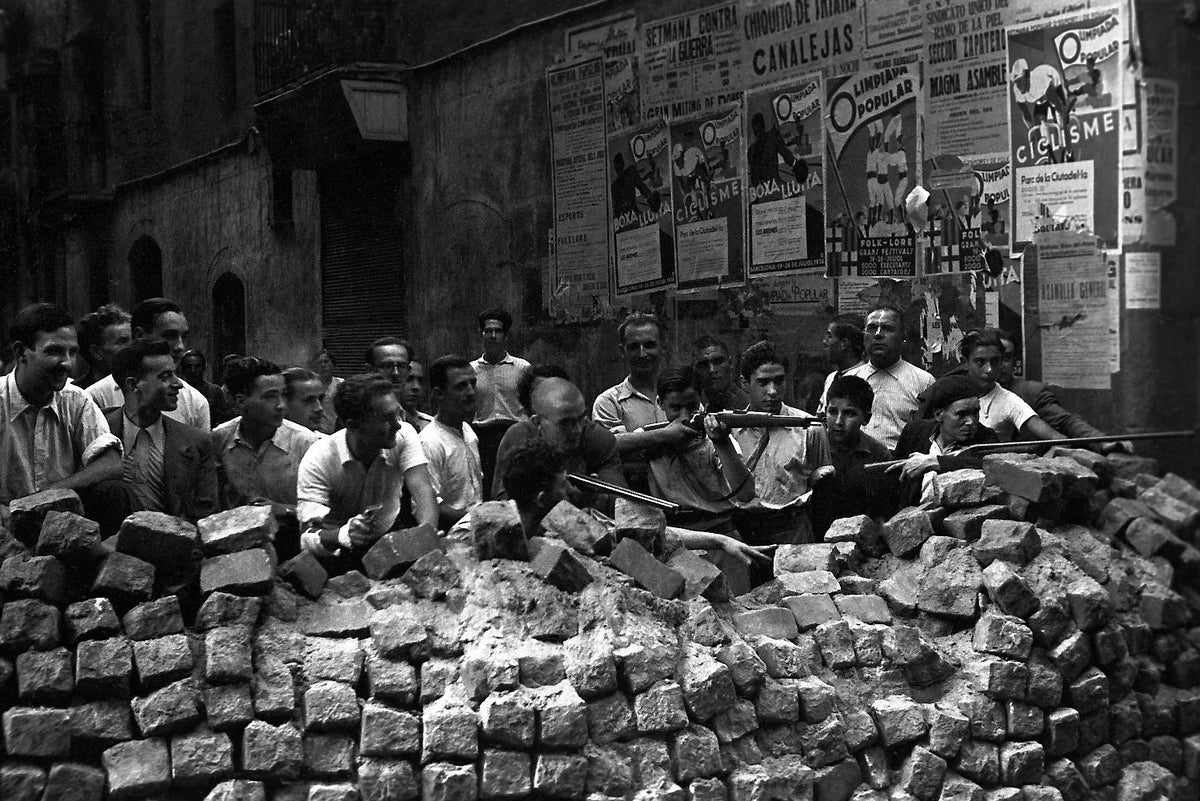
The Illusion of September 1st
The global consensus states that World War II began on September 1, 1939, when German panzers crossed the Polish frontier. This date is neat, convenient, and fundamentally wrong. By the time Warsaw faced bombardment, the geopolitical architecture of Europe had already been shattered, and the ideological battle lines had been written in blood across the Iberian Peninsula. The true ignition point of the global conflagration occurred exactly three years earlier, on July 17, 1936, when a military coup in Spain transformed from a localized mutiny into the opening salvo of a total war that engulfed the globe.
To view the Spanish Civil War as a mere dress rehearsal or an isolated domestic dispute is to misunderstand the mechanics of mid-century totalitarian expansion. The conflict was the precise moment the international order collapsed, replaced by a proxy war where the world’s major ideological blocs first tested their men, machines, and terrifying new doctrines of total destruction.
The Day the World Order Fractured
When General Francisco Franco and his co-conspirators launched their uprising against the Second Spanish Republic, they did not just start a civil war. They triggered a continental crisis that exposed the profound rot within the Western democracies.
1936: Spanish Civil War Begins -> Axis Intervention -> Failure of Non-Intervention -> 1939: Global War
Within days of the rebellion, the conflict ceased to be purely Spanish. Franco immediately appealed to Nazi Germany and Fascist Italy for logistical support. The response was swift and decisive. Adolf Hitler provided Junkers Ju 52 transport aircraft to airlift Franco’s battle-hardened Army of Africa from Morocco to the Spanish mainland. This operation was the first major military airlift in history, and it altered the trajectory of the war.
While Berlin and Rome poured resources, tanks, and pilots into Spain, Great Britain and France hid behind the shield of the Non-Intervention Committee. This policy was designed to contain the conflict, but it achieved the exact opposite. It starved the democratically elected Spanish Republic of the means to defend itself while allowing the Axis powers to violate international norms with total impunity.
Guernica was the Blueprint
The air war over Spain was not a sideshow. It was a laboratory for the destruction of European cities.
The Condor Legion, a unit of the German Luftwaffe composed of volunteers, used the Spanish skies to perfect the doctrine of strategic terror bombing. Before Spain, aerial warfare was largely confined to tactical support for ground troops or poorly coordinated raids on industrial hubs.
On April 26, 1937, the Basque town of Guernica was systematically obliterated by German and Italian aircraft. The raid was a calculated experiment in carpet bombing, utilizing a mixture of high-explosive and incendiary bombs to maximize civilian casualties and induce psychological terror. The tactics refined at Guernica—coordinating waves of bombers to trap citizens in a firestorm—were deployed with devastating precision a few years later against Warsaw, Rotterdam, Coventry, and London.
The Soviet Union also utilized Spain as a testing ground. General Secretary Joseph Stalin dispatched military advisors, tanks, and aircraft to support the Republic, demanding Spain's gold reserves in return. The battlefields of Guadalajara and the Ebro became testing grounds where Soviet T-26 tanks faced off against German Panzer Is, offering a grim preview of the massive armored clashes that would later define the Eastern Front.
The Myth of Neutrality and the Axis Birth
The diplomatic fallout of the Spanish conflict was even more catastrophic than the military innovations. The war forged the very alliance that would terrorize the globe for the next decade.
Prior to 1936, Italy and Germany were suspicious rivals. Benito Mussolini had previously mobilized troops to prevent a German annexation of Austria. However, their shared intervention in Spain drew the two dictators into a tight embrace. The common cause of crushing the Spanish Republic cemented the Rome-Berlin Axis, a term coined by Mussolini himself in late 1936.
+-------------------+------------------------------------+----------------------------------+
| Country           | Official Stance                    | Actual Practice                  |
+-------------------+------------------------------------+----------------------------------+
| Nazi Germany      | Signed Non-Intervention Agreement  | Supplied Condor Legion, armor    |
| Fascist Italy     | Signed Non-Intervention Agreement  | Dispatched 70,000+ troops (CTV)  |
| Soviet Union      | Signed Non-Intervention Agreement  | Sold weapons, sent advisors      |
| United Kingdom    | Championed Non-Intervention        | Enforced arms embargo on Republic|
+-------------------+------------------------------------+----------------------------------+
The Western democracies chose appeasement, miscalculating that isolationism would preserve the peace. By refusing to confront aggression in Spain, London and Paris demonstrated to Hitler that they lacked the stomach for a fight. This failure of nerve directly cleared the path for the annexation of Austria and the dismemberment of Czechoslovakia at Munich.
A Continuous Thread of Violence
History is rarely a series of clean breaks; it is a continuous, unfolding chain of cause and effect. The same divisions that fought in Spain from 1936 to 1939 simply packed up their gear, refined their notebooks, and moved their operations further north and east when the calendar turned to September 1939.
The Spanish Civil War officially ended on April 1, 1939, with Franco's victory. Exactly five months later, World War II broke out in Poland. The proximity of these dates is no coincidence. The conclusion of hostilities in Iberia freed up German and Italian resources, solidified the fascist alliance, and left the Soviet Union deeply cynical about Western resolve, paving the way for the shocking Molotov-Ribbentrop Pact.
When we isolate the events of September 1939 from the three years of globalized warfare that preceded them in Spain, we accept a sanitized version of history. The global conflict did not start because of a localized dispute over the Danzig corridor. It began when the international community allowed ideological totalitarians to systematically dismantle a sovereign state while testing the weapons of the next generation. The trenches dug in the hills outside Madrid were the very same trenches that eventually stretched across the globe.