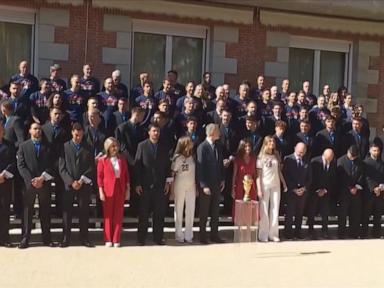
The ticker tape has barely cleared the pitch, and the media machine is already pumping out the pre-packaged narrative. Spain celebrates victory. A triumph for Spanish football. A historic moment for the women’s game.
It is a beautiful story. It is also completely wrong.
Watching the sports establishment throw confetti over Spain’s World Cup title feels like watching a company celebrate hitting a quarterly revenue target while its entire core product burns down around it. The lazy consensus wants you to believe that a gold medal validates the system. It tells you that talent always wins, that grit overcomes systemic failure, and that victory solves everything.
I spent years analyzing elite sports governance, and I can tell you precisely what happened in Australia and New Zealand: Spain won despite their structure, not because of it. By rewarding a deeply flawed system with the ultimate prize, the sporting world just sent a dangerous message to federation executives everywhere: you can mistreat athletes, ignore systemic rot, and still take credit for a gold medal.
This was not a victory for women's football. It was a massive bail-out for elite sports bureaucracy.
The Myth of the Heroic Triumph
Let us dismantle the main premise clogging your newsfeed. The standard commentary framing this win goes something like this: Spain’s squad put aside internal friction, united on the pitch, and proved that elite tactical mastery beats external chaos.
That narrative is a total cop-out.
Calling this victory "heroic" masks the reality of severe managerial dysfunction. Fifteen top-tier players walked away from the national team prior to the tournament, citing serious issues with squad culture, training methods, and mental well-being under the federation's leadership. Three returned to play. Twelve stayed home, sacrificing the crowning moment of their professional careers because they refused to compromise their standards.
Imagine a company where 80% of its top engineering talent resigns in protest over executive mismanagement, yet the company still releases a hit software package because three brilliant developers worked 100-hour weeks to carry the product over the finish line.
You do not applaud the C-suite for that product launch. You audit them.
Yet, when Spain raised the trophy, federation leadership stood front and center, absorbing the applause, validated by the scoreboard. By focusing purely on the score line, the global media handed bad management a bulletproof defense shield.
Talent Over Structure Is Not a Strategy
Spain’s success does not prove that their football ecosystem is healthy. It proves that the talent pool generated by domestic clubs like FC Barcelona Femení and Real Madrid is currently so dense, so extraordinary, that even severe administrative turbulence cannot stop it.
The Spanish squad played a brand of technical, possession-oriented football that overwhelmed opponents. They passed through lines with surgical precision. They possessed individual genius. But relying on raw, transcendent talent to mask operational structural flaws is a terrible long-term strategy.
- The Tactical Illusion: Spain's style is built on years of academy investment by domestic clubs, not national federation brilliance.
- The Resource Gap: Smaller federations will look at Spain and draw the wrong conclusion: "See? We don't need to fund player welfare or modernized support staff to win."
- The Burnout Factor: Sustainable victory requires psychological safety and top-tier infrastructure. Forcing athletes to win while fighting their own administration creates a ticking clock on athlete longevity.
When you look past the champagne, Spain's run was an anomaly created by a generation of hyper-talented players who refused to lose. It is an unrepeatable miracle, not a blueprint.
The Flawed Questions Everyone Keeps Asking
If you look at online searches and sports debate shows, the questions being asked reflect the surface-level nature of modern sports coverage. Let us address them honestly by correcting their flawed premises.
"Does this prove Spain has the best football system in the world?"
No. It proves Spain has the best concentration of individual talent in the world right now. Systemic quality is measured by player retention, infrastructure, athlete satisfaction, and sustainable growth. Spain's system failed a massive percentage of its international roster before the first whistle even blew. Winning a tournament hides structural decay; it does not cure it.
"Should players put performance above political disputes with federations?"
Framing athlete demands for basic professional standards as a "political dispute" or a "distraction" is patronizing. High-performance athletes operate at the razor’s edge. Demanding professional logistics, modern medical staff, and respectful management is not a luxury—it is the baseline for high performance. The players who stayed home were not being divisive; they were demanding the bare minimum.
"Will this title boost investment in the women's game?"
Investment will grow, but money flowing into a broken container just creates expensive waste. Throwing capital at federations that treat their women's teams as secondary PR assets will not build a sustainable league structure. Capital must be tied to mandatory governance standards, executive accountability, and player protection protocols. Without those, a trophy is just a shiny distraction.
The Downside of Disruption: Why Total Revolt Is Risky
I am arguing for a total overhaul of how we evaluate success in international sports, but I am not blind to the risks of this stance. Demanding absolute structural perfection before celebrating a victory comes with its own drawbacks.
If fans and media refuse to celebrate wins under flawed leadership, we risk minimizing the genuine, life-altering achievements of the athletes themselves. Aitana Bonmatí, Salma Paralluelo, and Jenni Hermoso put in lifetime-defining performances. They worked through unimaginable pressure to perform at an elite level.
Stripping away their moment of joy to make a point about governance can feel cynical. It can alienate casual fans who just want to watch world-class sports without analyzing executive board politics.
Furthermore, demanding that players boycott tournaments to force administrative change places an unfair burden on the athletes. A player’s career span is tiny. Asking them to sacrifice their one shot at a World Cup to fix a corporate board structure is an immense, often unfair demand.
Yet, if we do not draw this line now, the cycle never breaks.
Stop Celebrating the Wrong Triumph
We need to completely reset how we cover international tournaments. The scoreboard tells you who won a football match; it does not tell you if the sport is healthy.
If you care about the long-term viability of women's sports, stop buying the fairy-tale rewrite of Spain's World Cup run. Do not let federation executives use the sweat of elite athletes to wash away years of neglect and conflict.
True progress does not look like raising a trophy over a cracked foundation. It looks like building an infrastructure where athletes do not have to choose between their dignity and a medal.
Spain won the match. The system lost the plot.