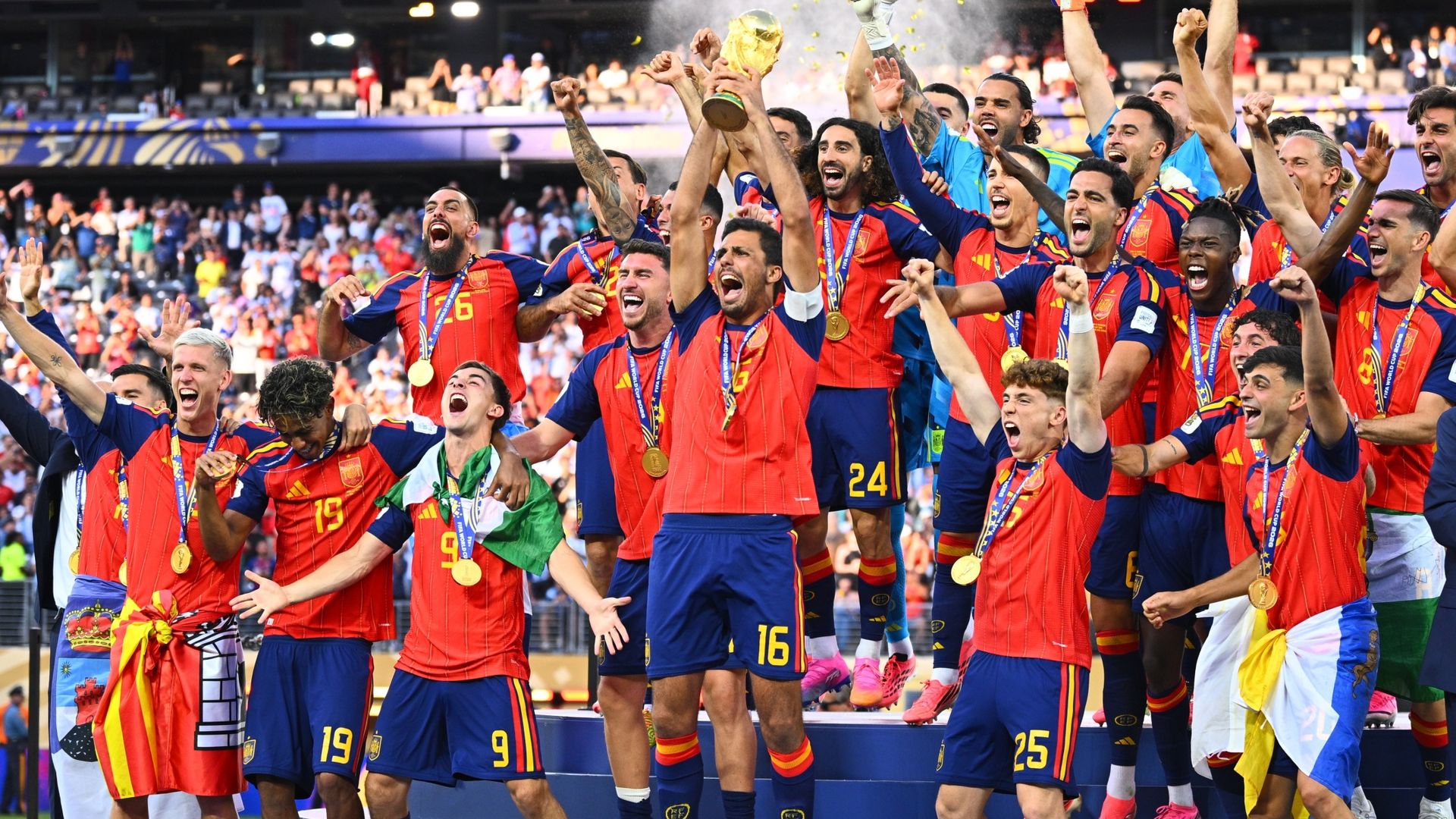
Madrid is nursing a collective hangover, drowning in a sea of red jerseys, cheap beer, and delusional euphoria.
Spain just beat Argentina to lift their second World Cup trophy. The mainstream media is already drafting the familiar, lazy narrative: a triumph of the system, a masterclass in modern possession, and the definitive proof that Spain's football factory is the undisputed ruler of the global game. Meanwhile, you can read other developments here: Why the World Cup Halftime Show Was a Logistical Nightmare That Barely Worked.
They are wrong.
What we witnessed in that final wasn't the dawn of a new golden era. It was the absolute peak—and the impending collapse—of an unsustainable footballing philosophy. While fans scream in the Plaza de Cibeles, the structural rot of European football is being swept under the rug. To understand the complete picture, we recommend the excellent article by Yahoo Sports.
Spain didn't win because their system works. They won because international football has become so tactically bankrupt, predictable, and structurally rigid that a mildly competent passing carousel can still pass for genius.
The Illusion of Dominance
Look at the raw data, not the emotional highlight reels.
Spain controlled the ball. They passed Argentina into submission. The pundits called it control; I call it cowardice. We are celebrating a team that averaged over 700 passes per match, yet generated fewer expected goals ($xG$) per minute of possession than almost any champion in the last thirty years.
International football has reached a state of hyper-optimization where risk mitigation trumps creation. Spain has mastered the art of not losing the ball, which is entirely different from playing winning football. They choked the life out of the tournament by playing a low-risk, high-volume possession game designed to exploit the lack of defensive cohesion in international squads.
- The Reality: Clubs train together ten months a year. National teams train together for ten days.
- The Exploit: Spain’s system works against national teams because pressing triggers require instinctual synchronization. Opponents cannot organize a high press in a three-week camp. Spain simply exploits this organizational deficit.
This isn't tactical supremacy. It’s a systemic cheat code that only works because the international calendar denies opposing managers the time required to build an effective antidote. Put this exact Spanish national team into the knockout stages of the UEFA Champions League against a drilled, club-level low block, and they get systematically picked apart on the counter-attack within ninety minutes.
Why the Talent Pipeline is Actually Broken
The standard narrative insists that Spain's academies are thriving. They will point to the teenage starlets starting on the wings as proof.
I have spent two decades analyzing youth development structures across Europe. I have watched the transition from street-smart footballers to hyper-sanitized academy products. The truth is that Spain is producing clones, not geniuses.
ACADEMY PRODUCT COMPARISON
---------------------------------------------------------
Metric              Traditional Maverick   Modern Academy Clone
---------------------------------------------------------
Dribbles per 90     High (Unpredictable)  Low (Risk-Averse)
Pass Completion %   75-80% (Aggressive)   90-95% (Lateral)
Tactical Flexibility Extreme               Rigidly Linear
Modern Spanish academies punish individuality. If a ten-year-old takes a risk, loses the ball, and concedes a transition, he gets benched. The system filters for compliance, high football IQ, and technical safety.
This creates a massive problem. When every player is taught to value the retention of the ball above all else, you eliminate the chaotic element required to break down elite defenses. Spain succeeded this month because Argentina’s defensive transitions were sluggish, a byproduct of an aging midfield core. Had Spain faced a peak-athletic, disciplined defensive unit, their possession would have degenerated into the same sterile, U-shaped passing perimeter that saw them crash out of previous tournaments.
We are celebrating a victory built on the last remnants of genuine individual brilliance while ignoring the assembly line of identical, risk-averse midfielders currently dominating the youth ranks.
The Flawed Premise of the "Modern Champion"
Go to any football forum or look at the "People Also Ask" sections on search engines. The questions are always the same: How can other countries replicate Spain's model? What makes Spanish coaching superior?
The entire premise of the question is fundamentally flawed. You cannot replicate a model that relies on a specific historical and cultural anomaly. Spain's success isn't just coaching; it is the result of a highly concentrated media, economic, and cultural ecosystem centered around two domestic giants that historically subsidized the national team's identity.
When you strip away that specific context, the model fails miserably. Look at the attempts to export this philosophy to other nations. It results in slow, agonizing, ineffective football that lacks the technical baseline required to execute it safely.
If you want to build a winning national team today, do not copy Madrid or Barcelona. Copy the high-efficiency, vertical transition models seen in modern club football. The future belongs to teams that accept losing the ball as a necessary metric for creating high-value attacking space. Spain’s refusal to accept this reality will be their undoing in the next cycle.
The Brutal Truth for the Losers
Argentina lost, but their tactical blueprint is actually closer to where the sport is heading. They attempted to play with verticality, utilizing direct central line-breaking passes rather than endless lateral shifting.
They failed because of execution and physical exhaustion, not philosophy.
The danger of Spain's victory is that it validates the wrong lessons. It tells young managers worldwide that the goal of football is to monopolize the ball. It tells directors of football that physical profile and vertical speed are secondary to technical retention.
This victory is a dead end. It is the final roar of a dying methodology. The data shows that physical demands, sprint distances, and transition speeds in elite club football are accelerating at an exponential rate. International football is a lagging indicator. It represents where the sport was five years ago, not where it is going.
Enjoy the parades in Madrid. Drink the champagne. But do not mistake a triumph of regression for a vision of the future. The teams that adapt to the hyper-athletic, chaotic reality of modern football are already rendering Spain's masterpiece completely obsolete.
Stop copying the champions. They won yesterday's war.