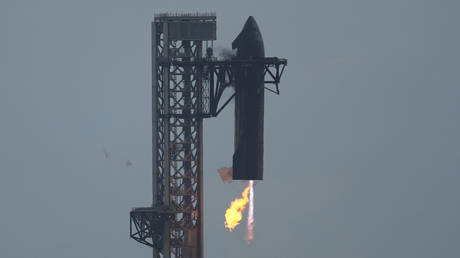
Everyone in aerospace media is currently drooling over Starfactory. You have seen the drone flyovers and read the breathless profiles treating SpaceX’s sprawling complex at Starbase, Texas, like an automotive assembly line for Mars rockets. They call it the birth of mass-produced spaceflight. They tell you that stamping out steel rings like Model Y chassis will automatically drop launch costs to pennies on the dollar.
They are completely missing the point.
Starfactory is not a magical vending machine for orbital rockets. It is a high-stakes bet on vertical integration that violates nearly every established rule of traditional aerospace manufacturing—and if the demand curve falters by even a fraction, that massive building becomes the most expensive steel mill in South Texas.
The Automotive Assembly Line Myth
The lazy consensus goes like this: SpaceX hired automotive manufacturing veterans, bought giant stamping presses, automated the welding, and solved rocket production. Now Starships will roll off the line like Toyota Camrys.
Stop comparing a 400-foot orbital launch vehicle to a sedan. It is intellectually dishonest.
A Toyota Camry is built on a frozen design. Engineers lock the geometry, validate the tooling over years, and pump out millions of identical units to amortize multi-billion-dollar capital expenditures. Starfactory is doing the exact opposite. SpaceX is attempting high-volume serial production on an experimental prototype whose design changes every few weeks.
I have watched aerospace primes burn hundreds of millions of dollars trying to scale production before freezing the engineering baseline. In traditional defense and aerospace programs—think of the early years of the F-35 Joint Strike Fighter—building the factory while still inventing the vehicle creates a nightmare called concurrency. Every time an engineer tweaks a propellant manifold or changes a weld seam thickness to save two hundred kilograms, you do not just change a CAD file. You rip out jigs, reprogram robotic welders, and scrap half-built barrel sections sitting on the factory floor.
SpaceX absorbs this pain because Elon Musk treats the factory itself as the primary product. By bringing the high-bay tent operations under a single climate-controlled roof spanning roughly a million square feet, SpaceX eliminated the outdoor weather delays and manual crane lifts that slowed down early prototypes. That is real progress. It is not, however, a traditional assembly line. It is a rapid-prototyping foundry operating at industrial scale.
Why Steel and Automation Are a Double-Edged Sword
When SpaceX ditched carbon-fiber composites for 300-series stainless steel back in 2019, commentators praised the move for its low raw material cost. Stainless steel costs roughly three dollars a kilogram compared to over a hundred dollars a kilogram for aerospace-grade carbon fiber.
Here is the nuance the cheerleaders ignore: raw material cost is irrelevant if your buy-to-fly ratio and rework rates spiral out of control.
In aerospace manufacturing, the buy-to-fly ratio measures the weight of the raw material purchased against the weight of the finished part that actually flies. While rolled steel rings waste far less material than machined aluminum blocks, welding thin-walled, four-millimeter stainless steel cylinders nine meters in diameter introduces massive thermal distortion. Heat warps metal. When you automate laser and friction-stir welding across dozens of ring sections stacked vertically, tiny millimeter deviations compound. By the time you stack thirty rings to build a Super Heavy booster, a microscopic alignment error at the bottom throws the thrust puck out of true at the top.
SpaceX solves this by brute-forcing the process: tight fixturing, automated optical scanning, and massive throughput. Yet automation has zero tolerance for ambiguity. A human welder in a tent can adjust a torch angle on the fly when two steel sheets have a slight gap. A programmed KUKA robot arm will happily weld straight through a defect unless your upstream tolerances are near-perfect.
Starfactory exists because manual welding could never hit the cadence required for orbital refueling. A single lunar landing under NASA’s Artemis program requires anywhere from ten to twenty tanker flights just to fill one depot in Low Earth Orbit. You cannot build a fleet capable of twenty launches a month with guys standing on scissor lifts holding TIG torches. You need automated lines. Still, automating a moving target means constantly rewriting software and recalibrating hardware while simultaneously trying to hit launch windows.
The Questions Everyone Is Asking About Starfactory (And Why They Are Wrong)
If you look at how the public searches for information on Starbase, the same flawed assumptions pop up repeatedly. Let us dismantle them.
Can Starfactory really produce one Starship per day?
This is the wrong question. Building a stainless-steel hull in twenty-four hours is trivial once your rolling and welding lines are tuned. The hull is just a giant pressurized thermos.
The real bottleneck at Starfactory is not the steel structure. It is the Raptor 3 engine and the Thermal Protection System (TPS).
You can stamp out steel rings until the cows come home, but a Starship booster requires thirty-three Raptor engines, and the upper stage requires six more. That is thirty-nine complex, full-flow staged combustion engines per stack. Even with Raptor 3 eliminating external plumbing and heat shields through integrated cooling channels, casting, 3D-printing, machining, and hot-fire testing thirty-nine engines per vehicle requires a supply chain and testing cadence that dwarfs hull fabrication.
Then there are the eighteen thousand hexagonal ceramic heat shield tiles covering the windward side of the ship. Installing, pinning, and inspecting fragile silica-based tiles on a curved steel surface—and ensuring they do not vibrate off during max-Q—is a brutal, labor-intensive nightmare. Until Starfactory solves rapid tile application and engine throughput, hull production speed is just a vanity metric.
Why is SpaceX building Starfactory in Boca Chica instead of Florida?
People assume SpaceX stayed in South Texas purely for cheap land and favorable state regulations. That is only half the story.
Cape Canaveral is surrounded by legacy aerospace infrastructure, dense population centers, and strict Eastern Range safety corridors. Moving nine-meter-wide rocket stages down public roads in Brevard County requires shutting down power lines and coordinating with local authorities. At Boca Chica, SpaceX owns the road between the production site and the orbital launch mount two miles away.
However, building a mega-factory on a coastal wetlands peninsula at the southern tip of Texas carries severe operational risks. High humidity corrodes tooling. Salt air attacks exposed electronics. Hurricane season threatens an entire production line sitting a few feet above sea level. SpaceX accepted extreme environmental and logistical penalties—shipping in every single ton of raw steel, liquid oxygen, and liquid methane by truck—solely to maintain absolute physical proximity between the factory floor and the launch pad.
The Brutal Economics of Vertical Integration
Traditional aerospace companies like Boeing, Lockheed Martin, and Northrop Grumman operate as systems integrators. They design the architecture, build the primary airframe, and subcontract seventy percent of the components to specialized tier-one and tier-two suppliers. They do this to spread financial risk. When launch rates drop, the prime contractor cuts purchase orders to suppliers instead of eating massive fixed overhead costs.
SpaceX rejected that model entirely. Inside Starfactory, SpaceX is bringing raw coil steel in one door and rolling out flight-ready stages from the other. They manufacture their own valves, flight computers, propellant tanks, engines, and actuators.
When launch cadence is climbing exponentially, vertical integration is an unstoppable superpower. You eliminate supplier markups, kill six-month lead times for specialty aerospace fasteners, and compress feedback loops from years to hours. When a flight test reveals a structural weakness in the interstage, the engineer walks across the street from mission control to the factory floor and changes the build process before dinner.
Here is the downside that Wall Street analysts and space bloggers refuse to confront: operating leverage cuts both ways.
Fixed overhead inside a facility like Starfactory is astronomical. Maintaining automated welding cells, giant hydraulic presses, cleanrooms, and thousands of salaried technicians burns tens of millions of dollars every single month whether a rocket launches or not.
Imagine a scenario where a catastrophic launch anomaly grounds the Starship fleet for nine months during an FAA mishap investigation. Under a traditional subcontracted model, you pause supplier deliveries and conserve cash. Inside Starfactory, you either keep paying an army of specialized workers to build rockets that sit idle in a storage lot, or you lay them off and lose institutional knowledge you cannot replace.
Vertical integration demands relentless, uninterrupted demand. Right now, SpaceX manufactures its own demand through Starlink. Because Falcon 9 cannot deploy full-sized V3 Starlink satellites fast enough to meet global bandwidth targets, SpaceX must get Starship flying at high cadence. Starlink is the captive customer paying the bills for Starfactory. Without Starlink, the financial math behind building a million-square-foot rocket factory in a remote corner of Texas would collapse under its own weight.
What Hardware Startups and Manufacturers Should Actually Learn From Starbase
Most tech executives read about Starfactory and take away the wrong lessons. They buy expensive robotics, lease massive warehouses, and talk endlessly about "first principles" while their burn rate incinerates their runway.
If you actually want to apply what works at Starbase without bankrupting your company, follow three rules:
- Automate the bottleneck, never the baseline. SpaceX did not automate Starship production on day one. They built Mk1 and SN1 through SN15 outdoors using manual labor, crude jigs, and grain-silo construction techniques. They proved the physics of the belly-flop maneuver and header tank feed systems before spending a dime on permanent factory automation. Never buy a robot to build a part you might delete next month.
- Co-locate design and assembly. The single greatest advantage of Starfactory is not the machinery; it is the absence of a physical barrier between the people who draw the parts and the people who weld them. When your CAD engineers sit three hundred miles away from your machinists, your product will inevitably become over-engineered, unbuildable garbage. Force your engineers to stand next to the technicians trying to torque a bolt in an impossible space.
- Design for manufacturability before performance. Legacy aerospace engineers optimize for specific impulse and structural mass fraction above all else. They will spend fifty thousand dollars to shave two hundred grams off a bracket. SpaceX optimizes for production rate and cost per ton to orbit. If making a steel ring one millimeter thicker eliminates three hours of precision machining and stress-relief heat treatment, take the weight penalty and add another engine.
The Real Test Has Not Started Yet
Starfactory looks impressive from a drone. The concrete is fresh, the lighting is bright, and the sheer scale of the building dwarfs anything built for commercial spaceflight since the Saturn V era at Michoud Assembly Facility.
Yet an empty factory floor or a half-built prototype sitting on a transport stand proves nothing. Manufacturing is not measured by square footage or press releases about automation. It is measured by sustained, repeatable output under real-world constraints.
Until Starfactory proves it can absorb constant design iterations, crank out thirty-nine reliable Raptor engines per stack, keep eighteen thousand heat shield tiles glued to a vibrating steel hull, and turn around orbital boosters faster than the FAA can print launch licenses, it remains an audacious, high-risk gamble. SpaceX has built the ultimate machine for making rockets. Now they have to survive the cost of feeding it.