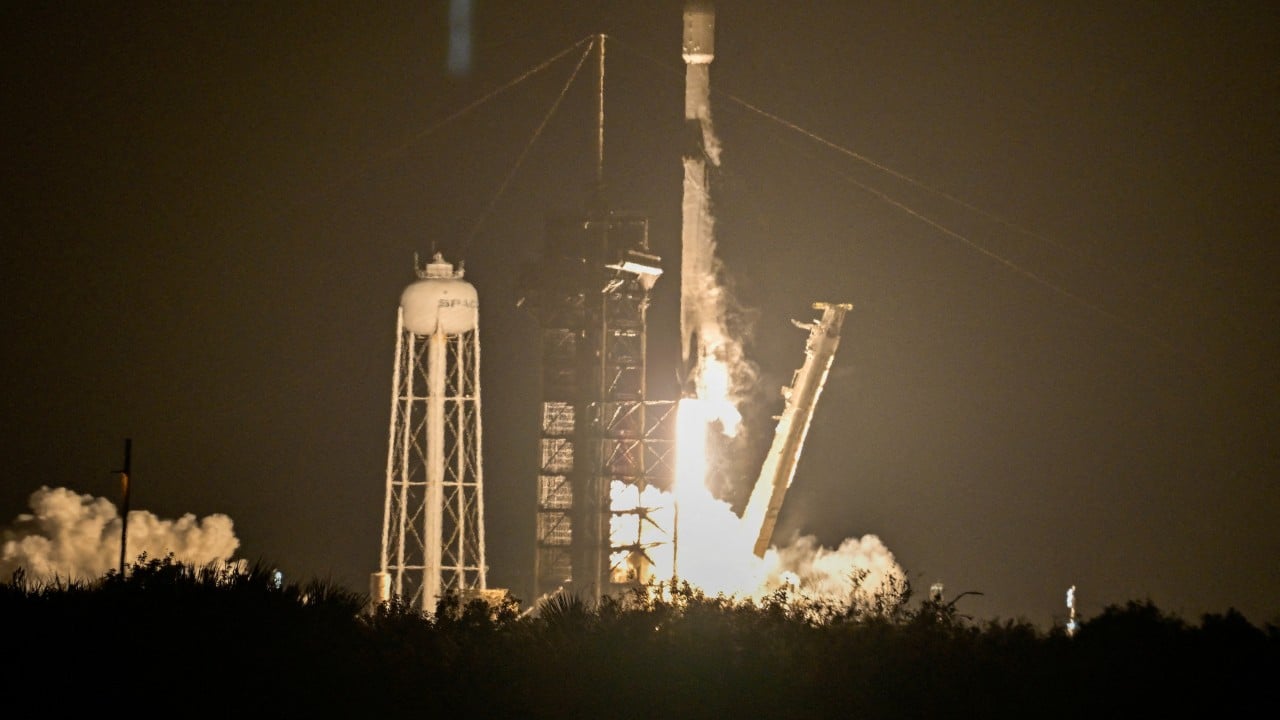
Uncontrolled space debris follows predictable mathematical trajectories until friction, gravitational anomalies, or surface collisions alter its momentum. When a discarded Falcon 9 second stage from a 2015 deep-space communication satellite launch was projected to impact the lunar surface, media coverage focused heavily on the visual novelty of an artificial crater. Beneath the sensationalized headlines lies a distinct engineering reality governed by orbital mechanics, kinetic energy transfer, and the growing oversight gap in cislunar space management. Analyzing this event requires stripping away speculative noise to examine the exact physical forces at play, the limitations of current tracking models, and the structural implications for future high-altitude space missions.
The Orbital Mechanics of Cislunar Decay
An object injected into a high-eccentricity orbit rarely decays through atmospheric drag alone. The Falcon 9 booster stage deployed the DSCOVR climate observatory into a libration point orbit before exhausting its fuel reserves, leaving the upper stage stranded in a chaotic, sun-perturbed orbit between Earth and the Moon.
Predicting the exact impact vector of such an object involves accounting for the three-body problem, where gravitational influences from the Earth, Moon, and Sun interact simultaneously. Unlike low Earth orbit trash, which experiences steady deceleration via the residual thermosphere, high-altitude debris operates in a gravitational tug-of-war.
Solar radiation pressure acts as a continuous low-thrust perturbation. Over years, this subtle photon momentum accumulates, shifting the semi-major axis and eccentricity of the orbit. Because the spent stage had a high area-to-mass ratio—a large, empty cylindrical aluminum hull exposed to sunlight and solar wind—solar radiation pressure exerted disproportionate force, rendering long-term deterministic tracking exceptionally difficult. Independent orbital dynamicists had to continuously update their ephemeris models using ground-based optical measurements to narrow down the impact window.
Kinetic Energy Transfer at the Lunar Surface
The physical consequences of the impact depend entirely on mass, velocity, and angle of incidence. The dry mass of the Falcon 9 second stage is roughly four metric tons. Upon entering the lunar gravitational well, acceleration increases rapidly due to the absence of an atmosphere, resulting in an impact velocity of approximately 2.58 kilometers per second.
Kinetic energy scales quadratically with velocity according to the classical equation $E_k = 0.5mv^2$. Multiplying the mass by the square of the impact velocity yields an energy release equivalent to several hundred kilograms of TNT.
Mass (m) ≈ 4,000 kg
Velocity (v) ≈ 2,580 m/s
Resulting Energy: ~1.3 × 10^10 Joules (~3 tons of TNT equivalent)
Upon surface contact, this energy converts instantly into a high-pressure shock wave that propagates through the lunar regolith and basaltic bedrock. The cratering mechanics follow standard hypervelocity impact physics:
- Contact and Compression: The leading edge of the rocket body compresses the target material, generating extreme localized pressures that melt or vaporize a fraction of the projectile and regolith.
- Excavation Flow: The shock wave reflects as a rarefaction wave, driving material upward and outward to form a transient cavity.
- Modification Stage: Gravity and seismic shaking cause wall collapse, resulting in a final crater estimated to be between ten and twenty meters in diameter, depending on the local subsurface density and impact angle.
Because the Moon lacks an atmosphere, no airburst occurs. The kinetic energy delivers its payload directly to the regolith, throwing out an asymmetric ejecta blanket and exposing fresh sub-surface material unweathered by solar wind.
The Cislunar Oversight Gap
This incident highlights a structural vulnerability in space traffic management. Current tracking infrastructure, maintained primarily by the United States Space Force and civilian agencies like NASA, prioritizes low Earth orbit and geostationary altitudes where active commercial assets operate. Cislunar space—the volume extending beyond geosynchronous orbit out to the Moon—has historically been treated as an operational desert.
When rockets complete deep-space burns, disposal protocols often rely on heliocentric or high-Earth orbits where the objects are expected to remain indefinitely out of the way. However, gravitational chaos frequently routes these derelict stages back into intersecting paths with Earth or the Moon.
The lack of mandatory reporting or active tracking for deep-space upper stages creates an information asymmetry. Operators design missions to satisfy immediate operational constraints—such as payload delivery velocity—without building in propellant reserves for active passivation or controlled disposal trajectories into remote ocean zones like the South Pacific Spacecraft Cemetery.
Strategic Implications for Lunar Exploration
As lunar missions increase in frequency, treating cislunar space as an infinite void for unguided debris is no longer viable. Planned crewed outposts, robotic resource prospecting missions, and permanent communication relays require a stable, predictable orbital environment.
Uncontrolled impacts, while geologically minor on a planetary scale, introduce high-velocity shrapnel and dust clouds that threaten nearby operational assets. Furthermore, identifying uncatalogued debris crossing lunar space becomes a critical safety requirement for landing operations.
Future mission architectures must internalize the cost of orbital cleanup. Regulatory bodies are beginning to weigh stricter guidelines for trans-lunar injection stages, requiring either immediate heliocentric disposal burns that permanently remove the asset from the Earth-Moon system or guided impacts into predetermined, scientifically sterile lunar maria. Engineers must factor disposal delta-v requirements into mission design parameters from inception, shifting the economic model of deep-space exploration from a throwaway paradigm to a closed-loop lifecycle framework.