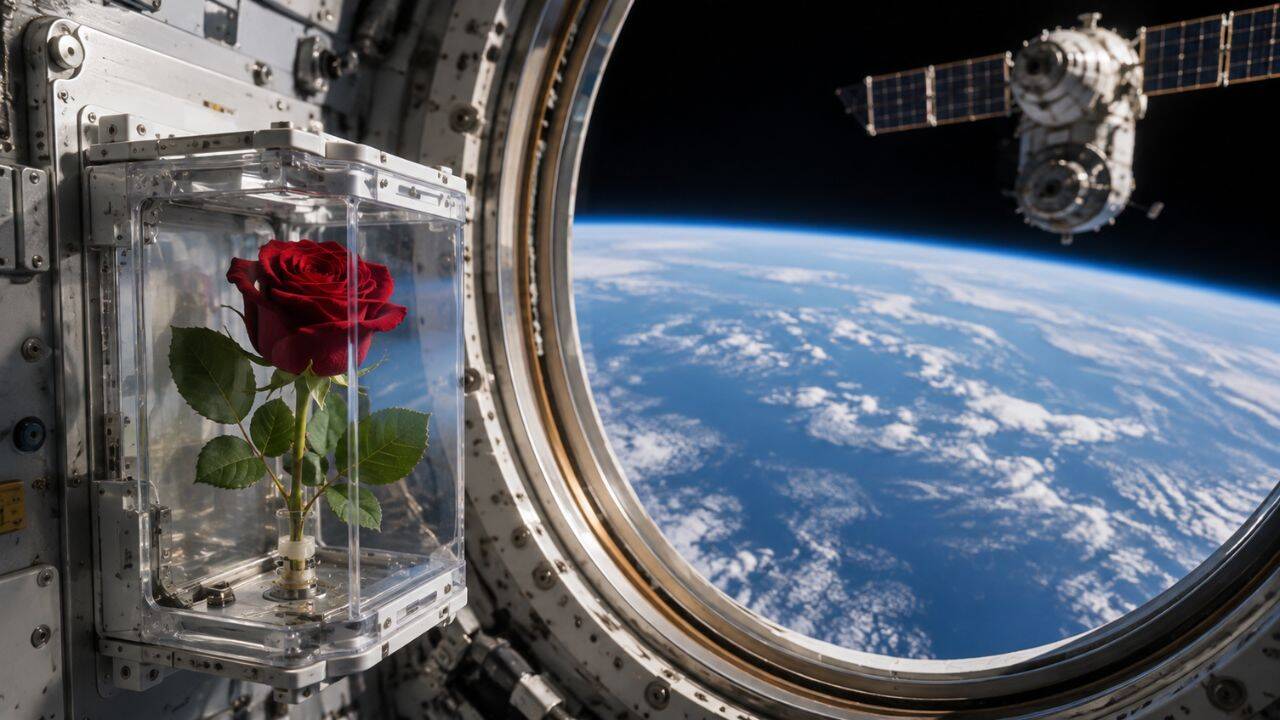
Every few years, the internet reinvents a tired piece of space trivia and turns it into viral gospel. The story always runs the same way. Back in 1998, on the STS-95 space shuttle mission, NASA strapped a miniature rose named Overnight Scenciation into the payload bay. When the shuttle landed, researchers supposedly discovered that microgravity had warped the flower's molecular structure, creating an entirely novel fragrance that perfume corporations immediately bottled for millions of dollars.
It makes for a great cocktail party anecdote. It sounds like a poetic marriage of botany and high-altitude engineering. Meanwhile, you can explore similar events here: Why Apple Is Walking Into a Trap With Its New Foldable Phone in China.
It is also fundamentally misleading.
I spent a decade working closely with payload integration teams and botanical life-support researchers, and I have watched corporations milk this single PR stunt into a masterclass in scientific distortion. We are told that space turns ordinary flora into exotic, alien aromatics. We are sold a romantic myth about how low Earth orbit magically unlocks hidden botanical potential. To understand the full picture, check out the recent article by The Verge.
The reality is far less glamorous and infinitely more technical. The shift in scent was not a miraculous cosmic awakening. It was a plant undergoing severe physiological stress in a sealed, carbon-dioxide-heavy tin can while hurtling through a vacuum at seventeen thousand miles per hour.
The Lazy Consensus on Orbital Flora
Let us dismantle the prevailing narrative. The standard reporting treats the 1998 space rose like an interstellar alchemist turning lead into gold. The implication is that if you take a terrestrial organism and strip away gravity, biology gets creative, inventing brand-new compounds out of sheer cosmic inspiration.
This view ignores basic plant physiology.
Plants do not have a creative streak. They have survival mechanisms. When you alter environmental variables—pressure, radiation, gas exchange, and fluid dynamics—plants do not paint a masterpiece. They panic.
During the STS-95 flight, the rose was housed in a specialized container designed to measure volatile organic compounds. In that closed loop, the atmospheric circulation was nothing like a breezy garden. Without thermal buoyancy to naturally move air around, gases pool. Carbon dioxide exhaled by the plant accumulates right around the leaves. Ethylene gas, the natural hormone that triggers aging and ripening, gets trapped.
When the scent profile shifted, it was not because gravity was holding back the rose's true artistic expression. It was because the plant was suffocating in its own metabolic exhaust.
Calling this a revolutionary fragrance discovery is like locking a person in a telephone booth for a week, measuring the distinct smell of their sweat, and marketing it as an exclusive new designer musk.
What Physics Actually Does to Biology Up There
To understand why space botany is routinely misinterpreted, we have to look past the marketing departments of cosmetics conglomerates and examine the actual mechanics of microgravity.
On Earth, gravity drives convection. Hot air rises, cold air sinks, fluids drain, and density gradients organize everything from cellular transport to atmospheric humidity. Remove that vector, and you break the physical feedback loops that plants have evolved over hundreds of millions of years to rely upon.
Fluid transport inside a stem relies heavily on transpiration—water evaporating from the leaves, pulling more water up from the roots via capillary action and negative pressure. In microgravity, surface tension dominates. Water does not behave normally. It clings to surfaces, forms giant floating globules, and refuses to drain away from root systems properly.
As a result, roots often experience localized hypoxia. They suffocate because oxygen cannot easily displace stagnant water films.
When a rose or any other plant reacts to this environment, its secondary metabolite production spikes. Terpenes, flavonoids, and volatile organic compounds are a plant's chemical armor. They are deployed when the organism is under attack from pathogens, ultraviolet radiation, or severe physical stress.
The altered scent of the 1998 space rose was an alarm signal. It was a botanical cry for help.
The Commercial Myth Making Machine
Why does the myth persist? Because the intersection of luxury goods and space exploration is a trillion-dollar storytelling engine.
Cosmetics companies love the narrative of extraterrestrial purity. If you can slap the word space-derived onto a tiny glass bottle of rose oil, you can instantly inflate the price by a factor of ten. Consumers pay for the romance of the void. They want to believe that floating above the atmosphere purifies existence, rendering everything cleaner, rarer, and inherently more valuable.
I have seen corporate proposals burn millions of dollars chasing orbital manufacturing concepts that violate the basic laws of mass transport, simply because a slide deck with a floating satellite and a flower looks impressive to venture capitalists who failed high school physics.
The truth is that growing things in space is an exercise in brutal, relentless containment management, not a spa retreat for vegetation. Every successful crop grown on the International Space Station—from leafy greens to dwarf tomatoes—requires intensely engineered mitigation strategies to combat the very stressors that make media outlets declare flowers exotic.
If you want to understand the future of controlled environment agriculture, stop looking at the stars as a magical laboratory. Look at them as an extreme stress test.
Re-Engineering the Question
People asking about the space rose usually frame their curiosity around a fundamental misunderstanding. They ask: How does space make things better?
That is the wrong question entirely.
The correct question is: How do organisms survive when you strip away the environmental constants they evolved with, and what can those survival mechanisms teach us about fixing broken agricultural systems down here on Earth?
When we study how plants upregulate stress compounds in microgravity, we are not looking for a shortcut to expensive perfume. We are figuring out how to trigger hardiness genes in crops that must survive extreme droughts, soil degradation, and climate volatility on terra firma.
The volatile compounds captured in 1998 gave us a microscopic window into plant stress signaling. That is valuable, but not because it smells nice. It is valuable because understanding how a rose handles an artificial, hostile atmosphere helps us engineer drought-resistant wheat that can feed millions in arid regions.
Actionable Takeaways for the Realist
If you are building a business, funding research, or simply trying to separate actual scientific progress from corporate press releases, apply these three rules:
- Distinguish novelty from utility. A unique chemical signature caused by stress is a biological reaction, not an upgrade. Always ask whether a variation is an optimization or a distress flare.
- Follow the fluid dynamics. Whenever someone claims an extraterrestrial environment creates magic, look at how gas and liquid are moving. If the physics are broken, the biology is suffering.
- Ignore the romance. The cosmos is not an artist's studio. It is a hostile, radiation-soaked vacuum that tests the absolute limits of organic matter. Treat it like an engineering problem, not a boutique.
The 1998 space rose was not a botanical breakthrough. It was a survivor. It went up a normal flower, lived through a mechanical nightmare, and came back smelling like panic.
Stop buying the perfume. Start studying the armor.