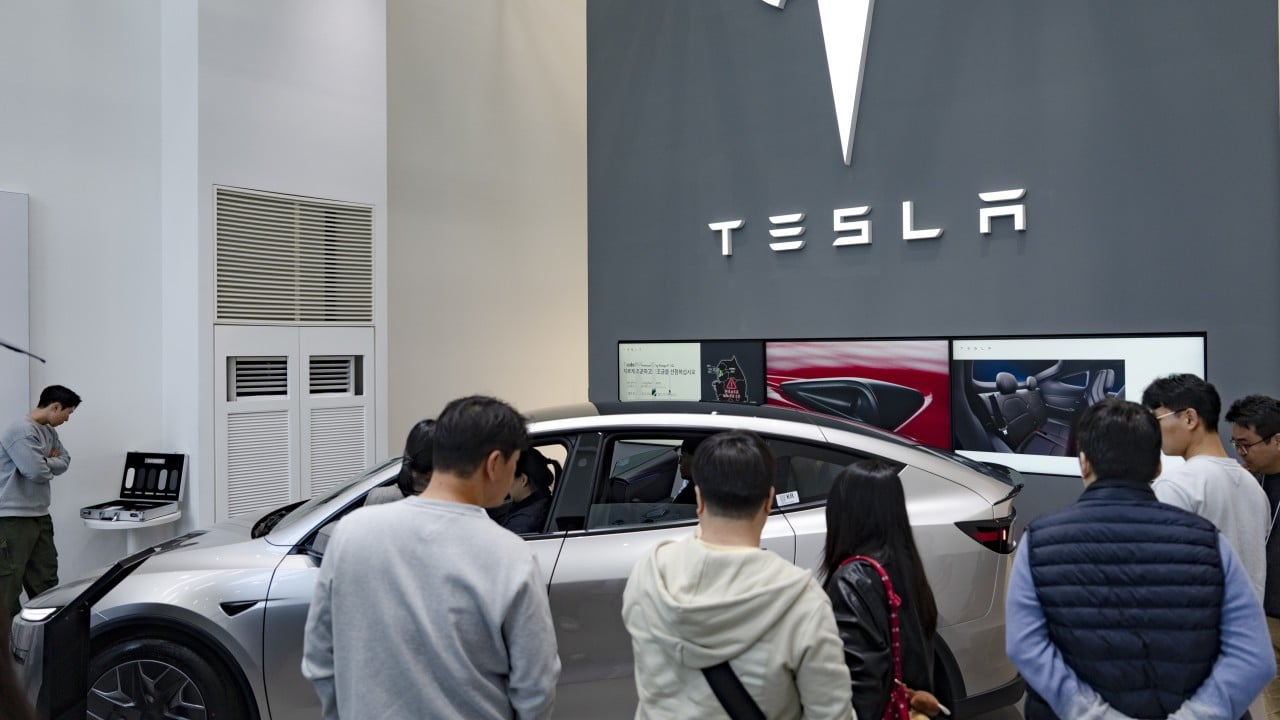
Hundreds of South Korean Tesla owners just suffered a decisive legal defeat in their attempt to secure refunds over the automaker's long-delayed Full Self-Driving (FSD) software. The Seoul Central District Court ruled against a group of more than 300 plaintiffs who alleged that Tesla engaged in deceptive marketing by selling an expensive autonomous driving package that could not legally or technically operate on South Korean roads. The court found that Tesla’s purchase agreements contained sufficient disclaimers regarding regulatory hurdles and feature availability, shielding the company from liability despite years of unfulfilled timelines.
The verdict exposes a massive fault line in modern automotive commerce. Consumers are increasingly asked to pay thousands of dollars upfront for software capabilities that exist only as beta versions or future promises. In South Korea, where Tesla commands a fierce, loyal following alongside fierce domestic competition from Hyundai and Kia, the lawsuit became a litmus test for how far corporate disclaimers can stretch before they cross into false advertising.
The Anatomy of a Software Mirage
To understand how over 300 buyers ended up in a Seoul courtroom, you have to look at how Tesla sells autonomy. Unlike traditional automakers that bundle driver-assistance features into hardware trims, Tesla treats its Full Self-Driving Capability as a standalone digital asset. Buyers pay roughly 9 million Korean won—around $6,500 to $7,000 depending on exchange rates—at the time of vehicle purchase.
In return, they receive a promise. The software package includes basic Autopilot functions, Navigate on Autopilot, Auto Lane Change, Autopark, and Summon. The crown jewel, however, is Autosteer on city streets, the feature that actually approximates autonomous urban driving.
Years passed after those initial purchases. South Korean owners watched via social media as drivers in North America gained access to FSD Beta—and later FSD (Supervised)—allowing their cars to navigate complex intersections, yield to pedestrians, and make unprotected left turns. Meanwhile, the software sitting on South Korean servers remained frozen in time. Local owners were stuck with Enhanced Autopilot capabilities while paying full freight for an autonomous future that never arrived.
Frustration curdled into litigation. The plaintiffs argued that Tesla misled consumers by advertising "Full Self-Driving" as an imminent reality rather than a speculative research project. They demanded a refund of the software purchase price, claiming the product was fundamentally defective because its core advertised function was non-existent in their market.
Inside the Seoul Courtroom Logic
The Seoul Central District Court did not buy the argument that buyers were tricked. When judges examined the actual sales contracts and order pages used by Tesla Korea, they found a wall of fine print that legally insulated the automaker.
Contract law in South Korea, much like in the United States, relies heavily on the explicit terms agreed upon at the point of sale. Tesla’s ordering interface explicitly stated that the availability of future features depended on achieving regulatory approval and further software validation. It warned buyers that timelines were estimates, not guarantees.
The court determined that a reasonable consumer reading the purchase agreement would understand they were buying a work in progress. Because Tesla never guaranteed a hard launch date for city-street autonomy in South Korea, the company had not breached its contract.
This ruling highlights a stark difference between regulatory enforcement and civil contract litigation. Earlier, South Korea's Fair Trade Commission (KFTC) had actually fined Tesla 2.85 billion won for exaggerating the driving range of its vehicles in cold weather and misrepresenting the performance of its Superchargers. Regulators took a dim view of Tesla's promotional language. Civil judges, however, hold plaintiffs to a much stricter standard of proof regarding contractual breach and direct financial fraud.
The Invisible Wall of Korean Mapping Laws
Even if Tesla had perfected its neural networks overnight, the company faced an obstacle in South Korea that money and engineering alone could not easily solve. South Korea maintains some of the strictest geospatial data laws in the developed world.
Technically still at war with North Korea, the South Korean government strictly prohibits the export of high-precision digital mapping data to foreign servers. Under the Act on the Establishment and Management of Spatial Data, companies cannot transfer detailed map coordinates outside the country without explicit government approval—an approval that is almost never granted to foreign tech giants.
Consider how an autonomous vehicle operates. While Tesla relies heavily on vision-based cameras and end-to-end neural networks rather than pre-mapped LiDAR routes, navigation still requires accurate, high-resolution mapping data for routing, lane geometry, and speed limit verification. Furthermore, training AI models on local road conditions requires uploading massive amounts of video and telemetry data back to central supercomputers.
For Tesla, whose Dojo supercomputer and primary AI training clusters sit in the United States, South Korea's data localization rules created a massive bottleneck. Localizing server infrastructure to process and store Korean road data inside the country requires immense capital expenditure and regulatory clearances.
To illustrate how this affects an everyday driver, imagine a hypothetical scenario where a Seoul commuter buys a Model Y in 2021. The car's cameras can physically see the blue bus lanes unique to South Korean highways and the complex, multi-tiered intersections in Gangnam. Yet without localized training data and compliant mapping pipelines, the vehicle's software cannot reliably interpret local traffic laws or distinguish between permissible turns and restricted transit zones. The hardware is sitting in the driveway, fully capable, while the digital brain remains locked out by geopolitical border controls.
Why Tesla Keeps Winning These Fights
The Seoul ruling is not an isolated anomaly. It follows a well-established pattern seen across global jurisdictions where Tesla faces legal pushback over its autonomy claims.
In the United States, Tesla has repeatedly defeated or stalled class-action lawsuits over FSD delays by invoking forced arbitration clauses buried in its purchase agreements. When buyers click "Order," they generally waive their right to sue in open court unless they manually opt out via physical mail within 30 days. Most buyers never read that clause.
Even when cases do reach a judge or an arbitrator, Tesla relies on a two-pronged defense that has proven remarkably durable.
First is the puffery defense. In legal terminology, "puffery" refers to exaggerated, subjective promotional claims that no reasonable person would take as a literal guarantee of fact. Calling a system "Full Self-Driving" while simultaneously stating in the fine print that the driver must keep their hands on the wheel and remain fully attentive creates a legal paradox. Courts have frequently ruled that the explicit operational warnings override the aspirational marketing name.
Second is the regulatory scapegoat. Automakers can legitimately argue that deploying Level 3 or Level 4 autonomous features is outside their unilateral control. Transport ministries in Europe, China, and South Korea all have distinct safety frameworks governing automated lane changes, hands-off driving, and liability in the event of a crash. When a feature is delayed, Tesla points to the local ministry of transport, framing the wait as a bureaucratic bottleneck rather than an engineering failure.
The Business Model of Selling Vaporware
Step back from the legal minutiae, and the broader industry shift becomes obvious. Tesla pioneered a radical financial model in the automotive sector by recognizing revenue—or at least collecting cash upfront—for software that does not yet exist.
In traditional manufacturing, you build the product, validate it, certify it with regulators, and then sell it. Cash flows in after the engineering risk has been retired. Tesla inverted that sequence. By selling FSD years before it was ready, the company effectively used customer deposits as zero-interest research and development financing.
The accounting mechanics behind this are fascinating. When a customer pays $7,000 for FSD, Tesla cannot immediately count all of that money as pure profit on its income statement. Under strict deferred revenue accounting rules, the company can only recognize the revenue as it actually delivers the promised features. Hundreds of millions of dollars sit on Tesla's balance sheet as deferred revenue, waiting to be unlocked by software updates.
Yet from a cash-flow perspective, the money is already in the bank. Tesla has the cash today to build factories, buy Nvidia GPUs, and fund engineering payrolls. The consumer bears the opportunity cost of that capital, plus the risk that they might sell or total their vehicle before the software ever activates in their country.
The Untold Friction of Hardware Obsolescence
There is an uncomfortable technical reality lurking beneath the South Korean lawsuit that rarely makes headlines. Software promises age much faster than automotive hardware.
Many of the plaintiffs in South Korea purchased their vehicles equipped with Hardware 3 (HW3), the proprietary self-driving computer Tesla introduced in 2019. At the time, Elon Musk stated unequivocally that HW3 possessed all the computational power necessary to achieve full autonomy safer than a human driver.
By 2023 and 2024, Tesla began rolling out Hardware 4 (HW4), featuring higher-resolution cameras, wider fields of view, and significantly greater processing throughput. As Tesla shifted its FSD architecture toward massive end-to-end neural networks that ingest raw video and output driving controls directly, the computational demands skyrocketed.
Owners in markets like South Korea, who bought HW3 cars years ago, face a double penalty. Not only have they waited years for regulatory approval, but by the time local authorities greenlight advanced FSD features, their aging vehicles may lack the processing power to run the latest software branches smoothly.
Tesla has acknowledged in the past that retrofitting older vehicles with newer computers is expensive, complex, and sometimes physically impossible due to differing power and cooling requirements. If an owner paid 9 million won in 2020 for a feature that finally arrives in 2027, only to find their car runs a stripped-down, legacy version of the software, the financial sting becomes permanent.
Regulatory Pushback vs. Consumer Reality
While the Seoul Central District Court handed Tesla a victory, the broader regulatory environment is tightening around how automakers market driver-assistance technology.
In California, the Department of Motor Vehicles has actively pursued administrative actions against Tesla, arguing that the terms "Autopilot" and "Full Self-Driving" mislead consumers into believing their vehicles are capable of autonomous operation without human supervision. In Europe, strict UNECE regulations heavily restrict how automated lane-centering and lane-change systems can behave, forcing Tesla to neutrally lobotomize features that operate freely in North America.
South Korea is attempting to walk a tightrope. The government wants to foster a domestic autonomous driving industry—supporting homegrown champions like Hyundai Motor Group's Motional joint venture and local startups—while protecting consumers from overhyped foreign tech.
The Korean Ministry of Land, Infrastructure and Transport has gradually eased rules around Level 3 autonomous driving on highways, allowing conditional hands-off operation at certain speeds. Yet urban autonomy, the core value proposition of Tesla's FSD package, remains heavily gated.
For consumers, the takeaway from the Seoul ruling is stark. Marketing hype carries almost zero weight when stacked against the fine print of a digital purchase agreement. When an automaker labels a feature "Capability" rather than an active service, it is legally buying itself an indefinite timeline.
The Illusion of Global Software Parity
Modern tech companies love to project an image of seamless global scale. Consumers buy an iPhone in Seoul, London, or New York, and aside from minor regional tweaks, the software experience is identical on day one.
Automobiles do not work that way, no matter how much Silicon Valley wants to treat them as smartphones on wheels. A car is a two-ton kinetic weapon operating inside a patchwork of local traffic laws, national security mapping restrictions, and divergent liability regimes.
The South Korean plaintiffs fell victim to the illusion of global software parity. They watched YouTube videos of Teslas smoothly navigating San Francisco hills and assumed that downloading the exact same capability in Seoul was merely a matter of flipping a server switch.
In reality, deploying autonomous software across borders requires rebuilding the regulatory, legal, and data-processing foundation from the ground up in every single jurisdiction. Until local laws catch up with artificial intelligence, buyers who pay upfront for autonomous promises are not purchasing a product. They are buying a lottery ticket with no expiration date, backed by a contract written entirely to protect the house.