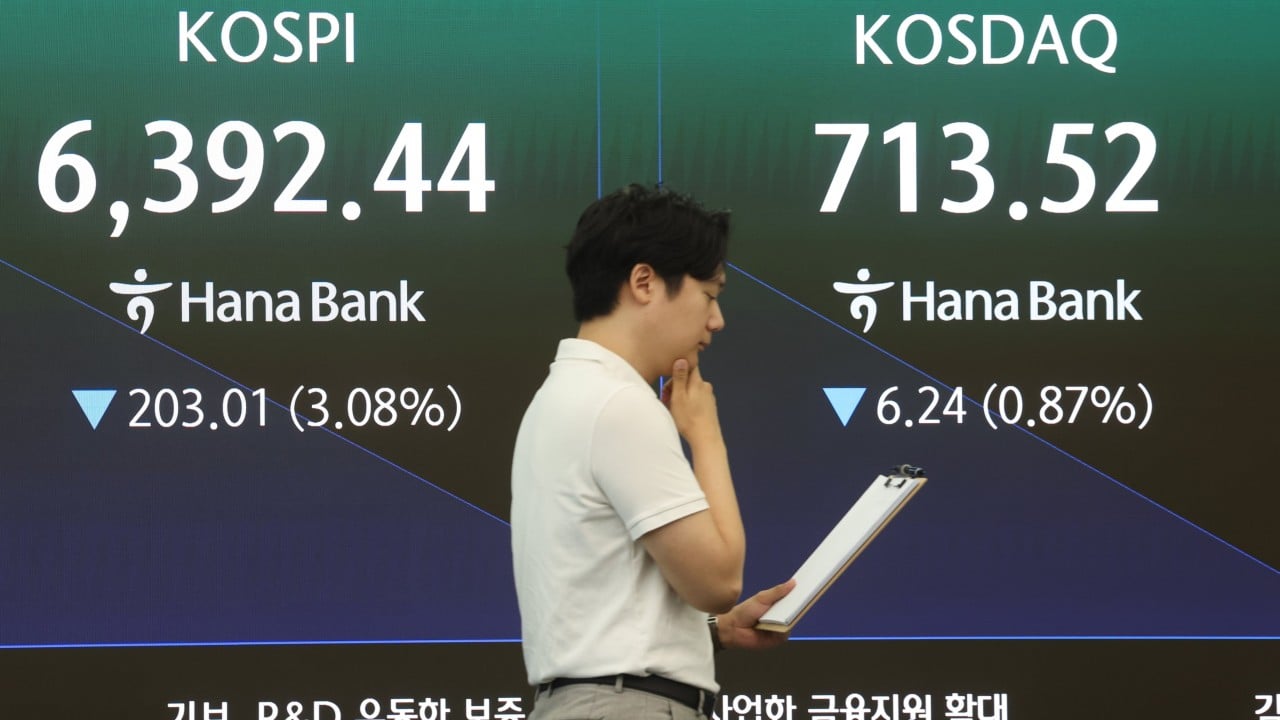
Regulators in Seoul are drawing a hard line. South Korea is tightening its grip on high-risk ETFs, moving aggressively to curb explosive retail speculation in leveraged and inverse funds as cumulative investor losses mount into billions of won. Financial authorities are no longer content with mere warnings. They are rewriting the rulebook, imposing mandatory educational hurdles, stricter margin requirements, and severe trading caps that effectively freeze casual day traders out of volatile derivative products.
The rationale from the Financial Services Commission appears straightforward on paper. Protect the public from systemic wealth destruction. Yet this intervention exposes a deeper, more uncomfortable structural friction within modern capital markets. When an entire generation of retail participants turns the stock exchange into a casino, who bears the ultimate responsibility for the wreckage? The state acting as a financial guardian, or the brokerage apps engineered to maximize dopamine hits through one-tap leverage? Expanding on this topic, you can also read: Inside the Shadow LNG Fleet Escaping Western Sanctions.
The Anatomy of a Speculative Frenzy
To understand why Seoul has pulled the emergency brake, look at the sheer velocity of retail capital moving through the Korea Exchange. South Korea boasts one of the most digitally connected and financially engaged populations on earth. Millions of retail traders armed with high-speed mobile trading apps treat equity markets not as a vehicle for long-term retirement savings, but as a high-stakes daily arena.
During periods of acute market volatility, this domestic army gravitates toward specialized exchange-traded products designed to multiply daily index movements by two or three times. These instruments are mathematical marvels of financial engineering. They are also ticking time bombs for anyone holding them longer than a single trading session. Experts at Bloomberg have shared their thoughts on this trend.
Compounding decay destroys returns over time. Because these funds rebalance daily to maintain their target leverage ratio, volatility eats away at the underlying value even if the base index eventually recovers to its starting point. Retail traders, seduced by the promise of rapid wealth creation during bull runs, routinely ignore these mechanics. They hold leveraged funds through multi-week downturns, watching helplessly as mathematical decay burns through their capital base long before broader market trends reverse.
+-------------------------------------------------------------+
|               The Mechanics of Daily Decay                  |
|                                                             |
|  Day 1: Index drops 10%  -> Leveraged ETF drops 20%         |
|  Day 2: Index rises 11.1% -> Leveraged ETF rises 22.2%      |
|  Net Result: Index is flat, but ETF is down roughly 2.3%    |
+-------------------------------------------------------------+
When markets turn sideways or downward, the losses accumulate with terrifying speed. Margin calls cascade. Forced liquidations follow. The Financial Services Commission watched these cycles repeat with clockwork regularity, culminating in billions of won vanishing from retail accounts during sharp corrections. The official policy shift was born out of statistical panic. The state decided intervention was cheaper than a widening social crisis driven by margin-ruined citizens.
Regulatory Overhaul and the New Barriers to Entry
Seoul's crackdown is multifaceted, combining behavioral friction with hard financial barriers. The regulatory framework now demands that any retail investor wanting to trade leveraged or inverse funds must complete mandatory education hours through authorized financial institutes. They must also maintain a steep minimum deposit in their brokerage accounts before placing a single order.
These measures are designed to act as a psychological speed bump. If you have to sit through hours of compliance training and lock up a significant cash buffer just to access a triple-leveraged semiconductor ETF, the impulsive midnight trade loses its appeal.
Brokerages themselves are feeling the heat. Compliance officers face heavy penalties if their platforms fail to properly vet account holders or if they permit under-funded novices to skirt the new requirements. The cozy relationship between aggressive retail volume and brokerage fee revenue is fracturing under regulatory scrutiny.
Yet, paternalistic market intervention carries a heavy cost. By locking out smaller participants from complex financial products, regulators are effectively drawing a ring-fence around what ordinary citizens are allowed to do with their own money.
The Hypocrisy of Protectionism
Critics of the new regime point to a glaring double standard. Institutional players and foreign hedge funds operate with vastly superior tools, unfettered access to derivatives, and custom over-the-counter structures that retail traders cannot touch. When institutional desks take multi-billion-dollar bets that blow up, central banks step in with liquidity injections or backchannel bailouts. When a retail worker loses three million won on a leveraged Kosdaq product, they get a lecture on financial literacy and a mandatory online seminar.
This creates a two-tiered market reality. The elite trade with maximum optionality while the public is funneled into vanilla index funds marketed as safe, stable alternatives. But safety is an illusion in modern markets driven by algorithmic trading and macroeconomic shocks.
The Broader Global Echo
South Korea is not acting in a vacuum. Financial capitals worldwide are wrestling with the fallout of the retail trading revolution born during the pandemic era. From meme stock surges in New York to options mania in Frankfurt, regulators everywhere are trying to solve the same equation. How do you preserve market liquidity and free enterprise without letting millions of under-educated participants immolate their net worth on high-risk derivatives?
In the United States, the Securities and Exchange Commission has floated similar conceptual warnings regarding complex ETFs, though direct product bans remain politically difficult. European regulators enforce strict packaged retail investment rules that similarly restrict complex products from standard consumer access.
However, Seoul’s approach is notably more heavy-handed. It reflects a cultural expectation embedded in East Asian governance where the state historically assumes an active role in steering societal behavior and protecting public welfare from market excesses.
Unintended Consequences in the Shadows
Every regulatory wall creates a shadow economy. By making leveraged and inverse exchange-traded products harder to access through legitimate domestic brokerages, the state risks pushing desperate or determined speculators into unregulated or offshore channels.
Cryptocurrency derivatives, foreign exchange margin trading platforms, and unverified peer-to-peer lending schemes stand ready to absorb the capital that is being squeezed out of the exchange-traded fund market. These alternative venues operate outside the oversight of the Financial Services Commission. They offer even higher leverage, zero investor protection, and a track record defined by catastrophic fraud.
Furthermore, dampening retail participation in domestic equity products risks sapping vitality from local markets. South Korea has long suffered from the Korea Discount, a persistent phenomenon where local stocks trade at lower valuations relative to global peers due to corporate governance issues and market inefficiencies. Retail volume has traditionally provided the liquidity engine that kept domestic valuations buoyant. Stripping out that energy could lead to stagnant price action for smaller listed companies, starving them of the capital needed for expansion.
Where the System Breaks Down
The fundamental tension at the heart of this crackdown is philosophical. Is a stock exchange a public utility meant for wealth preservation and capital allocation, or is it a public square where consenting adults should be free to make catastrophic financial mistakes?
Regulators in Seoul have answered that question with a definitive thumb on the scale. They have decided that systemic stability and public protection outweigh absolute financial freedom.
As these new rules bed down, the early data shows a sharp drop in retail turnover for high-risk products. Volume has plummeted. Brokerage revenues are contracting. Whether this translates to a more secure investor base or simply drives speculative energy into darker, more dangerous corners of the financial ecosystem remains the multi-billion-won question hanging over the Seoul financial district. The losses have slowed down, but the underlying pressure driving citizens to gamble on high-risk instruments in the first place has not gone away.
The state can legislate access, but it cannot legislate away the desperation of a populace watching traditional pathways to wealth vanish behind rising housing costs and stagnant wage growth. Until those root pressures are addressed, every barrier built to keep retail traders away from high-risk funds will simply be met with a search for the next loophole.