The air smelled of charred garlic, fried dough, and wood smoke. It was the familiar, heavy scent of a Seattle summer evening, dense with the humidity of thousands of bodies pressed together near the international fountains. Families clustered around paper plates piled high with street tacos and garlic fries. Teenagers laughed, their voices competing with the low thrum of festival speakers.
Then came the sharp, distinct cracks.
Not fireworks. Not the backfire of an engine straining up a steep Queen Anne hill. Everyone who has lived in a modern American city for more than a decade knows that specific frequency. It cuts through bass lines and chatter. It drops the temperature of the room by ten degrees in a fraction of a second.
Panic does not always look like a movie. It looks like a mother violently yanking a toddler behind a heavy metal trash receptacle. It looks like a crowd freezing for one collective, terrified heartbeat before fracturing in every direction, spilling over curbs and trampling discarded lemonade cups.
Two people would not leave that festival grounds alive. Authorities later confirmed the grim statistics, but numbers do not capture the weight of a summer night punctured by violence.
The Fragility of Public Space
We build these temporary cities of joy on asphalt and grass every weekend. We string up fairy lights, pitch white vendor tents, and invite strangers to share space, food, and music. We do this because humans crave proximity. We crave the sensory overload of community.
Yet, underneath that craving lies a quiet, persistent anxiety.
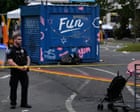
Consider what happens next: the immediate aftermath of a public shooting is a masterclass in modern disorientation. Sirens converge from multiple directions, wailing over the roar of helicopter blades chopping at the twilight air. Police tape unfurls in bright yellow ribbons, carving a stark boundary between the ordinary world we thought we inhabited and the crime scene we suddenly find ourselves trapped inside.
I remember the first time I smelled cordite mixed with spilled cotton candy. It ruins things. It permanently alters how you look at a crowd. You stop looking at the menu board for local food trucks. You start scanning exits. You track the movements of someone standing too stiffly with their hands deep in their pockets. That hyper-vigilance is the tax we pay for living through an era where public celebrations routinely double as tactical vulnerabilities.
When the Feast Becomes a Crime Scene
The Bite of Seattle is supposed to be an institution of culinary indulgence. People go there to lose track of calories and time, wandering from booth to booth, debating whether local seafood or artisanal barbecue is the better investment for the evening.
Instead, on that night, the festival grounds transformed into a chaotic maze of confusion. Witnesses spoke of a sudden eruption of gunfire near the venue perimeter, a flash of conflict that spilled into the dense foot traffic. Two lives extinguished in the span of seconds. Others injured, rushed to hospitals while festival-goers still clutched their half-eaten skewers of teriyaki chicken, wondering if the danger had passed or if another round was chambered.
Investigators arrived to sift through a nightmare of discarded belongings. Cell phones buzzing with anxious text messages from parents and partners. Strollers abandoned near curbs. Sneakers lost in the rush.
The public narrative usually pivots quickly to security protocols. Metal detectors. Bag checks. Heavy police presence. But each layer of fortification we add to our public spaces changes the nature of those spaces. Every time we turn a food festival into a checkpoint, we surrender a little bit of the openness that makes these gatherings worth attending in the first place.
The Long Shadow
The news anchors report the casualty counts and move on to the weather. The politicians issue statements offering thoughts and prayers before pivoting to policy debates that stall out before sunrise.
For the families of the victims, the news cycle is an insult. Their lives did not pause for a commercial break. They woke up the next morning in a world that had suddenly become unimaginably smaller and colder, defined entirely by an empty chair at the kitchen table and a ringing phone that will never again connect to the person they love.
We have normalized this grief to our eternal shame. We process it with a sigh, lock our doors, and wonder how long we can continue pretending that public joy is entirely safe from public terror.
The summer heat fades, but the pavement remembers. Long after the food trucks have packed up their grills and driven away, and long after the grass at Seattle Center has grown back over the footprints of that frantic night, the echo remains. It lingers in the sudden jump of a pedestrian when a car backfires two blocks away. It lives in the hesitation of parents deciding whether to take their kids to the next crowded street fair.
We keep going back to the festivals because the alternative is letting fear win. But we go back with different eyes, knowing just how fragile the boundary is between a community breaking bread and a community breaking apart.