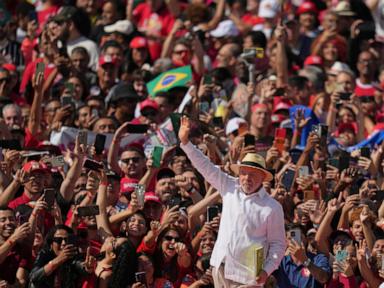
The air in São Bernardo do Campo smells of stale coffee, exhaust fumes, and the heavy, sweet scent of damp earth after a sudden tropical downpour. It is a working-class scent. A union scent. For decades, this industrial sprawl on the outskirts of São Paulo has served as the cradle of political rebirth for Luiz Inácio Lula da Silva. When the metalworkers union hall doors swing open here, history usually follows.
Walk these streets today and the tension is tangible. You can feel it in the way shopkeepers eye customers through half-closed security grills, wondering which way the currency will swing by sunset. You can hear it in the rhythmic clatter of bus engines idling in the terminal where thousands of commuters begin their three-hour journeys before dawn.
Lula has returned to this soil. Not merely as a sitting president seeking another mandate, but as a man acutely aware that the machinery of state is a blunt instrument against the grinding anxiety of ordinary kitchens.
Consider a hypothetical voter named Marinalva, fifty-four years old, who spends her mornings standing behind the counter of a cramped bakery smelling of scorched sugar and warm bread. She remembers the boom years. She remembers when the government credit lines felt like a ladder out of the cellar. She also remembers the inflation that followed, the empty spaces on grocery shelves, and the exhaustion of trying to stretch a minimum wage across a month that refuses to shrink.
When Marinalva hears that Lula is back in his stronghold to kick off his campaign, she does not cheer. She pauses. She wipes down the stainless steel counter with a damp rag and watches the morning news flicker on a small television mounted in the corner.
Hope is a fragile commodity in Brazil. It gets traded daily on the commodities floor, but it is paid for in sweat on the factory floor.
A thousand miles away, the coastal breeze of Rio de Janeiro carries a very different kind of electricity. In the bustling neighborhoods of Tijuca and Barra da Tijuca, Flávio Bolsonaro steps onto a stage bathed in the aggressive glare of television lights. The contrast is not merely geographical. It is existential.
Flávio operates in the shadow of a political dynasty built on grievance, social media saturation, and the raw, unfiltered anger of a middle class convinced that the institutions are rigged against them. To understand his campaign launch, you have to look into the eyes of voters like Roberto, a thirty-year-old rideshare driver who keeps a small brass crucifix dangling from his rearview mirror.
Roberto works twelve hours a day. His car is his office, his sanctuary, and occasionally, his target. He talks about security the way other people talk about oxygen. When he listens to Flávio speak about law, order, and reclaiming the streets from corruption, Roberto hears a reflection of his own daily terror. He has been held up twice at gunpoint this year. The police report took hours. The stolen phone was never recovered.
For Roberto, politics is not about macroeconomic indicators or global climate summits. Politics is the distance between his driver seat and the dark corner of the favela where a boy with a pistol might step out of the shadows.
This is the dual theater of modern Brazil. Two men. Two strongholds. Two entirely incompatible versions of reality fighting for the soul of a continent-sized nation.
The map of Brazil is vast, stretching from the dense, breathing emerald lungs of the Amazon down to the chilly, windswept pampas of the south. Yet, every four years, the map shrinks until it is defined by these sharp, bitter ideological fault lines.
Lula knows the power of memory. He speaks the language of the metal shop, the calloused hands, the collective struggle. He reminds his audiences of the social programs that lifted millions out of extreme poverty, painting a picture of a compassionate state that wraps its arms around the vulnerable.
Yet memory cuts both ways. The scars of massive corruption scandals, economic turbulence, and a polarized populace run deep through the national psyche. To walk through São Bernardo do Campo is to hear whispers of doubt even among the faithful. People want to believe in the dream of industrial dignity, but the cost of beef, rice, and electricity has a way of eroding the most passionate loyalty.
Across the divide, the Bolsonaro camp thrives on the energy of the insurgent outsider, even as they command the apparatus of entrenched opposition. Their strategy relies on a relentless drumbeat of cultural anxiety. They mobilize evangelical congregations, digital native influencers, and a deeply disillusioned urban bourgeoisie that feels culturally displaced and economically squeezed.
It is a battle between the promise of collective care and the demand for individual sovereignty at gunpoint.
Step back from the podiums and the screaming headlines. Look at the data, but humanize the numbers.
Inflation rates are not abstract percentages printed in financial broadsheets. Inflation is the moment Marinalva has to tell a regular customer that the price of coffee has doubled, watching the customer's face drop as they calculate whether they can afford breakfast tomorrow.
Polling numbers are not just bar charts on cable news. They are the collective pulse of millions of families holding their breath, wondering if their children will grow up to inherit a functioning democracy or a fractured wasteland of mutual suspicion.
When candidates return to their strongholds, they are performing a ritual of renewal. They are seeking the warm embrace of the converted to inoculate themselves against the cold indifference of the undecided middle. They need the cheers of the faithful to drown out the silence of the weary.
The campaign has officially begun, but the race was never truly paused. It has been simmering in WhatsApp group chats, in crowded subway cars, in quiet kitchens where parents argue over whether to buy groceries or pay off old debts.
As the sun sets over the concrete expanse of São Paulo, the neon signs of pharmacies and auto-repair shops flicker to life. The city keeps moving. It is resilient, exhausted, endlessly complex, and stubbornly alive.
Lula and Flávio have drawn their lines in the dirt of their respective domains. Now, the rest of the nation waits in the gathering dusk, holding their breath to see which storm will break first.