Ash tastes like copper. It settles on the back of your tongue before you even smell the smoke, coating your teeth in a fine, bitter grit that no amount of warm water can wash away.
For anyone who has ever stood at the edge of a freshly shelled orchard—watching centuries-old olive roots smolder beneath a gray crust of pulverized concrete—the statistics published in diplomatic briefings feel almost absurdly polite. Reports speak of tonnage. They measure carbon plumes in metric tons and classify agricultural collapse in percentages. They rarely mention the silence. They never mention that when the birds vanish from a coastline, the air itself feels heavier, thicker, as though the sky has forgotten how to breathe.
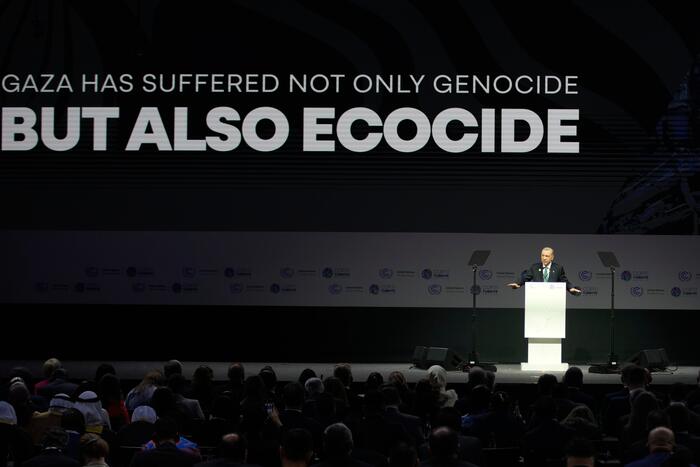
In November 2024, inside the cavernous, air-conditioned halls of the UN climate summit in Baku, Azerbaijan, Turkish President Recep Tayyip Erdoğan stepped up to a podium and dropped a word onto the polished floor like a grenade.
Ecocide.
To the diplomats adjusting their translation earpieces at COP29, the term was a sharp geopolitical escalation—a deliberate accusation aimed squarely at Israel’s military campaign in Gaza. To the people digging through the poisoned dust of the eastern Mediterranean, however, that single word was simply an overdue translation of what their lungs already knew.
The Architecture of an Invisible Wound
Most wars are tallied in flesh and brick. We count the dead, we photograph the collapsed apartment blocks, and we trace the shifting lines on tactical maps. We are conditioned to view the earth beneath a battlefield as merely a stage—an inert backdrop upon which human tragedies play out, waiting patiently to be swept clean once the treaties are signed.
That assumption is a lie.
To understand what Erdoğan was pointing toward on that stage in Baku, set aside the speeches for a moment and consider a hypothetical farmer—let’s call him Tariq—standing on a two-acre plot just east of Khan Younis. Before October 2023, Tariq’s wealth wasn't stored in a bank vault; it lived in the top eighteen inches of his soil. It took his grandfather forty years of careful composting, drip irrigation, and crop rotation to turn sandy coastal earth into dark, loamy magic capable of feeding three generations with citrus, strawberries, and olives.
Now watch what happens in forty-eight hours of modern industrial warfare.
First come the heavy armored treads, grinding the porous topsoil under seventy tons of steel until it becomes as hard and impermeable as a paved parking lot. Rain can no longer sink in; it runs off, carrying away whatever nutrients remain. Next come the bunker-busting munitions. When high explosives detonate underground, they don't just carve craters. They flash-boil soil moisture, incinerate the microscopic fungal networks that allow plant roots to absorb water, and inject a cocktail of heavy metals—lead, mercury, depleted uranium, white phosphorus—directly into the agricultural layer.
Tariq doesn't just lose a harvest. He loses the biological engine that makes harvesting possible.
When Erdoğan stood before world leaders at COP29 and declared that Israel had turned Gaza into a "heaped pile of rubble" while committing a massive environmental crime, he wasn't offering poetic hyperbole. He was naming a phenomenon that military strategists have exploited for centuries, even if international law has struggled to define it.
What Does Ecocide Actually Mean?
The word itself sounds clinical, almost academic, until you pull back its layers. Coined in 1970 by biologist Arthur Galston to describe the U.S. military's deployment of Agent Orange across the jungles of Vietnam, ecocide refers to the unlawful or wanton destruction of ecosystems on a scale so vast that recovery becomes impossible within a human lifetime.
Think of an ecosystem not as a collection of scenery, but as a life-support machine on a deep-space vessel. You can survive a broken window for a little while. You can patch a hull breach. Ecocide is what happens when someone takes a sledgehammer to the oxygen scrubbers and the water recyclers at the exact same time.
In Baku, the Turkish president pointed directly to the receipts. According to environmental assessments cited by UN agencies and independent researchers throughout 2024, the numbers emerging from the narrow, 141-square-mile strip of Gaza read like an autopsy of the land itself:
- Agricultural obliteration: Satellite analysis by the UN Food and Agriculture Organization (FAO) and UNOSAT confirmed that well over two-thirds of Gaza’s permanent crop fields and orchards had been destroyed or severely damaged. Greenhouses—the delicate glass-and-plastic lungs of local food security—were flattened by the thousands.
- The water table collapse: With sewage treatment plants bombed offline or starved of fuel, more than 100,000 cubic meters of raw sewage began pouring daily into the Mediterranean Sea and seeping straight down into the Coastal Aquifer, the sole freshwater lifeline for over two million people.
- The toxic dust: The sheer volume of rubble generated—exceeding 40 million tons—contained an estimated 800,000 tons of asbestos alongside pulverized plastics, battery acids, and unexploded ordnance.
Every time the wind blows off the sea, that dust lifts. People breathe it in. Children play in it. Rain washes it into the groundwater.
This is the unsettling truth that makes war-driven environmental collapse so uniquely terrifying: bombs have an expiration date, but poisoned soil does not. A ceasefire stops the airstrikes at midnight; it does not pull lead out of an aquifer, nor does it coax a dead olive grove back to life in the spring.
The Irony in the Room at COP29
Of course, politics is never pure, and pretending otherwise insults the intelligence of anyone paying attention.
When Erdoğan took the microphone in Azerbaijan, he was speaking at a climate summit hosted by a petro-state, surrounded by delegations whose own domestic track records on fossil fuels, deforestation, and carbon emissions were under fierce scrutiny. Critics were quick to note the geopolitical theater at play. Turkey has positioned itself as one of the fiercest diplomatic opponents of Israeli Prime Minister Benjamin Netanyahu’s government, severing trade ties and routinely championing the Palestinian cause on the global stage. To skeptics in Western capitals, accusing Israel of ecocide at a UN climate conference looked like a shrewd diplomatic maneuver—a way to weaponize the language of green transition against an adversary while deflecting attention from regional complexities.
It is easy to get lost in that cynicism. Honestly, when you watch leaders trade accusations under crystal chandeliers while carbon emissions hit record highs every single year, numbness feels like the only rational response. You start to wonder if words like sustainability and climate justice are just diplomatic currency, spent freely when convenient and forgotten when tanks roll across a border.
Yet dismissing the message because of the messenger misses the seismic shift happening underneath our feet.
Consider the carbon math alone. A landmark study by researchers in the United Kingdom and the United States calculated that the first few months of the war in Gaza generated more planet-warming emissions than the annual carbon footprints of more than twenty of the world's most climate-vulnerable nations combined. That figure didn't even include the colossal carbon cost of eventually rebuilding millions of tons of shattered concrete and steel—an effort projected to emit tens of millions of additional tons of greenhouse gases.
Here was the raw contradiction sitting in the middle of COP29: wealthy nations were spending two weeks haggling over billions of dollars in climate finance to help developing countries adapt to rising seas and scorching droughts, while simultaneously funding, arming, or ignoring conflicts that accelerate ecological collapse in real time.
Erdoğan’s speech exposed that nerve. By framing the devastation of Gaza as an ecological crime rather than solely a humanitarian or territorial dispute, he forced a question onto the diplomatic table that nobody in that room wanted to answer: How can you claim to be saving the planet while excusing the deliberate erasure of an entire corner of it?
A History Written in Scorched Earth
To grasp why this moment matters far beyond the borders of Gaza or Ankara, you have to look backward. Humans have been weaponizing nature for as long as we have been sharpening bronze.
In 146 BC, Roman legions didn't just defeat Carthage; legend holds they salted the earth so nothing would grow there again. During the American Civil War, General William Tecumseh Sherman’s March to the Sea systematically burned crops, slaughtered livestock, and tore up railroads to break the Confederacy's ecological capacity to sustain itself. In 1991, retreating Iraqi forces set fire to more than six hundred Kuwaiti oil wells, turning noon into midnight across the Persian Gulf and pumping thick black soot into the upper atmosphere for months.
For most of human history, international law treated this kind of destruction as unfortunate collateral damage—a messy byproduct of military necessity. Even the 1977 additions to the Geneva Conventions, which technically prohibit methods of warfare intended to cause "widespread, long-term and severe damage to the natural environment," set the legal bar so impossibly high that not a single person has ever been prosecuted under them.
The threshold was deliberately designed to be unreachable. Lawyers argued endlessly over what "widespread" meant. Diplomats debated how many decades constituted "long-term." Meanwhile, munitions grew deadlier, cities grew denser, and the delicate ecological margins holding the Middle East together grew razor-thin.
Look at a map of the Levant today. This is one of the most water-stressed, rapidly warming regions on Earth. Temperatures in the eastern Mediterranean are rising roughly twenty percent faster than the global average. Droughts are longer; coastal aquifers are already strained by saltwater intrusion from rising seas.
In a landscape this fragile, war acts like a blowtorch held against dry paper.
The Invisible Aftermath
Let’s return to the ground level, away from legal definitions and diplomatic podiums, because that is where the real bill comes due.
Imagine a mother—we’ll call her Layla—standing in a displacement camp near Deir al-Balah, trying to boil a pot of water for her two-year-old son. The fuel is scarce, scraped together from broken pallets and plastic wrappers. The water came from a truck drawing from a shallow, brackish well because the municipal desalination plants were destroyed months ago.
Layla doesn't read UN environmental impact assessments. She has never heard the word ecocide.
What she knows is that her son has had chronic diarrhea for three weeks because the water tastes faintly of salt and rust. She knows that the persistent cough rattling in his chest gets worse every time a bulldozer clears rubble a hundred yards away, kicking up clouds of gray powder laced with crushed fiberglass and pulverized concrete. She knows that the lemon tree outside her sister’s house—the one whose blossoms used to scent the whole street every April—is now a blackened stump surrounded by craters filled with stagnant, green water where mosquitoes breed.
This is the quietest form of violence ever invented. A bullet takes a fraction of a second. A poisoned aquifer takes fifty years to flush itself clean, silently stunting the neurological development of children who weren't even born when the treaties were signed.
When toxic heavy metals bind to soil particles, they don't stay put. They migrate into the roots of the first weeds that brave the rubble. Goats eat the weeds. People drink the milk. Or rain washes the contaminated silt straight into the Mediterranean surf, where heavy metals accumulate in the fatty tissues of fish caught by local boats, entering the human bloodstream through the very sea that has sustained coastal communities for five millennia.
You cannot build a border wall high enough to stop groundwater from flowing. You cannot intercept windblown asbestos with an air-defense battery. Ecology does not recognize ceasefires, checkpoints, or diplomatic immunity.
The Legal Reckoning on the Horizon
That stubborn biological reality is precisely why the legal movement behind the word Erdoğan used in Baku is gaining momentum—quietly, relentlessly, and far beyond Turkey’s borders.
In September 2024, just two months before the COP29 summit, a coalition of Pacific island nations—Vanuatu, Fiji, and Samoa, countries literally watching their homelands vanish beneath rising oceans—formally proposed to the International Criminal Court that ecocide be recognized as the fifth core international crime under the Rome Statute, standing alongside genocide, crimes against humanity, war crimes, and the crime of aggression.
Think about what happens if that threshold is crossed.
For the first time in human history, political leaders, military commanders, and corporate executives could face individual criminal prosecution in The Hague not just for killing people directly, but for destroying the environmental systems that allow human life to continue.
Suddenly, bombing a wastewater treatment facility ceases to be a routine tactical calculation. Bulldozing ten thousand ancient olive groves stops being dismissed as clearing a "buffer zone." Scorching agricultural land becomes a prosecutable atrocity in its own right.
Does naming a crime stop it from happening? No. Laws against murder haven't emptied prisons, and treaties against war crimes haven't emptied graves. We shouldn't be naive enough to believe that adding a fifth crime to the Rome Statute will magically turn battlefields into nature preserves overnight.
Yet language shapes what we allow ourselves to tolerate. Before Raphael Lemkin coined the word genocide in 1944, Winston Churchill famously described the systematic slaughter of European Jews as "a crime without a name." Giving the horror a name didn't undo the past, but it stripped away the fog of euphemism. It forced courts, historians, and ordinary citizens to look directly at the architecture of destruction rather than hiding behind sterile military jargon.
That is what hung in the air after Erdoğan stepped away from the podium in Baku. Regardless of the geopolitical calculations behind his speech, the word itself refused to dissolve back into the diplomatic noise. It lingered because the evidence on the ground matched the syllable-for-syllable weight of the accusation.
What Remains When the Smoke Clears
Years from now, long after the current headlines have been archived and the diplomats at COP29 have retired to write their memoirs, someone will walk onto a patch of land in Gaza carrying a spade.
They will push the steel blade into the earth, turn over a clod of soil, and look closely at what is inside.
If the land is alive, that clod will be dark, crumbly, and threaded with pale hair-like roots. An earthworm will curl away from the sunlight. A faint, sweet smell—the scent of geosmin, produced by healthy soil bacteria—will rise up to meet them. That single shovelful of dirt will mean that a city can rise again, that orchards can be planted, and that children can drink from wells without fear.
If the land is dead, the spade will strike gray, lifeless dust that smells faintly of sulfur and crushed stone. Nothing will move beneath the surface. The rain will pool on top like oil on glass, refusing to sink in, waiting to evaporate back into a hotter, emptier sky.
Wars always end with ink on paper, handshakes in neutral cities, and speeches declaring that the worst is finally behind us. The soil keeps a much longer memory. It remembers every ton of steel, every spilled barrel of fuel, and every root torn from the dark—and until we learn to count the earth among the casualties, no ceasefire will ever truly mean peace.