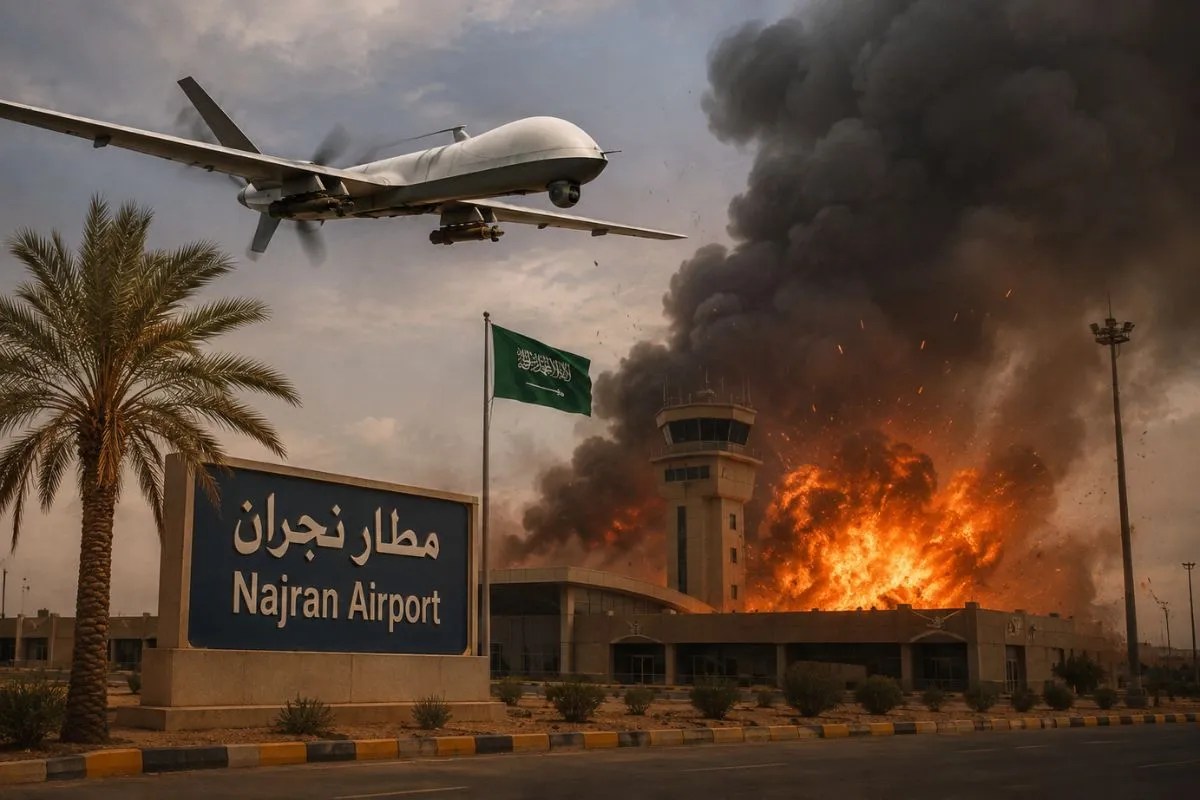
The morning air in Najran usually smells of dust and the faint, sweet warmth of roasting coffee beans. It is a border city, ancient and stubborn, carved into the stone of southern Saudi Arabia where the desert meets the rugged peaks of Yemen. For centuries, people lived here by the rhythm of the sun and the old trade routes. They knew the wind. They knew the silence.
Then came the sound that broke the morning.
It was not the roar of a commercial jet lifting toward Riyadh. It was a sharp, angry buzz, thin and metallic, tearing through the pale blue sky before the impact swallowed the sound entirely.
To understand what happened at Najran Airport, you have to look past the military communiqués and the dry wire-service tickers. You have to imagine standing on the tarmac, watching a routine day shatter into smoke and sirens.
When the Horizon Changes
For years, the conflict to the south remained a distant rumble for many living in the border provinces—a jagged line on a map, a matter of intercepted threats and distant artillery. But gravity has a way of asserting itself.
When the Houthi movement claimed responsibility for the drone attack targeting Najran Airport, the abstract math of geopolitical warfare suddenly became very personal. This was not a remote desert skirmish. This was civilian infrastructure, a regional transport hub where families gathered to greet returning relatives, where merchants shipped goods, where daily life hummed with ordinary ambition.
Consider what happens in the seconds after a drone strikes a tarmac.
The immediate flash is blinding, but the silence that follows is heavier. Alarms begin to shriek. Red lights paint the concrete. Passengers waiting inside the terminal are suddenly ordered to the floor, clutching hand luggage, listening to the frantic instructions of security personnel. (Hypothetical scenario based on standard emergency protocols during aviation strikes.) In that moment, the grand narratives of regional proxy wars dissolve into a very human question: When did the sky become a hostile space?
The Anatomy of Modern Asymmetry
To grasp the weight of these events, we have to look at how modern conflict has evolved. Air defense systems like Saudi Arabia's Patriot batteries are marvels of engineering, designed to track incoming ballistic missiles traveling at supersonic speeds. But technology adapts downward.
Drones—often assembled from commercial components, guided by civilian GPS units, and packed with inexpensive explosives—represent a brutal tactical shift. They are the great equalizer of modern asymmetric warfare. They are cheap to build, difficult to spot against ground clutter, and devastatingly effective at psychological disruption.
Think of it like a lock on a heavy wooden door. You can reinforce the wood, add iron bolts, and station guards. But if someone finds a way to slide a burning coal through the mail slot, the heavy door matters very little. Najran Airport, like many facilities across the region, found itself grappling with this exact vulnerability. The attack was not just about the physical damage inflicted on the runway or the grounded aircraft; it was about the psychological friction it introduced into daily commerce and transit.
The Cost Kept Off the Ledger
We tally wars in numbers. We count intercept rates, millions of dollars in defensive ordnance, delayed flights, and structural repair bills.
We rarely count the cost of hesitation.
In Najran, after the smoke clears and the runway is swept clean of debris, the invisible tax is paid in the minds of the people who live there. It is the mother who second-guesses booking a flight for her children to visit grandparents in Jeddah. It is the local merchant who watches cargo flights with a knot in his stomach, wondering if the supply chain will hold.
Security is an invisible architecture. When it holds, you do not notice it. You step onto a plane, you look out the window at the clouds, and you trust the machinery of modern civilization to carry you safely across borders. When that architecture fractures—even for a few terrifying minutes on a regional airstrip—the illusion of safety is pierced.
The Houthi claim of responsibility was more than a tactical bulletin sent to newsrooms. It was a deliberate reminder that the geography of the war has no clean boundaries. Every airport, every power station, every civilian depot sits within the radius of a changing technological reality.
The Long Shadow Over the Border
Standing in Najran today, the contrast is stark. The mountains still stand eternal against the horizon. The markets still open their shutters. Life demands to be lived, and human resilience has always been remarkably stubborn in the face of hazard.
Yet, the sky has lost its innocence. Every drone that hums across a border zone leaves behind a permanent adjustment in how nations must defend not just their borders, but the very fabric of normal life.
The sirens have stopped. The runway has been patched. But high above the desert, the watchfulness remains, a permanent fixture of a new era where the horizon can never be trusted quite the same way again.


