The hospital room smelled of eucalyptus cleaner and unsaid prayers.
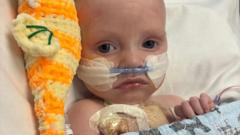
Outside the window, a gray Tuesday morning pressed against the glass, indifferent to the absolute gravity of the room. Inside, a machine kept time. Beep. Beep. Beep. Each mechanical pulse marked a second stolen back from the brink. In the center of the bed lay a bundle so small it looked like an afterthought of creation. A baby. Barely a week old, yet her skin already bore the translucent, bruised exhaustion of a veteran of war.
Her parents sat on opposite sides of the plastic-covered mattress. They had not slept in seventy-two hours. Sleep is a luxury for people whose world is not actively tearing at the seams. Every time the tiny chest rose, it was an argument against the odds. Every time it paused, their own breathing stopped with it.
Medical textbooks call it congenital heart disease. Statistics call it a rare anomaly, affecting a fraction of a percent of newborns. But statistics do not have names. Statistics do not cry in the sterile glare of a neonatal intensive care unit while a surgeon explains, with terrifying calmness, that a human heart the size of a walnut needs to be stopped, repaired, and restarted.
They had been given days. Just days.
Time became an enemy. It accelerated when you wanted it to stretch, and it congealed like cold grease when you waited for the doctor's morning rounds. The diagnosis had hit them like a falling beam. One moment they were planning nursery colors and arguing over crib mobiles; the next, they were signing consent forms that listed risks no parent should ever have to read.
Consider what happens when a newborn's plumbing is fundamentally flawed. Blood bypasses the lungs, or fails to pump to the body, leaving tissues starving for oxygen. It is an engineering disaster inside a sanctuary of flesh. To fix it, you cannot simply wait. You have to intervene with steel and precision while the patient is smaller than a house cat.
The surgeon walked in. Dr. Hayes. He looked tired too, his eyes ringed with the kind of focus that only comes from staring into open chests for hours on end. He didn't offer false cheer. False cheer is an insult to people staring into the abyss. Instead, he offered a plan.
"We are going to stop her heart," he said simply.
Silence swallowed the room.
"We will put her on bypass," Hayes continued, his voice steady, anchoring them against the vertigo. "We will cool her body down to protect her brain. Then, we go in. The valve is narrow. We widen it. We patch the wall. And then, we bring her back."
It sounded like science fiction. It sounded like madness. Stop a life to save it. Press pause on a beating heart and hope the universe has the patience to let you press play again.
The operation day arrived wrapped in the cold efficiency of a surgical suite.
The parents waited in the designated family lounge, a room designed by someone who understood anxiety but had no idea how to cure it. The clock on the wall ticked with offensive cheerfulness. Hours dissolved. Every time the door opened, their hearts slammed against their ribs. A nurse came in twice with updates. On bypass. Cooling down. Repairing now.
Words. Just words. Floating in a vacuum.
During a procedure like this, the heart-lung machine takes over the work of the entire body. It is an external engine of survival, pumping oxygenated blood through plastic tubes while the surgeon works in a field smaller than a postage stamp. It is a terrifying suspension of natural law. For hours, the baby's body temperature drops, slowing cellular metabolism to a crawl. She is suspended between living and dying, waiting for human hands to rebuild her foundation.
Then came the moment of truth. The repair was done. The rewarming process began.
The hardest part of pediatric heart surgery is not the repair itself; it is the restart. Sometimes, after you fix the plumbing and warm the blood, the heart simply forgets how to beat. It lies there, flaccid and quiet, refusing the electrical spark.
In the waiting room, the phone rang.
The father answered. His hand was shaking so badly he nearly dropped the receiver.
It was Hayes. The operation was over. They had restarted the heart. It was beating on its own.
Relief is not a warm wave. It is a physical blow. The mother collapsed into a chair, the tears finally breaking through the dry dam of days of terror. But the war wasn't won yet. The post-operative ICU is a minefield of swelling, fluid retention, and infection risks. The first forty-eight hours are a jagged cliff edge.
Back in the room, the mechanical beeps had changed rhythm. They were stronger now. Less frantic, more assured.
The baby was still hooked to monitors, a spiderweb of wires and IV lines crisscrossing her tiny limbs. But the blue tint to her lips—the cruel signature of oxygen deprivation—was gone. Replaced by a faint, stubborn flush of pink.
Days turned into weeks. The body heals with miraculous stubbornness when given half a chance. Children possess a resilience that adults squander. They do not look backward at what went wrong; they simply grow toward the light.
Today, months removed from that gray Tuesday, the scene is entirely different.
The hospital smells are gone, replaced by the scent of baby powder and sour milk. The nursery has been finished, the mobile spinning gently above a crib that is no longer an empty promise. When you look at her now, you have to look very closely to see the fine, pale line running down the center of her chest. A signature of survival.
She is thriving.
She kicks her legs with furious energy, babbling at the ceiling fan, completely unaware of the army of strangers who stopped time so she could have a future. Her parents still jump when she coughs. The phantom trauma of the ICU lingers in the corners of their minds, a ghost that refuses to fully vanish. Every medical checkup is a high-wire act of anxiety.
Yet, as the sunlight streams through the living room window, catching the fine gold fuzz of her hair, the terror recedes.
The heart keeps time. Not with the frantic, artificial beep of a monitor, but with the steady, quiet rhythm of a life reclaimed from the edge. It beats on, small and fierce, reminding anyone willing to listen that even the most broken things can be made whole again by human hands and stubborn, unrelenting hope.