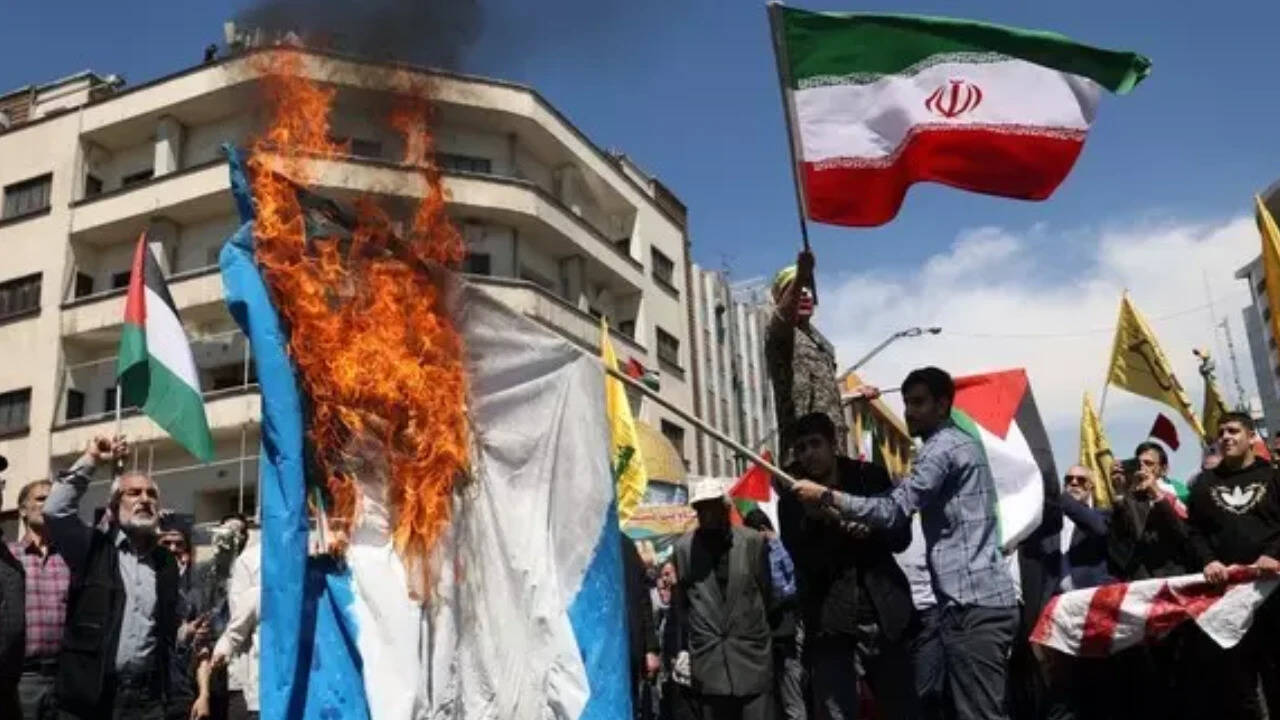
Air raid sirens have a specific frequency that bypasses the ears and vibrates directly in the center of the chest. It is a hollow, metallic wail, designed decades ago to mimic the sound of a dying beast, warning anyone within miles that the sky is no longer safe. For families in Tel Aviv and Tehran alike, that sound has shifted from a historical echo into the background noise of daily life.
We often view geopolitical conflict through the clean, cold lens of satellite imagery and press briefings. The headlines read like a chess match. Iran issues a warning. Israel vows retaliation. The United States moves a carrier strike group.
But geopolitics is not chess. Chess pieces do not bleed. They do not lie awake at 3:00 AM wondering if the rumble in the distance is thunder or the beginning of an exchange that cannot be undone.
To understand the current precipice between Iran, Israel, and the United States, you have to look past the official communiqués. You have to look at the invisible lines of friction that have brought three nations to the edge of an abyss.
The Calculus of the Unpredictable
Imagine a crowded room where three people are holding loaded weapons, each pointing at the other. If one person flinches, everyone fires. This is the doctrine of deterrence, stripped of its academic jargon. For years, the shadow war between Israel and Iran operated under a strict, unwritten code. Hit a proxy here, cyberattack a facility there, but never strike the homeland directly.
That code is dead.
When Iran launched hundreds of drones and missiles directly toward Israeli soil, the paradigm shifted permanently. It was no longer a shadow war. It was a direct, state-on-state confrontation. The Iranian leadership issued a stark declaration, warning that the "Zionist regime will not be safe" and threatening that any American intervention would turn regional US bases into targets.
Israel, anchored by a doctrine that views any unanswered strike as an invitation to annihilation, immediately promised a response.
The math of modern warfare is brutal and asymmetric. A single ballistic missile can cost millions of dollars to build. The interceptor missile used to shoot it down can cost twice that amount. During major escalations, defense systems like Israel’s Arrow and David's Sling, alongside US naval assets, burn through billions of dollars in ammunition in a matter of hours.
But the economic cost is a distraction. The real currency being spent is time.
Every time a missile is intercepted, the clock resets. But the interval between the strikes gets shorter. The margin for error shrinks to nothing. A single malfunctioning radar system, a single miscalculated flight path landing in a crowded apartment block instead of an empty field, and the regional war everyone claims they want to avoid becomes an inevitability.
The Ghost in the Machine
We tend to think of military power in terms of hardware. We count tanks, F-35 fighter jets, and uranium centrifuges.
The real vulnerability is human psychology.
Consider the person sitting in a command bunker beneath Tel Aviv or a secure facility in Tehran. They are operating on a severe deficit of sleep. They are receiving conflicting intelligence reports. They know that a delay of thirty seconds could mean the difference between intercepting an incoming warhead or losing a city block. Under that kind of pressure, the human brain stops thinking about long-term strategy. It reverts to survival.
Washington finds itself caught in the middle of this psychological trap. The United States has pledged an ironclad commitment to defend Israel, a promise backed by the deployment of stealth fighters and guided-missile destroyers to the region. Yet, American diplomats are working the phones in a desperate bid to cap the escalation. They are trying to build a firebreak around a blaze that is already leaping from ridge to ridge.
The difficulty lies in the fact that both sides believe they are acting defensively.
Tehran views its missile strikes as a justified response to repeated assassinations of its military commanders and scientists. Israel views its counterstrikes as a non-negotiable requirement to deter an existential threat from a regime that has openly called for its erasure. When both sides believe they are fighting for survival, moderation looks like suicide.
What Happens When the Screen Goes Black
If you talk to veterans of the Cold War, they will tell you that the most dangerous moment was not the Cuban Missile Crisis itself. It was the breakdown in communication. During the tensest moments of that standoff, messages took hours to translate and transmit. Decisions were made in the dark.
Today, communication is instantaneous, but understanding is lower than ever. Public rhetoric has become a hostage to domestic politics. A leader cannot look weak to their own citizens, so they issue maximalist threats on state television. But those threats are picked up by the adversary’s intelligence agencies and interpreted as imminent operational plans.
The escalatory spiral feeds on itself.
Step back from the map for a moment. Look at the geography. The distance between Tehran and Jerusalem is roughly one thousand miles. A ballistic missile can cover that distance in less than twelve minutes. That is the entire window for decision-making. Twelve minutes to wake a leader, verify the launch, determine the target, coordinate with allies, and launch interceptors.
There is no time for nuance. There is no time for a second opinion.
The world watches this play out on social media feeds, tracking flight paths and analyzing satellite imagery of scorched airfields. It feels like a spectacle. But for the people on the ground, the reality is measured in the mundane details of survival. It is the sound of masking tape being peeled off a roll to seal windows against chemical agents. It is the calculation of how many liters of bottled water can fit into a basement shelter. It is the text message sent to a child that simply says, Where are you? Come home now.
The rhetoric from both capitals suggests that victory is possible through overwhelming force. But history offers a different, harsher lesson. In the Middle East, wars rarely end with a neat treaty or a clear victor. They bleed into the soil, leaving behind a legacy of ruin that guarantees the next conflict before the dust from the last one has even settled.
The missiles are prepped in their silos. The aircraft are idling on the tarmacs. The warning has been given, and the promise of retaliation has been made. The world holds its breath, not because it expects a sudden burst of diplomatic wisdom, but because it knows how quickly a spark can turn a desert into a furnace.