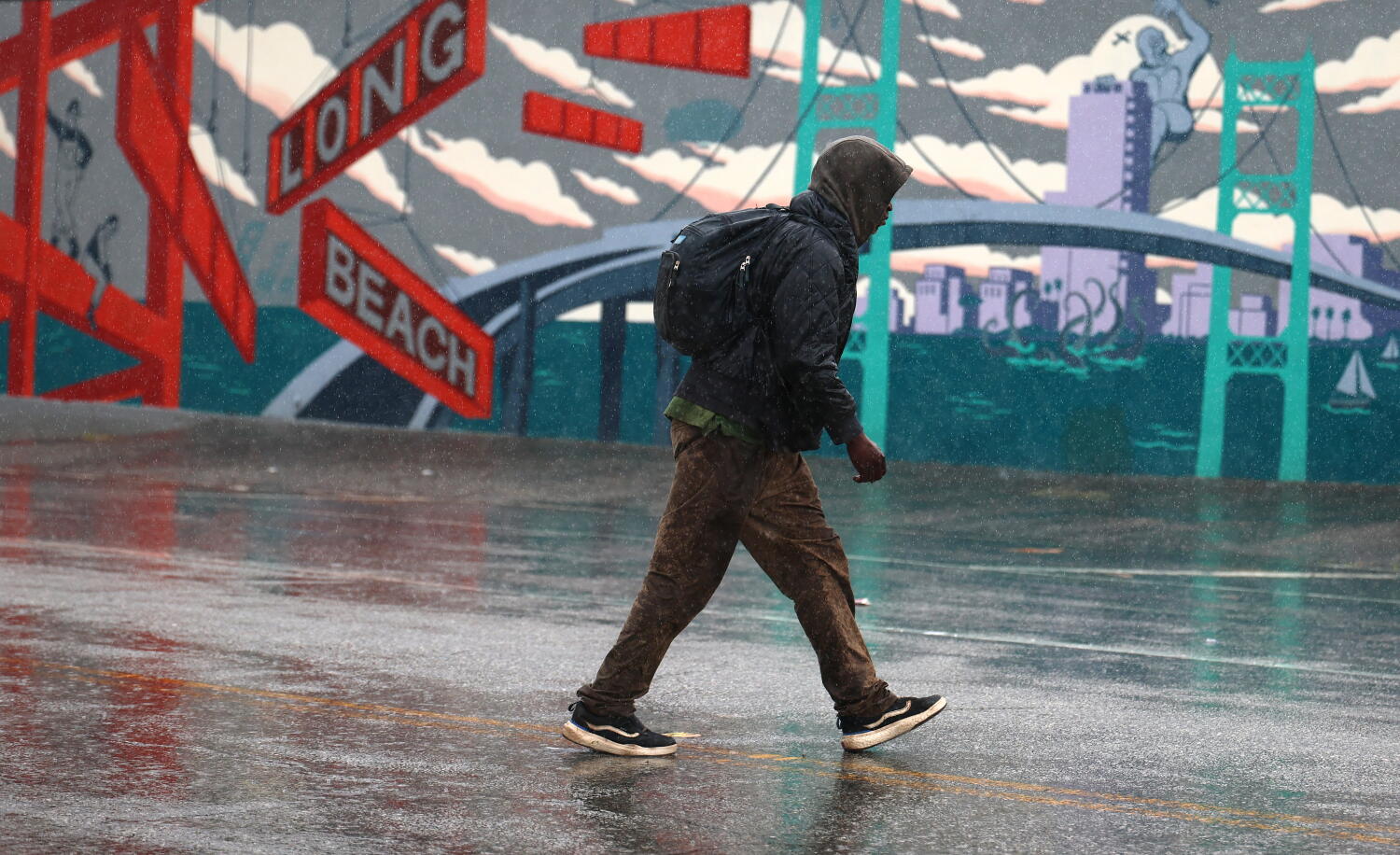
Listen.
Before the sirens start wailing across the canyons of Los Angeles, before the push notifications light up millions of bedside tables in Ventura and Orange counties, there is always a very specific sound. It is the low, metallic rattle of aluminum patio furniture dragging across sun-bleached concrete as a coastal gale sweeps inland off the Pacific. Meanwhile, you can read other events here: The Anatomy of High-Profile Residential Incursions in Los Angeles.
For most of the year, Southern California lives under a truce with the sky. You buy a house tucked into the chaparral-covered folds of the San Gabriel Mountains or build a life along the sprawling, sun-baked basin below, and you accept a quiet bargain. You trade the predictable rhythms of four seasons for three hundred days of blinding, golden light. You forget that the dry, cracked creek beds winding behind the strip malls are not decorative trenches. You forget that the mountains rising dramatically behind the freeways are young, steep, and crumbling.
Then an atmospheric river aims its firehose straight at Point Conception, and the truce dissolves. To understand the full picture, check out the detailed report by The New York Times.
When meteorologists issue flash flood and evacuation warnings across Southern California, the headlines usually reduce the event to box scores of misery. Inches per hour. Swollen freeways. Closed canyon roads. Yet the real story of a major Southern California storm is never about the water falling from the clouds. It is about what the water wakes up when it hits the ground.
The Memory of Fire
To understand why three inches of rain can paralyze a metropolis of eighteen million people while barely dampening a Tuesday in Seattle, you have to look at the hills six months earlier.
Consider a hypothetical family—let us call them Elena and Marcus—living in a split-level ranch house perched just below a recent wildfire burn scar in the foothills above Duarte or Pacific Palisades. Let us trace what happens to their hillside when the sky turns the color of a fresh bruise.
In a healthy forest, rainfall is a slow negotiation. Tree canopies catch the initial drops. A thick carpet of pine needles, oak leaves, and tangled roots acts like a kitchen sponge, absorbing water and feeding it gradually into the underground aquifers.
Wildfire destroys that sponge and replaces it with glass.
When intense heat sweeps through Southern California’s coastal sage scrub and chaparral, the burning plants release waxy, organic compounds that vaporize and sink a few inches into the topsoil. As the soil cools, those vapors solidify, coating individual grains of sand and dirt in a water-repellent shell. Soil scientists call this hydrophobic soil. In plain terms, the mountain becomes wrapped in plastic wrap.
Now picture the storm arriving at two in the morning. Rain hammers the steep, blackened slopes at a rate of three-quarters of an inch per hour—the exact threshold that makes hydrologists lose sleep. Because the water cannot soak into the baked earth, every single drop stays on the surface. It gathers speed. It merges into sheets. Soon, it is no longer water; it is a heavy, grinding slurry of ash, topsoil, charred branches, and boulders the size of compact cars.
This is a debris flow, and calling it a mudslide does a disservice to its physics. Water weighs roughly sixty-two pounds per cubic foot. A debris flow, choked with rock and sediment, weighs closer to one hundred and twenty pounds per cubic foot—nearly the density of wet concrete. It does not politely flow around obstacles. It shears trees at their trunks, lifts pickup trucks off their axles, and hits the back walls of hillside homes with the kinetic force of a freight train.
When emergency managers knock on Elena and Marcus’s door at midnight, urging them to grab their go-bags and leave before the canyon road closes, they are not reacting to puddles. They are trying to outrun gravity.
The Architecture of a Trap
If you have never driven through a Southern California downpour, the experience feels profoundly disorienting, almost claustrophobic. The infrastructure of the region was engineered during the twentieth century with one overriding obsession: moving cars fast under clear skies, and getting rare, violent bursts of rainwater out to the ocean before they could drown the suburbs.
To achieve that, the Army Corps of Engineers encased the Los Angeles River and hundreds of miles of tributary washes in smooth, trapezoidal concrete channels. It was a triumph of mid-century civil engineering, turning erratic, meandering floodplains into predictable storm drains.
That engineering comes with a hidden cost during extreme weather.
Because forty to sixty percent of the urban basin is sealed beneath asphalt, rooftops, and concrete, rain has nowhere to go except into the storm drains—all at once. A trickle in a neighborhood wash in the San Fernando Valley can transform into a roaring, thirty-foot-wide torrent moving at twenty-five miles per hour in less than twenty minutes. You do not even need to be standing under a raincloud to get caught; a thunderstorm dumping two inches of rain five miles upstream in the foothills can send a wall of brown water surging down a dry arroyo where a dozen unhoused residents had pitched tents under a highway overpass an hour earlier.
Meanwhile, out on the freeways, the asphalt itself becomes a hazard. During months of dry weather, millions of tires deposit a microscopic film of motor oil, brake dust, and rubber onto the lanes of the 405, the 101, and the 5. When the first heavy rain hits, that oil floats to the surface before the water can wash it away, turning eight lanes of high-speed concrete into a skating rink. Add clogged storm drains choked with eucalyptus leaves and plastic trash, and low-lying underpasses quickly fill into lakes deep enough to stall an engine and trap a driver inside a rising cabin.
I still remember the first time I watched a canyon road vanish beneath a storm. Years ago, during an intense winter deluge in Topanga, the sound was what stayed with me—not the drumming of rain on the roof, but a deep, rhythmic thud-thud-thud vibrating through the floorboards. It was the sound of granite boulders rolling down the creek bed beneath the house, colliding with each other underwater like bowling balls in the dark. You realize, standing in your kitchen with a flashlight in one hand and your car keys in the other, how thin the veneer of modern civilization really is when the geology decides to move.
The Psychology of the Warning
There is a quiet crisis happening every time the National Weather Service upgrades a Flood Watch to a Flash Flood Warning, and it has nothing to do with meteorology. It is a crisis of human intuition.
We are wired to trust our eyes. If you look out your window in Silver Lake or Santa Barbara at four in the afternoon and see a steady, manageable drizzle, your brain tells you that the emergency alert screaming on your phone is an overreaction. You think about the last three storms that fizzled out into light mist. You think about the hassle of packing up your kids, loading the dog into the crate, finding a hotel that takes pets, and leaving your home unguarded.
Psychologists call this normalcy bias—the tendency to underestimate both the likelihood of a disaster and its possible effects, simply because nothing terrible has happened to you yet. In Southern California, normalcy bias is amplified by the hyper-local violence of the terrain. One neighborhood might receive half an inch of gentle rain over twelve hours, while a canyon three miles away sits directly beneath a stalled convective band, absorbing four inches in ninety minutes.
By the time your eyes confirm what the radar already knew—when water is bubbling up through the floorboards or brown mud is cresting the backyard retaining wall—the window for safe escape has usually slammed shut.
Consider what happens next when someone waits too long. Nearly half of all flash flood fatalities happen inside vehicles. A driver approaches a flooded dip in the road, sees the headlights of a car on the other side, and assumes the water is only a few inches deep. In reality, just six inches of fast-moving water can reach the bottom of most passenger cars, causing loss of control and stalling the engine. Twelve inches will float many vehicles. Two feet of rushing water will sweep away almost any car, including heavy SUVs and pickup trucks.
Once a car loses traction and begins to drift, the sheer weight of the water pressing against the doors makes them impossible to open manually until the cabin fills completely—a terrifying reality that turns a five-minute errand into a swift-water rescue operation.
Reading the Sky Before the Siren
Surviving a Southern California atmospheric river does not require paranoia. It requires trading the illusion of control for a few deliberate habits before the first drop falls.
Start by understanding the difference between the alerts lighting up your screen, because the language matters:
- A Flood Watch means the ingredients are on the counter. Atmospheric conditions are ripe for heavy rain and runoff. This is your cue to clear leaves from backyard drains, move valuables off garage floors, and make sure your gas tank is at least half full.
- A Flood Warning means the meal is cooking. Flooding is imminent or already occurring. Avoid low-lying roads, river washes, and canyon routes entirely.
- A Flash Flood Warning means the house is on fire. Violent, life-threatening water is surging right now. If you are near a creek, a burn scar, or an underpass, move to higher ground immediately without stopping to pack.
If you live in or near a canyon or a recent burn zone, pack your bag while the sun is still shining. Keep sturdy, closed-toe shoes and a flashlight beside your bed—not in a hallway closet—because power outages almost always accompany wind-driven storms, and stepping onto broken glass or wet concrete barefoot in the dark slows you down when seconds count.
And if emergency officials issue an evacuation order for your street, treat it as a gift of time rather than an inconvenience. Law enforcement officers do not lightly order thousands of residents out of their homes; they do it because their models show that once the mud starts moving, fire engines and ambulances will not be able to reach your driveway.
The Long Drink
By morning, the storm always breaks the same way.
The clouds tear apart into ragged, dazzling white towers racing east toward the Mojave Desert. The air smells sharp and clean, scrubbed free of smog and dust, carrying the sweet, resinous scent of wet sage and eucalyptus. From the coastal bluffs, you can see Catalina Island sitting on the horizon so crisp and close it looks as though you could reach out and touch it.
Down below, the concrete rivers are still roaring, carrying millions of gallons of silty brown mountain runoff, tangled branches, and urban debris out into the Santa Monica Bay, painting a vast, swirling plume of tan across the deep blue Pacific. Bulldozers scrape yellow mud off the Pacific Coast Highway while utility crews string fresh copper wire between snapped wooden poles.
Life in Southern California rushes back into the sunlight with astonishing speed. Freeways dry out. Coffee shops reopen. People step over puddles in sneakers and squint against the sudden glare, already forgetting the sound of the wind rattling the windows at midnight.
Yet up in the hills, the earth remembers. Every gully carved deeper into the granite, every saturated slope holding tons of water beneath a thin crust of roots, waits quietly for the next dark band of clouds gathering out over the ocean. The mountains are still settling, the concrete channels are still scarred with high-water marks, and the truce between the city and the sky remains, as it has always been, entirely temporary.