The clock on the wall ticks toward midnight.
In most newsrooms, this hour is defined by a specific kind of quiet. It is not peaceful. It is the tense, heavy silence before the morning edition breathes its first life. Coffee cups are stained and cold. Keyboards clack in erratic bursts. Somewhere down the hall, a wire service printer hums, churning out thousands of financial filings, quarterly reports, and corporate earnings disclosures that arrive in a relentless, digital flood.
Meet Elena. (Note: Elena is a hypothetical composite character based on standard workflows observed in modern financial journalism.)
Elena is a senior reporter who has spent fifteen years tracking corporate acquisitions, earnings beats, and executive shuffles. She knows the rhythm of the markets in her bones. She knows how to read a balance sheet upside down. Yet, for all her expertise, Elena has spent a significant portion of her career doing something soul-crushing.
She has spent it wrestling with routine data.
Every single quarter, thousands of publicly traded companies release earnings reports at the exact same time. Revenue figures, net income, year-over-year comparisons, operating margins. The raw facts are vital. Investors need them. The public relies on them. But turning those dry numbers into accurate, standardized corporate coverage is a massive logistical bottleneck.
There are only so many hours in a day. There are only so many reporters on a desk.
For decades, the math simply did not work. Major financial publications like Nikkei faced a harsh physical limit. They could cover the corporate giants—the multinational behemoths whose every move dominated the front page. But hundreds of smaller, equally important companies? The mid-cap firms, regional innovators, and emerging market players whose decisions quietly shaped local economies? They slipped through the cracks. Not because they lacked news value, but because human hands could only type so fast.
Then came a quiet shift.
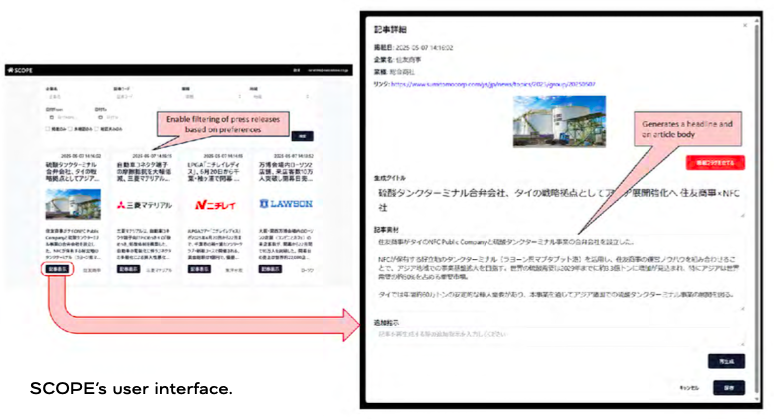
It did not arrive with a dramatic announcement or a robotic revolution. It arrived as a tool. A system designed to ingest raw financial data, cross-reference historical archives, and generate automated, AI-assisted drafts within seconds of a corporate filing dropping.
Consider what happens next in that midnight newsroom:
A corporate earnings report hits the wire at 11:45 PM.
Within three seconds, the system parses the net income, compares it to analyst expectations, and drafts a structured baseline report.
By 11:46 PM, Elena opens her screen.
The blank page is gone.
Instead of starting from zero—hunting for last quarter's revenue or calculating percentage changes manually—she is looking at a complete, structured draft. Her job changes fundamentally in that single heartbeat. She stops being a human calculator. She becomes an editor, a verifier, and an investigator.
This is the real story behind how organizations like Nikkei use AI-assisted drafting to expand their corporate coverage. It is not about replacing journalists. It is about removing the invisible wall that restricted how much truth could be told.
Think about the sheer volume of corporate data generated globally. It is an ocean. Historically, news organizations could only scoop up a few buckets from the shore. Automated drafting builds a pipeline.
When Nikkei integrated AI tools into its reporting pipeline, the goal was structural expansion. By delegating the initial, highly formulaic heavy lifting of earnings summaries to algorithms, human reporters were freed to do what humans have always done best: ask difficult questions, uncover context, and pursue investigative angles that numbers alone cannot reveal.
Skepticism is healthy here. Whenever algorithms touch the news, alarm bells ring. People worry about hallucinations, lost nuance, and the erosion of human authenticity. Those are valid fears. We live in an era where trust in media is fragile, and the temptation to automate shortcuts is everywhere.
That is why the human-in-the-loop requirement is not just a feature; it is an absolute necessity.
Every single AI-assisted draft produced in modern newsrooms goes through human verification before publication. The machine provides speed; the journalist provides accountability. The algorithm computes the percentage drop; the reporter investigates why the supply chain failed in Southeast Asia. The algorithm lists the new CEO; the reporter calls sources to find out why the previous one was pushed out.
It is a partnership. An uneasy one, perhaps, born out of necessity and economic pressure, but a powerful one nonetheless.
Look at the numbers. Publications utilizing these workflows report exponential increases in the sheer volume of companies they can track. Small-cap firms that previously received zero coverage now get standard, reliable reporting. Local investors get visibility they never had. The corporate ecosystem becomes slightly more transparent, simply because the spotlight is wider.
We often fear technological shifts because we imagine them as sudden, violent fractures with the past. We picture a future where human effort is rendered obsolete.
But watch a veteran reporter work alongside these tools on a late-night shift. You do not see obsolescence. You see leverage of a different kind—the kind that gives time back to human curiosity. You see a reporter finishing their review ten minutes early, grabbing their coat, and walking down to the floor to chase a tip that a machine could never comprehend.
The files keep coming. The wire service hums in the dark. But the space between the data and the reader has grown a little bit smaller.
The screen goes dark as the office lights automatically dim. Somewhere in the quiet code, a server rests. Tomorrow, the numbers will rise again, waiting for the dawn.