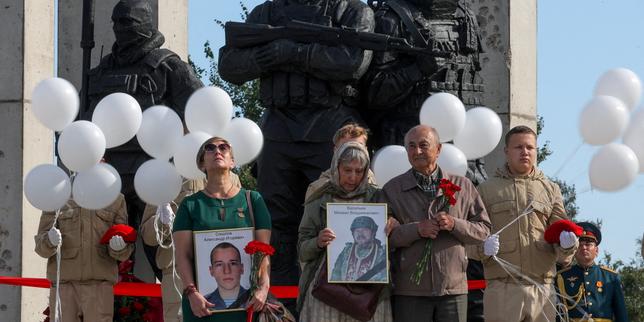
In a small wooden house four hours east of Moscow, a telephone rings on a scrubbed pine table. It does not ring with the sharp urgency of a crisis, but with the flat, persistent tone of official routine. The woman who answers already knows. She has known for six months, ever since the handwritten letters stopped coming from a muddy trench outside Avdiivka.
What the voice on the other end delivers is a bureaucratic euphemism. A missing notice. A delay in accounting. But behind the deliberate ambiguity of state paperwork lies a grim arithmetic that no official decree can hide for long.
Across the Russian countryside, thousands of these phone calls have accumulated into a quiet, crushing reality. While official broadcasts in Moscow project an image of steady composure and unyielding strength, the statistical reality leaking through military casualty reports, cemetery expansions, and open-source intelligence tells a drastically different story. Four hundred thousand dead. The figure is difficult to wrap your mind around. It is not just a statistical milestone in a prolonged conflict; it is the virtual erasure of an entire generation of young men from working-class towns across eleven time zones.
The Geography of Loss
If you walk through the central districts of St. Petersburg or the polished avenues of Moscow, the war feels like a distant television broadcast. The coffee shops remain open. The subway runs on schedule. This is by design. The human toll of the conflict has been systematically steered away from the political centers of power, mapped instead onto the economically vulnerable regions of Siberia, the North Caucasus, and the Far East.
Consider the reality of a town like Buryatia, nestled along the shores of Lake Baikal. Here, recruitment bonuses that equal three years of local wages transformed military service from an abstract duty into an act of financial survival for young men with few other choices. When those men do not return, the local economy does not simply lose soldiers; it loses fathers, mechanics, drivers, and breadwinners.
The state attempts to manage this loss through a meticulously constructed system of compensation, often referred to locally as "cargo 200 payments." Families receive sums that can instantly clear mortgages or pay for higher education for surviving siblings. It is an exchange of human capital for economic relief. Yet, as the total casualties climb past the four-hundred-thousand mark, even this financial cushion begins to strain the structural framework of regional budgets.
The math of modern attritional warfare is brutal and unforgiving.
Military analysts tracking the conflict through satellite imagery note that the physical footprint of regional cemeteries has expanded exponentially since 2022. Rows of fresh graves, adorned with identical military banners, stretch into reclaimed farmland on the outskirts of towns most Westerners will never hear named. These are not numbers on a spreadsheet. They are the physical evidence of a demographic wound that will take decades to heal.
The Architecture of Secrecy
Why go to such lengths to obscure the true scale of human loss? Because in modern statecraft, information control is as vital as ammunition reserves.
Throughout history, large-scale military engagements have hinged on public endurance. When casualty counts remain low or hidden, the domestic perception of war remains theoretical. The moment the true cost breaks into public consciousness, the political equation changes overnight.
To prevent this shift, the apparatus of record-keeping was restructured. Casualty statistics were classified as state secrets. Independent journalists attempting to tally deaths by reading local obituaries, scanning social media posts, and counting fresh graves found themselves facing severe legal penalties or forced exile. The state replaced granular data with a curtain of complete silence.
Yet silence creates its own problems.
When a nation loses hundreds of thousands of men in their prime reproductive and economic years, the consequences cannot be confined to the battlefield. They leak into the labor market. Construction sites find themselves short of crew leads. Agricultural regions face labor deficits during harvest season. Factory floors report record shortages of skilled operators. The human body count eventually manifests as an economic weight that no propaganda strategy can lift.
The Invisible Stakes
To understand what four hundred thousand dead actually means for a nation’s future, you have to look beyond the immediate grief and look at the demographic trajectory of Russia itself.
Before the first troops crossed the border in February 2022, Russia was already facing a severe demographic challenge. The population was aging rapidly, a lingering legacy of the sharp birth rate collapse during the economic turmoil of the 1990s. The cohort of men currently aged twenty to thirty-five was already one of the smallest in modern Russian history.
Now, take that already diminished pool of young men and subtract hundreds of thousands through combat deaths, severe permanent injuries, and the massive wave of draft-age emigrants who fled the country to escape mobilization.
What remains is a structural hollow.
- Labor Shortages: Critical industries outside the defense sector are experiencing unprecedented manpower deficits.
- Demographic Decline: The potential birth rate for the next decade has taken a direct, measurable hit that will echo through school enrollments and workforce entries for thirty years.
- Social Strain: Millions of family members are left navigating long-term psychological trauma without access to public mental health infrastructure designed for military-scale grief.
This is the hidden cost that state media works tirelessly to offset with patriotic programming and promises of territorial expansion. Land can be mapped, claimed, and fortified. But land does not work factories. Land does not care for aging parents. Land does not birth the next generation.
The Echo in the Silence
Late in the evening, far away from the military briefings and strategic headquarters, the reality of this war settles into its true form. It lives in the quiet kitchens of regional towns, where dinner tables are set with one fewer chair.
The attempt to hide the four-hundred-thousand casualty threshold was never just about controlling a news cycle or preserving an international narrative. It was about delaying an inevitable reckoning between a government’s strategic ambitions and the finite physical capacity of its people to bear the cost.
Statutes can prohibit the publication of data. Courts can silence independent researchers. Censorship can scrub the internet of obituaries. But no law can fill a vacant home, and no propaganda can bring back a generation buried beneath the quiet soil of the steppes.


