The air inside the manufacturing district does not taste like steel anymore. It tastes like quiet.
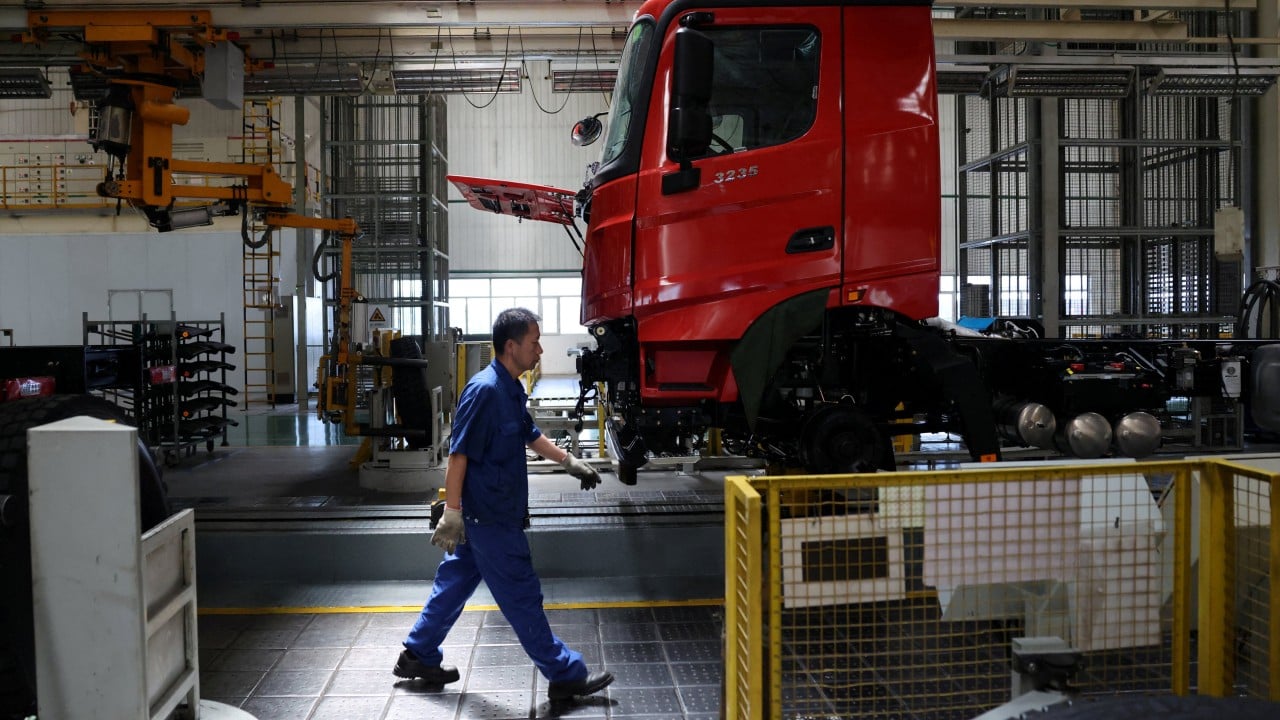
Walk down an assembly corridor in the industrial heartland during a typical summer afternoon, and you expect the percussive roar of presses, the hum of heavy current, the sharp metallic tang of ozone and heated oil. Instead, you hear ventilation fans. You hear shoes squeaking on epoxy floors. You hear the rhythmic, polite clicking of keyboards in glass-walled control rooms overlooking floors where fewer human hands touch the metal than ever before.
Growth has slowed its frantic pulse. Production numbers, long treated as an unbroken upward march, are flattening into a plateau. This is not a sudden collapse. It is a cooling. The machines are still running, but the frantic urgency that defined the sector for a generation has given way to a watchful, deliberate quiet.
Behind this ambient hush, something far more consequential is taking shape.
Consider a silicon wafer inside a cleanroom. It is thinner than a human hair, polished to an atomic mirror finish, carrying billions of microscopic gates that will soon decide the path of an electrical current. For years, domestic semiconductor outfits played catch-up, relying on older equipment to stamp out commodity chips while the world's most advanced silicon flowed from a handful of foreign shores.
That dynamic is snapping.
ChangXin Memory Technologies, known across the industry as CXMT, did not arrive in the headlines with a grand explosion. It grew in the shadows of heavy capital allocation and relentless engineering hours. Quietly, methodically, the company has ramped up production of dynamic random-access memory—DRAM—chipping away at a market that was once impenetrable to domestic challengers. When you look at the shipment volumes, the trajectory resembles a steep cliff face. They are producing advanced memory components at a scale that forces global competitors to recalculate their margins, their supply chains, and their long-term survival strategies.
Why does a silicon memory chip matter to a worker standing on a cooling factory floor? Because the cooling of old-line manufacturing and the surge of advanced semiconductor production are two sides of the same coin. The heavy, dirty, low-margin assembly lines are losing momentum because capital, talent, and state backing are migrating upward. They are moving into the micro-universe of nanometers, lithography, and memory architecture.
Down in the southern districts, the anniversary of the People's Liberation Army passed with the usual choreographed display of precision and iron discipline. Uniforms pressed, boots gleaming, banners snapping in the humid wind. Yet, military parades today look less like exhibitions of raw manpower and more like technology trade shows. The hardware rolling through the streets—automated logistics units, encrypted communication arrays, autonomous flight systems—relies entirely on the very semiconductor breakthroughs being forged in places like CXMT's fabrication plants.
National security and industrial policy are no longer separate conversations. They are fused at the silicon level.
Imagine a strategist sitting in a command room fifty miles outside Beijing. Their monitor does not show infantry movements; it shows yield rates. It shows the percentage of usable memory wafers coming out of a multi-billion-dollar cleanroom. If the yield drops, the strategic posture weakens. If the yield surges, the technological containment strategies designed across oceans begin to fray.
This is the invisible stake of our current era. We tend to measure power by aircraft carriers or gross domestic product, but power is increasingly concentrated in a piece of silicon smaller than a fingernail, manufactured in an environment cleaner than a hospital operating theater, protected by layers of patents, subsidies, and national resolve.
The cooling factories are a symptom of a systemic pivot. Traditional heavy industry—cement, standard steel, basic consumer assembly—is reaching saturation. The domestic market has absorbed what it can, and global demand is shifting under the weight of trade barriers and localized supply chains. To keep the economic engine turning, the focus must shift from making more things to making smarter things.
Yet, this transition is fraught with friction.
Building a memory chip is not like building a bicycle. It requires extreme precision, chemical purity that borders on the miraculous, and access to advanced tooling that remains fiercely guarded by international export controls. When a domestic champion surges despite those barriers, it signals a massive mobilization of domestic engineering talent. Engineers who trained abroad are returning, setting up labs, troubleshooting botched etching processes at three in the morning, and rewriting the playbook on how to build high-tech infrastructure from the ground up.
We have seen this script before in telecommunications, in high-speed rail, in electric vehicles. A sector starts with imitation, stumbles through failure, absorbs staggering financial losses, and eventually achieves critical mass.
The human element in all of this is easy to overlook beneath the macroeconomic data. It is found in the young graduate holding a doctorate in materials science who turns down a lucrative post abroad to take a grueling shift in an Hefei cleanroom. It is found in the aging factory supervisor in a rust-belt town who watches his mechanical stamping press slow down for lack of orders, wondering if his children will work with grease or with code.
The cooling of traditional production lines is not an ending. It is a reallocation of gravity. As the old heavy industries cool down, the high-tech frontier heats up with an intensity that will define global markets for decades to come.
The machines in the older halls may run a little slower tomorrow. But in the cleanrooms, under the yellow light, the silicon keeps spinning.