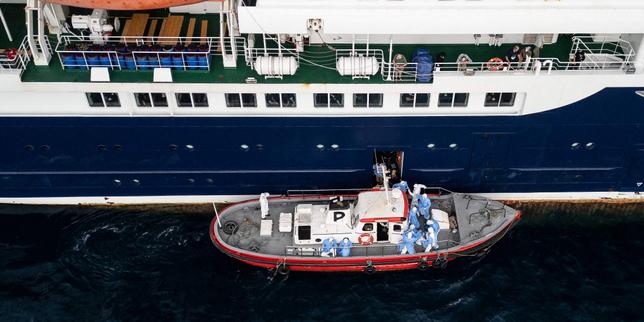
The steel hull of the MV Hondius groans against the shifting pack ice of the Southern Ocean. It is a sound that usually signals adventure—the visceral reminder that you are at the edge of the world, far from the reach of strip malls and stable Wi-Fi. But for a handful of passengers on a recent voyage, that groaning sound was soon replaced by the rhythmic, labored breathing of the sick.
A fever begins as a flicker. It is easy to dismiss as a chill from the Antarctic wind or the exhaustion of a day spent watching leopard seals hunt. Then the flicker becomes a roar. Muscle aches turn into a deep, bone-crushing fatigue. When the word hantavirus began to circulate through the ship’s corridors, the isolation of the polar wilderness suddenly felt less like a luxury and more like a trap.
The initial reports were a jumble of panic and clinical detachment. A passenger was ill. Then two. Then a trail of breadcrumbs leading back to a single, terrifying question: Where did the invisible killer come aboard?
The Expert in the Room
An expert from the World Health Organization (WHO) sat before a bank of microphones, her voice the only steady thing in a sea of speculation. She didn't offer comfort; she offered a timeline. Investigation is a slow, methodical peeling of an onion. You look at the manifest. You look at the ports of call. You look at the mice.
Hantavirus is not a ghost, though it acts like one. It lives in the lungs and the waste of rodents. It waits in the dust of a long-closed cabin or the soil of a rural outpost. To catch it, you don't usually shake a hand; you breathe in the microscopic debris of a creature that lived there before you.
The WHO’s verdict was swift and surgically precise. The first contamination did not happen on the Hondius. It did not happen during a shore excursion. The virus was an uninvited guest that had been hiding in the luggage of the past, long before the ship ever cast off its moorings.
A Narrative of Displacement
Imagine a traveler named Elias. He isn't real, but his itinerary is. Three weeks before boarding the Hondius, Elias was cleaning out an old shed on his property in rural South America. He was sweeping up the winter’s accumulation of dust and dried leaves, preparing for his "trip of a lifetime." He felt a sneeze coming on. A simple, reflexive action. In that moment, he inhaled a cloud of aerosolized particles—the invisible legacy of a long-tailed pygmy rice rat.
He felt fine. He packed his thermal layers. He flew to the port. He boarded the ship, marveled at the buffet, and toasted to the icebergs.
But the virus has a clock.
The incubation period for hantavirus is a biological suspense novel. It can sit silent for one week, two weeks, sometimes even five. By the time Elias—or whoever the primary patient truly was—started to feel the first tremors of the disease, he was already deep in the Drake Passage. The ship became the stage for a drama that was written hundreds of miles away, in a dusty shed or a forgotten crawlspace.
The Myth of the Petri Dish
We have a collective obsession with the idea of the "plague ship." We see a vessel as a closed loop, a floating petri dish where sickness leaps from person to person like a spark in dry grass. This fear is what makes cruise ship outbreaks so magnetic to the news cycle. It touches on our primal anxiety about being confined with a threat we cannot see.
Yet, the science of the Hondius case flips this script.
Hantavirus, specifically the strains found in the Americas, rarely moves from human to human. It is a lonely path of infection. The expert’s testimony confirmed a truth that is both relieving and unsettling: the ship was clean. The stopovers were safe. The danger wasn't in the Antarctic air or the communal dining room. The danger was a stowaway in the blood.
This distinction is everything. If the virus had originated on the ship, the Hondius would be a pariah, a steel coffin to be quarantined. Because the contamination happened elsewhere, the ship is merely a witness.
The Cost of the Invisible
There is a specific kind of terror in the realization that your body can be a ticking time bomb. You go about your life, you plan your retirement, you buy the expensive camera lens for the penguins, all while a microscopic entity is quietly replicating in your lungs.
When the WHO official spoke, she wasn't just clearing the name of a cruise line. She was highlighting the terrifying lag of modern life. We move at the speed of jet engines and high-speed rail, but our pathogens still move at the speed of biology. We carry our local environments with us. When you step onto a ship, you aren't just bringing your suitcase; you are bringing the biological history of every place you’ve been in the last month.
The stakes of this realization are high for the travel industry. If a ship can be exonerated through a timeline, it proves that surveillance works. It proves that we can distinguish between a systemic failure of hygiene and the sheer, random bad luck of an incubated infection.
A Cold Reality
The Southern Ocean does not care about viral titers or WHO press releases. It remains indifferent to the drama on deck. But for the people watching from the shore—the families of the sick, the future travelers, the investors in the blue economy—the expert’s words were a lighthouse.
The investigation into the Hondius reminds us that the world is smaller than we think, but the gaps in our knowledge are larger. We want to point a finger at a dirty kitchen or a negligent crew because that gives us a sense of control. If someone is at fault, we can fix it.
The truth provided by the WHO is harder to swallow. It tells us that sometimes, the monster follows us from home. It tells us that the "safest" places on earth—the pristine, white expanses of the Antarctic—can still be haunted by the dust of a distant backyard.
As the Hondius continues its path, carving through the black water and white ice, it carries more than just tourists. It carries the lesson that health is not a local matter. It is a global thread, stretched thin across oceans, connecting a shed in the mountains to a cabin on the sea.
The fever breaks, the sun sets over the glaciers, and the ship sails on, cleared of a crime it never committed, yet forever part of a story about how easily the world’s hidden dangers can travel to the ends of the earth.