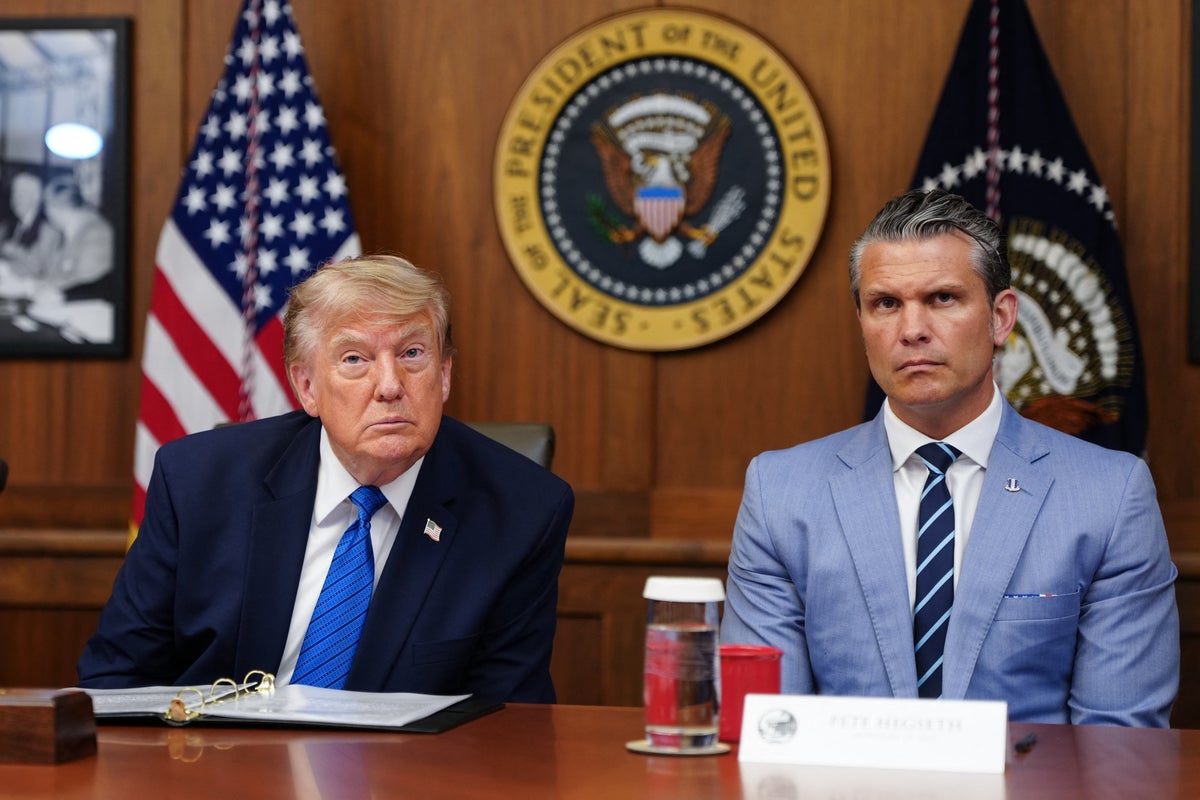
The crisp air of Camp David usually offers a sanctuary from the relentless velocity of Washington. Trees frame the horizon, heavy with the quiet dignity of a mountain retreat meant for contemplation and strategy. But on one particular weekend, the atmosphere inside the presidential cabin bore little resemblance to a peaceful escape. The friction was palpable. The stakes were absolute.
At the center of the tense exchange stood Donald Trump and Pete Hegseth.
Reports detailing the encounter reveal a stark confrontation over a quiet, creeping vulnerability that military planners whisper about behind closed doors: a dwindling stockpile of critical munitions. Specifically, the conversation turned toward Iran and the readiness of American defensive architecture. It is a terrifying equation. When you spend decades projecting power across oceans, you rely on the assumption that the magazines are full.
They are not always full.
Consider the mathematics of modern defense. Every interceptor fired into the night sky to neutralize an incoming drone or ballistic missile carries a staggering price tag and an even more irreplaceable manufacturing timeline. These are not items you pull off a shelf at a hardware store. They take years to forge, requiring rare earth minerals, precision engineering, and specialized assembly lines operating at peak efficiency.
When those lines slow down, the margin between deterrence and disaster shrinks to zero.
Trump understood this instinctively. His frustration at Camp David was rooted in a fundamental principle of statecraft: strength requires backing. You cannot posture as a global deterrent if your supply chain runs dry after the first wave of a conflict. Hegseth, stepping into the immense gravity of defense leadership, faced the sobering reality of what sitting inventories actually look like when matched against worst-case operational scenarios in the Middle East.
This was not a theoretical policy debate. It was an argument about survival.
Think about what happens when a nation overextends its technological reach. The public sees the sleek metal of a fighter jet on television or the impressive arc of an interceptor cutting through the dark. We cheer. We feel secure. We sleep soundly under the umbrella of a superpower security apparatus.
Yet, beneath that polished surface lies an industrial reality that feels increasingly fragile.
Manufacturing munitions at scale is an unglamorous business. It involves sprawling industrial parks in the Midwest, shift workers welding components in deafening noise, and supply chains stretching across fragile geopolitical fault lines. For years, defense contractors prioritized lean manufacturing models. Lean is efficient for a peacetime economy. Lean is profitable for quarterly earnings reports.
Lean is lethal in a protracted great-power competition.
When tensions flare with regional actors like Iran, the burn rate of high-end ordnance accelerates exponentially. A single night of aerial defense can consume inventory that took months to produce. If the replenishment rate cannot match the consumption rate, the strategic posture collapses. That was the core of the confrontation at the presidential retreat. It was a collision between political ambition and the hard, unyielding constraints of logistics.
Logistics unmake empires.
Alexander knew it. Rome learned it in the sands of North Africa. Modern superpowers discover it every time a ledger is opened and a deficit is revealed.
The exchange between Trump and his defense pick highlights a broader truth about the current geopolitical moment. The global order is fraying at the edges. Proxy conflicts in the Middle East are no longer localized skirmishes; they are stress tests for the entire Western defense apparatus. Every time an Iranian-backed militia launches a salvo of drones or missiles, America and its allies spend millions—sometimes billions—to swat them out of the air.
The arithmetic is brutal.
An inexpensive, low-tech drone built with commercial off-the-shelf parts forces the deployment of a multi-million-dollar precision interceptor. Do the math over a sustained campaign of weeks or months. The defender goes bankrupt first, not necessarily in dollars, but in inventory.
This is what kept advisors awake at night. This is why voices were raised in the rustic rooms of Camp David.
We often talk about foreign policy as a game of grand gestures, summit meetings, and sharp rhetoric. We watch the podiums. We analyze the body language of world leaders on our screens. But the real theater of power is invisible. It lives in inventory spreadsheets, warehouse audits, and factory floor throughput metrics.
When those numbers turn red, the grand gestures mean nothing.
The confrontation underscores an urgent pivot in how Washington views national security. The era of fighting asymmetric insurgencies with endless supplies of counter-insurgency gear is over. The horizon now demands preparation for high-intensity, peer-or-near-peer conflict where missiles fly fast and replacements arrive slow.
Fixing this gap requires more than shouting matches in the mountains. It requires a complete mobilization of domestic industrial capacity, a willingness to override bureaucratic inertia, and the political courage to tell defense contractors that production speed matters more than profit margins.
The mountains outside Camp David remain silent, indifferent to the political storms that pass through their midst. But the echoes of that conversation linger. They remind us that the distance between a superpower and a paper tiger is measured not in the reach of its weapons, but in the depth of its magazines.
And right now, those magazines are echoing with an empty sound.


