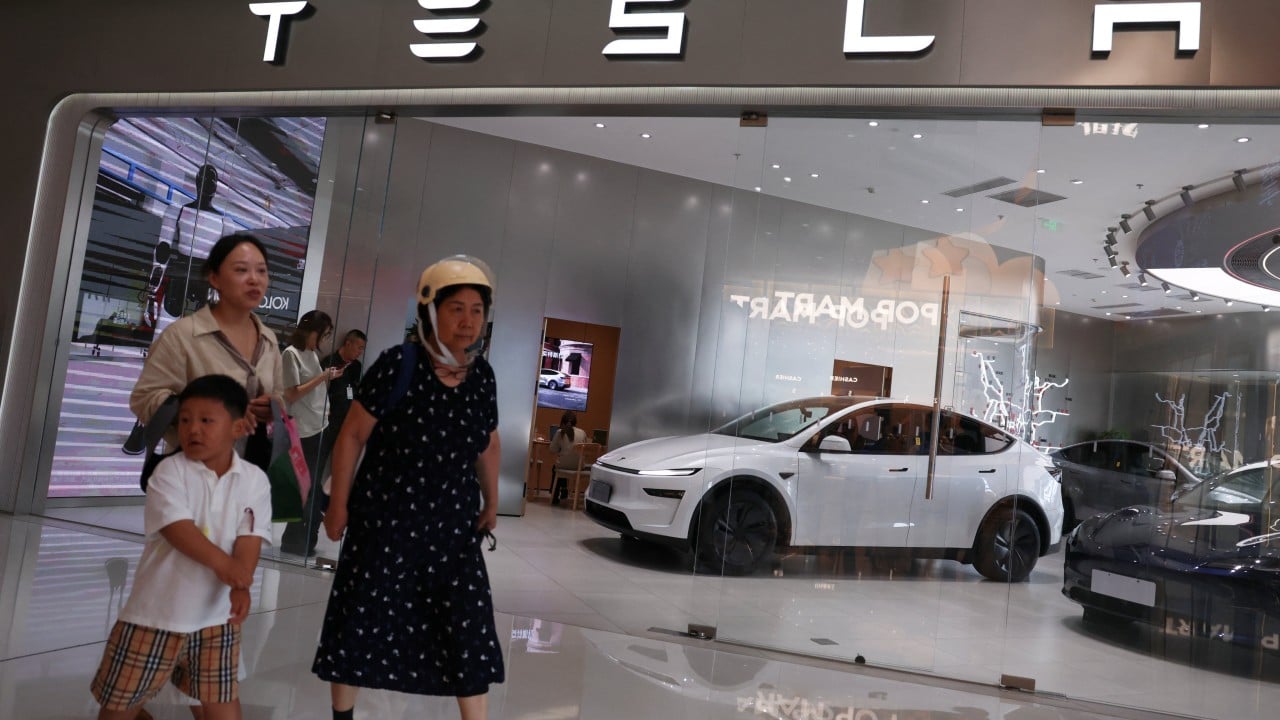
Conventional financial journalism loves a clean narrative. Writers sit in New York or London staring at geopolitical maps, convincing themselves that multinational corporations can simply pull up stakes, cut the cord, and retreat to domestic shores whenever diplomatic weather turns sour. They look at Gigafactory Shanghai, look at rising trade friction, and declare that decoupling is an inevitable, grueling inevitability.
They are fundamentally wrong.
The lazy consensus treats Tesla as an American car company that happened to build a massive factory abroad. That perspective misses the operational reality entirely. Tesla is not an American manufacturer with a Chinese outpost; it is a hyper-efficient manufacturing organism whose cardiovascular system is deeply embedded in the Yangtze River Delta. Trying to decouple that setup does not protect the company. It executes it.
The Manufacturing Illusion
Let us address the core misconception immediately. Pundits love to argue that because political pressure is mounting, corporate survival requires a retreat to domestic borders. This ignores how modern physical engineering actually scales.
I have watched hardware startups burn through tens of millions of dollars trying to replicate foreign supplier clusters domestically, assuming that throwing capital at a problem substitutes for an ecosystem. It does not. When Tesla built its Shanghai plant, it did not just drop concrete walls into an empty lot. It plugged into a dense matrix of over four hundred local suppliers who deliver components with a proximity and velocity that Western industrial bases abandoned decades ago.
More than ninety-five percent of the parts inside a China-built Model 3 or Model Y originate locally. More importantly, dozens of those exact same tier-one Chinese suppliers feed Tesla's global operations. This is not a dependency you can snip away with a corporate restructuring plan or a legal spin-off without bleeding out your cost structure.
The SpaceX Distraction
Recent corporate gossip suggested that separating the China division might be a necessary hurdle to clear regulatory paths for a potential merger with SpaceX, a primary defense contractor. The logic sounds neat in a boardroom briefing deck. Shield the classified space technology from foreign soil, wall off the software, and cleanly divide the balance sheets.
Imagine a scenario where a corporate surgeon takes a scalpel to this arrangement, slicing away the Chinese corporate entity to satisfy defense compliance officers in Washington. What is left on the operating table? You lose the manufacturing linchpin that accounts for more than half of the company's global vehicle deliveries. You lose the high-speed iteration engine that moves from drawing board to mass production in months rather than years.
Worse yet, you starve the corporate transition into artificial intelligence and robotics. Tesla is no longer just an automotive assembly shop. Management has repeatedly signaled that the mass-production discipline perfected in Shanghai is meant to anchor the scaling of humanoid hardware and autonomous systems. Cut off that factory, and you are not just selling cars; you are amputating the physical muscle required to build the future.
The Cost of Autarky
If you force a total separation, you trigger a brutal economic reality. Western manufacturing cannot magically absorb the output, nor can it match the cost efficiency. The working capital facilities, the local debt structures secured against Asian assets, and the localized supply chains are not easily translatable to Texas or Berlin without a catastrophic reset in vehicle pricing.
Competitors in domestic markets are not standing still waiting for Western boardrooms to untangle their geopolitical anxiety. While analysts draw imaginary lines on maps, local competitors are iterating at a blistering pace. Yielding the most efficient production ecosystem on the planet in the name of risk mitigation is like setting your house on fire to keep out the morning chill.
Stop asking how quickly a separation can happen. Start asking how long any modern hardware enterprise can survive once it voluntarily blinds its most productive eye.