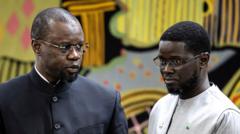
The partnership that upended West African politics is officially dead. Senegal's President Bassirou Diomaye Faye just sacked his Prime Minister, Ousmane Sonko, dissolving the entire government in one swift late-night television decree. To outside observers, it looks like a shocking betrayal.
It isn't.
If you've been watching Dakar closely, you knew this meltdown was coming. The alliance between Faye and Sonko was born in a prison cell, fueled by shared enemies, and destined to shatter under the weight of actual governance. You can't run a country when the prime minister acts like he's still leading an angry opposition movement from the streets, and you certainly can't do it while the treasury is completely empty.
The Myth of the Unbreakable Brotherhood
Let's clear up the biggest misconception floating around international news desks. The media loved framing Faye and Sonko as political soulmates. They were both former tax inspectors. They both got thrown in jail by the previous regime under Macky Sall. They got released a mere 10 days before the 2024 presidential election, swept into office on a massive wave of youth anger, and promised a socialist, pan-African utopia.
But there was always a glaring power imbalance. Sonko was the superstar. He was the firebrand orator who mobilized the youth, but a defamation conviction barred him from running for office. Faye was essentially his proxy—a quiet, low-profile lieutenant who stepped into the vacancy. When Faye won 54% of the vote, he became the boss on paper. Sonko remained the boss in the hearts of the Pastef party faithful.
That's a recipe for disaster in any executive branch. Rumors had been swirling for months about Faye growing tired of Sonko's "excessive personalization" of the government. Sonko treated the prime minister's office like the true seat of power, pushing highly controversial domestic agendas and picking fights abroad. The tension boiled over during a Tuesday parliamentary session when Sonko openly criticized Faye's leadership. Hours before his dismissal, Sonko stood in parliament and defiantly announced he wasn't a prime minister who would "blindly obey and acquiesce to everything."
Faye gave him exactly what he asked for. He took away the job.
A Ghost Economy and the IMF Trap
While the personality clash makes for great political theater, the real catalyst for this breakup is cold, hard cash. Senegal is broke.
Shortly after taking office, the new administration ran an audit on the nation's finances. What they found was a total horror show. The previous government had drastically misreported the national debt, hiding billions of dollars from public view. Suddenly, Senegal's debt skyrocketed to over $40 billion, representing a staggering 132% of its GDP.
The International Monetary Fund did what it always does when countries cook the books. It froze a vital $1.8 billion lending program.
This is where the ideological divide between the two men became a canyon. Sonko is a staunch, left-wing nationalist. He views the IMF as an instrument of Western financial tyranny. He publicly refused to negotiate a debt restructuring plan and doubled down on aggressive economic nationalism. In March, Sonko went on a crusade against foreign corporations, revoking 71 mining licenses and declaring a major BP gas contract for the Greater Tortue Ahmeyim project completely unfair. He honestly believed he could fix the budget by tearing up contracts and forcing multinational corporations to pay more.
Faye, despite his radical campaign rhetoric, has to face reality. He's the president, and he knows the state cannot function without international credit. While Sonko was busy fighting foreign capitalists, Finance Minister Cheikh Diba was quietly trying to patch things up with Washington. Just hours before Sonko was fired, Diba told parliament that Senegal planned to resume critical talks with the IMF on June 8, hoping to lock down a deal by the end of the month.
You can't negotiate a multi-billion-dollar bailout when your prime minister is actively sabotaging the talks on social media and blocking austerity measures. For instance, Diba begged the government to raise domestic fuel prices because the state subsidy bill is on track to blow past its budget by $2 billion. Sonko flatly refused. Faye realized that keeping Sonko meant financial default.
What Happens When the Street Fights the State
Sonko didn't just alienate international bankers; he started picking fights that threatened internal stability. He leaned heavily into divisive culture wars, championing harsh new anti-LGBTQ legislation that triggered a wave of domestic arrests and drew fierce international condemnation. He was playing to the most conservative elements of his base, oblivious to how it damaged the country's diplomatic standing.
Now that he's out of a job, the political landscape is highly volatile. Hundreds of young students already marched through Dakar chanting Sonko's name right after the announcement. Don't expect him to go quietly into the night. He still controls the Pastef party, which holds a massive majority in the National Assembly. He can effectively paralyze Faye's legislative agenda, block reforms, and stall the very IMF deal Faye is desperate to sign.
Sonko's immediate reaction on social media tells you everything about his mindset. "Tonight I will sleep with a light heart," he wrote, noting he was back at his private residence. He's comfortable in the opposition. He knows how to weaponize anger from the outside.
If you're watching Senegal's next steps, keep your eyes on the week of June 8. Faye needs to appoint a pragmatic, technocratic prime minister who can convince the IMF that Senegal is a safe bet. He also needs to brace for a furious backlash from the youth who feel their revolution was hijacked. The alliance that broke the old guard has fractured, and Senegal is about to find out if its young president can actually govern without the man who put him in power.