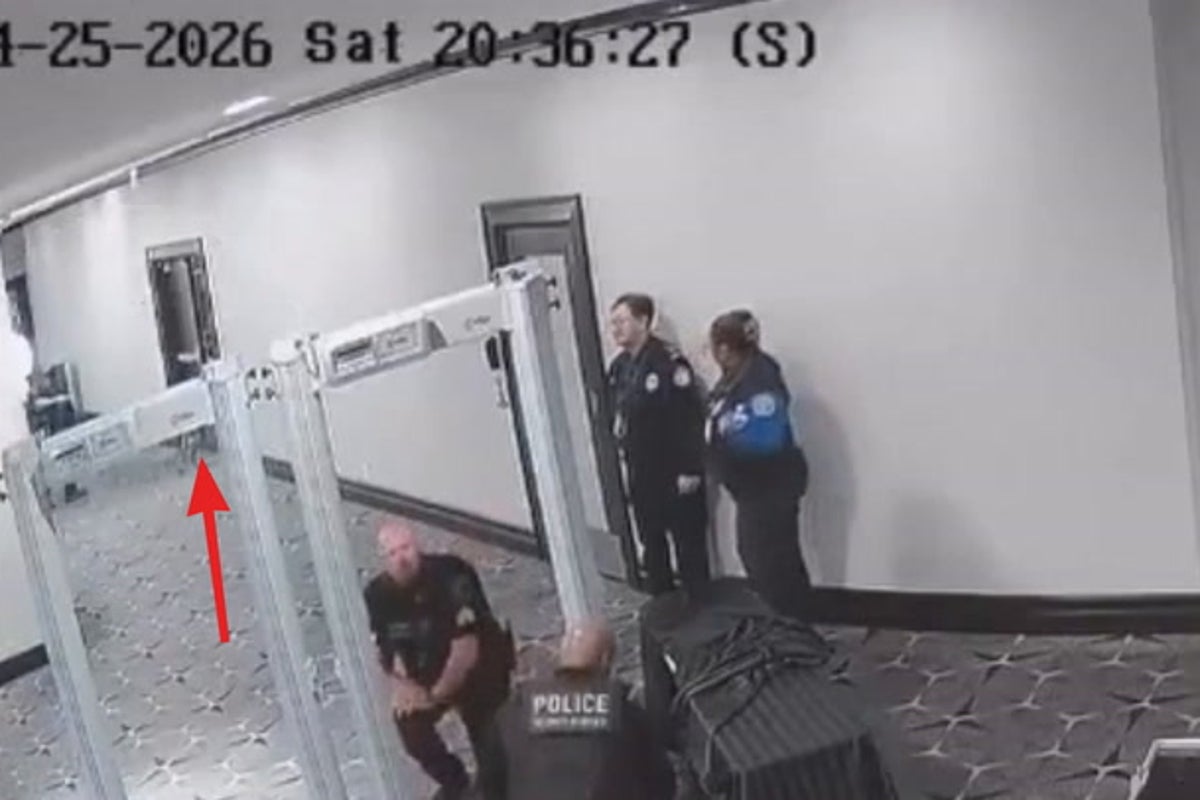
The breach at the White House Correspondents’ Dinner security perimeter functions as a case study in the breakdown of multi-layered surveillance and the failure of preemptive intervention protocols. While public reporting focuses on the visual of a "guard dog" following the suspect, a rigorous analysis must look beyond the optics to evaluate the systemic friction between detection, tracking, and the kinetic interception of a threat. The seconds preceding the charge at the security gate represent a critical window where the transition from passive monitoring to active neutralisation failed, exposing the limitations of human-animal-machine coordination in high-stakes environments.
The Architecture of Perimeter Defense
Securing an event of this magnitude involves three concentric circles of protection: the outer observation zone, the screening threshold, and the sterile interior. The incident occurred at the transition point between the outer observation zone and the screening threshold. In an optimal security model, a threat is identified and engaged in the observation zone to prevent a kinetic breach of the threshold.
The presence of a K9 unit trailing the suspect indicates that the detection phase had succeeded, yet the suppression phase lagged. This lag creates a Response Gap, defined as the duration between the identification of hostile intent and the physical deployment of force. When a suspect can maintain a closing velocity toward a gate despite being "shadowed," the security layer is effectively transparent.
The Kinematics of the Breach
The failure to intercept the suspect before he reached the gate can be deconstructed through the lens of human and animal reaction times versus the acceleration of a human sprinter.
- Velocity vs. Vector: A suspect moving toward a hard target at a high rate of speed (6–8 meters per second) requires an immediate lateral or rear-guard interception.
- K9 Operational Constraints: A guard dog on a leash is tethered to the reaction speed of its handler. If the handler is in a "tracking" posture rather than a "takedown" posture, the K9 becomes a passive sensor rather than a kinetic deterrent.
- The OODA Loop Breakdown: The Observe-Orient-Decide-Act loop was stuck in the "Orient" phase. Security personnel observed the suspect and oriented themselves to his presence, but the decision to engage was delayed until the suspect initiated his final charge.
The "shadowing" behavior observed is a symptom of a wait-and-see doctrine. In high-security environments, wait-and-see is a high-risk strategy because it cedes the initiative to the attacker. By the time the suspect "charged," he had already overcome the psychological barrier of the perimeter, leaving security with zero buffer time.
Sensory Overload and Signal Noise
The environment surrounding the White House Correspondents’ Dinner is characterized by extreme signal noise. This includes high-volume pedestrian traffic, flashing lights from media crews, multiple radio frequencies, and the presence of numerous high-profile targets.
This noise level increases the False Positive Threshold. Security teams are often trained to avoid aggressive takedowns of non-threatening individuals to prevent PR disasters or legal liability. However, this creates a vulnerability: a "Soft Start" approach. The suspect likely exploited this by moving in a manner that was suspicious enough to warrant tracking, but not overtly hostile enough to trigger immediate detention until it was too late to prevent the physical contact with the gate.
The Failure of K9 Integration
The utilization of K9 units in perimeter defense is frequently misunderstood as a purely physical deterrent. In reality, their primary value is sensory. A dog can detect hormonal shifts (cortisol and adrenaline spikes) associated with aggressive intent faster than a human can recognize facial micro-expressions.
The fact that the K9 followed the suspect suggests the animal had locked onto the target's specific signature. The breakdown occurred in the Communication Link between the K9’s detection and the handler’s execution. If the handler is restricted by ROE (Rules of Engagement) that require a verbal warning or a specific overt act of violence before a "bite" command or physical tackle is authorized, the advantage of the K9's speed is neutralized.
Structural Vulnerabilities at the Screening Gate
The gate itself represents a mechanical bottleneck. While designed to stop vehicles, pedestrian gates often rely on human guards to act as the primary latch. This incident highlights a reliance on Static Defense (the gate) over Dynamic Defense (interception before the gate).
The suspect’s ability to reach the gate indicates that the "Stand-off Distance"—the space between where a threat is identified and where the threat can do damage—was reduced to zero. In tactical terms, if a suspect reaches the gate, the perimeter has already been breached, regardless of whether they are eventually tackled. The goal of executive protection is to ensure that a threat never makes physical contact with the threshold.
Tactical Mitigation and Future Protocols
To prevent a recurrence of this specific failure, the doctrine of "shadowing" must be replaced with a Proactive Intercept Model. This requires a shift in how security assets are managed during high-level events:
- Unshackling the Sensor: K9 units should be deployed in a manner that allows for rapid transition from tracking to engagement. This may involve tiered leash lengths or specialized training that allows the dog to "block" a path without a full bite-work deployment.
- Automated Behavioral Analysis: Leveraging computer vision to monitor the outer zone can provide handlers with objective data on closing speeds and erratic movement patterns, reducing the cognitive load on the human guards and accelerating the "Decide" phase of the OODA loop.
- Dynamic Perimeters: Instead of a fixed gate being the only line of defense, security teams should implement "roving thresholds" where suspects are intercepted 50–100 feet before they reach any physical structure.
The incident at the Correspondents’ Dinner was not a failure of detection, but a failure of Intercept Velocity. The security apparatus saw the threat, tracked the threat, and then allowed the threat to dictate the timing and location of the conflict. In a high-stakes environment, the only acceptable outcome is for the security team to dominate the timeline.
Security coordinators must now recalibrate their engagement triggers. If a K9 unit is deployed to follow a specific individual, that individual should be considered a "Contained Threat" and stopped for questioning immediately, rather than being allowed to continue their trajectory toward a sensitive entrance. The cost of a false-positive stop is negligible compared to the cost of a physical breach of a high-security gate during a presidential-level event.