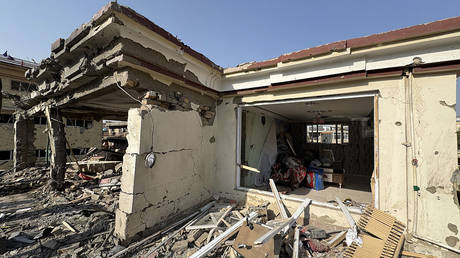
The targeted airstrikes launched by Pakistani fighter jets into the border provinces of Khost and Paktika inside Afghanistan, killing 13 civilians, represent a dangerous breaking point in regional security rather than a routine counter-terrorism operation. While Islamabad claimed the cross-border raids targeted safe havens of the Tehrik-i-Taliban Pakistan, known as the TTP, the immediate fallout reveals a deeper crisis of strategic miscalculation. By killing civilians, including women and children, Pakistan has not neutralized its internal security threat. Instead, it has backed the Taliban regime in Kabul into a corner, effectively torching whatever remained of a decades-long proxy relationship.
The strikes mark the end of an illusion. For years, Pakistan’s military establishment operated under the assumption that a Taliban-led Afghanistan would provide Islamabad with "strategic depth" against India and permanently secure its porous western border. That calculus has shattered completely. You might also find this related article insightful: The Quiet Architecture of a Handshake.
The Myth of Strategic Depth Shatters
To understand how a nuclear-armed state ended up dropping bombs on its impoverished, landlocked neighbor, one must examine the internal panic gripping Rawalpindi, the seat of Pakistan’s military power. Pakistan is currently experiencing a catastrophic surge in domestic terrorism. The TTP, an ideological twin and ally of the Afghan Taliban, has waged a revitalized campaign of suicide bombings, ambushes, and targeted assassinations against Pakistani security forces.
When Kabul fell to the Taliban, celebrations broke out among certain factions within Pakistan's political and intelligence apparatus. The victory was hailed as a triumph over Western influence and a guarantee that a friendly government in Kabul would finally reign in anti-Pakistan militants. As discussed in recent articles by NPR, the results are significant.
The opposite happened.
The Afghan Taliban did not dismantle the TTP. Instead, they provided them with greater operational freedom, emboldened by the departure of US forces and the abandonment of advanced military hardware. The TTP began using Afghan soil not just as a sanctuary, but as a sovereign shield from which to launch increasingly lethal cross-border raids into Pakistan's Khyber Pakhtunkhwa province.
Islamabad’s decision to launch conventional kinetic strikes into sovereign Afghan territory was an act of desperation. It was a public admission that diplomacy had failed, intelligence sharing was dead, and the Pakistani state could no longer contain the blowback of its historical foreign policy choices.
Collateral Damage and the Radicalization Pipeline
The numbers out of Khost and Paktika tell a story that the official press releases from Islamabad tried to obscure. Thirteen civilians are dead. In the brutal mathematics of asymmetric warfare, civilian casualties are never just statistical anomalies. They are compounding interest on future violence.
When a conventional military uses airpower against guerrilla forces embedded within tribal structures, the margin for error is razor-thin. The Pashtun borderlands are governed by Pashtunwali, an ancient tribal code where Badal—the absolute obligation to seek revenge for the killing of kin—reigns supreme. By hitting homes instead of hardened militant bunkers, the Pakistani military did not deter the TTP. It provided the group with an invaluable, emotionally charged recruitment narrative.
Consider the mechanics of local radicalization. A drone or jet drops a payload on a mud-walled compound. The state claims a high-value commander was neutralized. The local population digs out the bodies of children. The tribal elders, previously skeptical or fearful of the TTP's harsh religious extremism, suddenly find common ground with the militants against an external aggressor.
Pakistan has essentially outsourced its tactical targeting to flawed intelligence streams, producing strategic failures that will haunt its western border for a generation.
The Taliban Double Game
Kabul’s response to the strikes was swift, performative, and entirely predictable. The Afghan Ministry of Defense claimed its border forces targeted Pakistani military positions along the Durand Line with heavy weaponry. Firefights erupted at multiple border crossings, forcing thousands of civilians on both sides to flee their homes.
Yet, behind the fiery rhetoric from Taliban spokesman Zabihullah Mujahid lies a cold, pragmatic calculus. The Afghan Taliban cannot and will not hand over the TTP to Pakistan. Doing so would violate their own ideological foundations and cause massive internal rifts within their ranks.
The Ideological Bond
- The Bay'ah (Oath of Allegiance): The TTP maintains a formal oath of loyalty to the supreme leader of the Afghan Taliban, Hibatullah Akhundzada. Breaking this bond would undermine the Afghan Taliban’s claims to Islamic legitimacy.
- Shared Trenches: For twenty years, TTP fighters bled alongside the Afghan Taliban against US and NATO forces. The rank-and-file fighters in Kandahar and Kabul view the TTP as brothers-in-arms, not bargaining chips for foreign policy convenience.
The Internal Fracture Risk
If the Kabul regime attempts to forcefully crack down on the TTP to appease Pakistan, they risk driving thousands of hardened TTP fighters into the arms of Islamic State Khorasan Province, or ISKP. ISKP remains the most potent domestic threat to the Taliban’s rule in Afghanistan. The Taliban leadership judges that it is far better to tolerate the TTP's anti-Pakistan activities than to trigger a civil war within the regional jihadi movement.
Economic Chokepoints as Weapons of War
The conflict is not contained to kinetic exchanges. It is destroying the fragile economic ecosystem of the border region. Following the airstrikes, Pakistan repeatedly shut down key trade crossings, including Torkham and Chaman. These gates are the economic lifeblood for millions of traders, truck drivers, and farmers on both sides of the frontier.
| Border Crossing | Primary Economic Activity | Strategic Impact of Closure |
|---|---|---|
| Torkham | Main transit route for goods between Kabul and Peshawar; vital for Afghan fruit exports. | Strands thousands of trucks; causes millions in perishable cargo losses; drives up food prices in Kabul. |
| Chaman | Connects Kandahar to Balochistan; heavy foot traffic for divided tribes and daily laborers. | Sparks mass protests among local tribes; cuts off access to medical facilities in Pakistan for Afghans. |
By utilizing border closures as a punitive measure, Pakistan hopes to pressure the Taliban through economic strangulation. Afghanistan’s economy is already on life support following the freezing of central bank assets and the withdrawal of international aid.
This leverage is a double-edged sword. Shutting down trade also damages Pakistan’s own economy, particularly its export sector, which desperately needs access to Central Asian markets via Afghanistan. Furthermore, it alienates the border populations within Pakistan, who view Islamabad’s heavy-handed tactics as a direct assault on their livelihoods.
The Ghost of the Durand Line
At the heart of this geopolitical wildfire lies a line drawn on a map in 1893. Sir Mortimer Durand drew a 1,640-mile border between British India and the Emirate of Afghanistan, deliberately cutting through the Pashtun tribal heartland. No Afghan government—whether it was the monarchy, the communists, the Western-backed republics, or the Taliban—has ever formally recognized the Durand Line as an international border.
Pakistan inherited this border in 1947 and has spent decades trying to legitimize it. Islamabad recently completed a massive, multi-billion-dollar project to fence virtually the entire length of the rugged frontier. The Afghan Taliban, much like their predecessors, have physically torn down sections of the fence, asserting that the border does not exist and that Pashtuns on both sides must be allowed to move freely.
The recent airstrikes are a violent reassertion of a border that one side refuses to acknowledge. When Pakistan bombs locations inside Paktika, it is treating the area as sovereign foreign territory harboring enemies. When the Taliban fires back, they are defending what they perceive as an occupied frontline. This fundamental disagreement ensures that any tactical incident can rapidly escalate into a regional crisis.
Washington and Beijing Watch from the Sidelines
The international community's response to the deteriorating situation along the Afghan-Pakistani border is defined by cautious paralysis. The United States, having completed its chaotic withdrawal from Afghanistan, has little appetite for direct re-engagement. While Washington maintains a keen interest in over-the-horizon counter-terrorism capabilities, it views the current tension primarily through the lens of regional stability and nuclear security.
Beijing, on the other hand, faces a direct threat to its sprawling economic ambitions. Pakistan is the crown jewel of China’s Belt and Road Initiative, home to the multi-billion-dollar China-Pakistan Economic Corridor, known as CPEC. TTP militants, alongside Baloch separatists, have repeatedly targeted Chinese engineers and projects inside Pakistan, including the strategic port of Gwadar.
China has consistently pressured both Islamabad and Kabul to resolve their differences through dialogue. Beijing wants a stable environment to secure its investments and eventually exploit Afghanistan’s vast untapped mineral wealth. Yet, the limits of Chinese diplomatic mediation are becoming glaringly obvious. No amount of infrastructure investment or diplomatic pressure can easily smooth over deep-seated ideological ties and decades of mutual distrust.
The Dangerous Path Forward
Pakistan’s current military strategy against the TTP and its Afghan patrons is unsustainable. Air raids into Afghanistan cannot fix a structural failure of domestic intelligence and border security. Every bomb dropped on an Afghan village weakens the moderate voices within the Taliban administration who argue for pragmatic engagement with the international community. It strengthens the hardline factions centered in Kandahar, who advocate for total ideological purity and defiance of external powers.
The military establishment in Islamabad must face a harsh reality. The policy of distinguishing between "good Taliban" (those who fight foreign adversaries) and "bad Taliban" (those who fight the Pakistani state) has collapsed entirely. The Taliban movement is an interconnected network; it cannot be partitioned to suit Pakistan’s security preferences.
The cycle of violence along the Durand Line will not be broken by kinetic operations alone. Pakistan must secure its own internal territory by addressing the socio-economic grievances in its border regions, dismantling domestic militant networks, and abandoning the outdated doctrine of seeking strategic depth through foreign proxies. Until Islamabad realizes that military force cannot substitute for a coherent, realistic regional foreign policy, the borderlands will continue to burn, and civilians will continue to pay the ultimate price for state miscalculation.
The cross-border strikes did not project strength. They broadcasted a profound, volatile vulnerability.