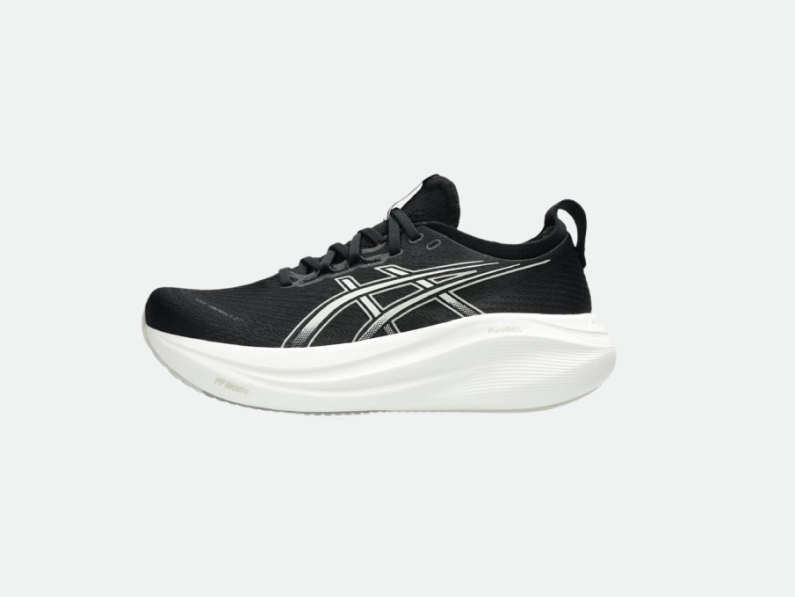
The alarm sounds at 5:15 AM. It does not entice; it demands. Outside, the world is a monochromatic wash of slate gray and damp asphalt. Your breath blooms in the crisp air, a brief, fragile cloud vanishing against the streetlamps. You stand on the porch, shifting your weight, and there it is—the dull, familiar ache in the lower lower-left meniscus, or perhaps the tight, angry binding of the plantar fascia along the arch of your foot.
Every runner knows this negotiation. It is the silent calculus performed on the threshold of a morning run. We like to think running is a spiritual pursuit, a clean communion of mind and muscle. It isn't. It is an engineering problem. Specifically, it is a collision problem.
With every single stride, your body absorbs roughly three times its total mass in impact force. If you weigh 150 pounds, that is nearly a quarter of a ton of violence traveling up your tibia, through your knee, and into your lower spine. Every. Single. Step. Over a modest five-mile loop, those numbers compound into millions of pounds of cumulative stress.
In this brutal equation, the thin slab of foam strapped to the bottom of your foot is the only defense attorney you have. Yet, most of us choose that defender based on a striking colorway, a promotional discount, or a vague notion of what "looks fast."
We have been looking at running shoes completely backward. We treat them like fashion statements or status symbols, when we should be treating them like precision medical devices.
The Chemistry of the Pavement
To understand how we lost our way, we have to look at Sarah. She is a hypothetical runner, but she represents thousands of people who lace up their shoes every week. Sarah decided to train for a local half-marathon. She walked into a big-box sporting goods store, picked a pair of neon pink trainers because they felt plush on the carpeted floor, and hit the road.
Three weeks later, Sarah was sitting on her couch with an ice pack strapped to her shin, wondering why her body had failed her.
Her body hadn't failed. Her foam had.
The modern running shoe is a marvel of polymer chemistry, but it is not a monolithic object. The industry categorizes these tools into three distinct buckets, and choosing the wrong one is a recipe for orthopedic disaster.
Consider the daily trainer. This is the workhorse. It is designed to swallow the mundane, grueling miles of mid-week training. The magic lies in the midsole—usually composed of Ethylene-Vinyl Acetate (EVA) or a proprietary Polyurethane blend. Let us look closer at how this material handles that quarter-ton of violence:
When Sarah stepped onto the pavement, the tiny gas-filled cells within her cheap EVA foam flattened completely, failing to disperse the energy. Instead of bouncing back, the shoe bottomed out. The concrete won.
For everyday mileage where joint preservation is the ultimate goal, shoes like the Nike Pegasus 41 or the Brooks Ghost 16 are built to prevent this specific failure. They utilize dense, nitrogen-infused foams that act like tiny, resilient mattresses, absorbing the blow and returning just enough kinetic energy to push you into the next stride without destabilizing your ankle. They are not flashy. They are blue-collar tools.
The Myth of the Neutral Stride
But cushioning is only half the battle. The deeper, more insidious misunderstanding revolves around how your foot actually meets the earth.
When you run, your foot naturally rolls inward to absorb shock. This is pronation. It is a beautiful, evolutionary mechanism designed to keep our ancestors from shattering their bones while chasing down prey on the savanna. But modern concrete is unforgiving, and many human bodies overcompensate.
If your ankle rolls too far inward, it is overpronation. If it remains rigid and fails to roll at all, it is underpronation, or supination.
Imagine a building constructed on a shifting foundation. If the basement tilts two degrees to the left, the roof doesn't collapse immediately. Instead, the drywall upstairs begins to crack. The doors stop fitting into their frames. In the human body, overpronation is that tilting basement. The crack in the drywall happens in your hip, or the small of your back.
This is where stability shoes enter the narrative. For years, stability shoes were clunky, heavy contraptions that felt like running in ski boots. They featured hard plastic posts jammed into the medial arch to physically block the foot from rolling. It was a ham-fisted solution to a delicate problem.
Today, the engineering is subtle. Shoes like the Asics Gel-Kayano 31 or the Hoka Gaviota 5 do not force your foot into submission. Instead, they use widened platforms, asymmetric geometries, and J-Frame technologies—firmer foam wrapping around the inside of the heel—to gently guide the foot into a neutral path. They do not fight your stride; they cooperate with it.
If you have flat feet or notice the inner edges of your shoe soles wearing down prematurely, you are likely an overpronator. Ignoring this isn't discipline. It is stubbornness.
The Cost of Velocity
Then there is the allure of pure speed.
Walk into any local road race, and you will see weekend warriors lined up at the start line wearing bright, aggressively curved shoes that look like they belong in a sci-fi film. These are super shoes. They are the Ferraris of the running world, epitomized by models like the Nike Vaporfly 3 or the Saucony Endorphin Pro 4.
They feature thick stacks of ultra-responsive Pebax foam and rigid carbon-fiber plates curved like a spoon. The mechanics are undeniable. The carbon plate acts as a lever, stabilizing the squishy, unstable foam and snapping your foot forward at toe-off. Studies show these shoes can improve running economy by up to four percent.
Four percent is the difference between a personal record and heartbreak. It is the difference between qualifying for Boston or going home empty-handed.
But there is a hidden cost to this velocity, one that the marketing campaigns rarely mention. Super shoes are inherently unstable. They are designed for one thing: forward momentum at high speeds. When you slow down—say, to a recovery pace or an easy jog—the carbon plate stops working as an efficient lever and begins working against you. The rigid structure forces your calf muscles and Achilles tendons to bear a different load than they are accustomed to.
Furthermore, these shoes are fragile. The hyper-responsive foam degrades rapidly. A standard daily trainer can easily survive 400 miles of abuse. A carbon-plated racer often loses its magic after 150 miles. At upwards of $250 a pair, that works out to a steep tax per mile.
Using a super shoe for your casual evening jog is like driving a Formula 1 car to the grocery store. It is loud, uncomfortable, wildly expensive, and entirely counterproductive.
The Budget Dichotomy
We must talk about money, because the running industry has developed an expensive habit. It is easy to recommend a $160 daily trainer or a $260 marathon shoe. But what about the person who just wants to clear their head after a grueling shift at the hospital without draining their savings account?
There is a dangerous misconception that cheap running shoes are inherently dangerous. They aren't. You do not need to spend two days' wages to protect your knees.
The secret lies in finding the sweet spot of previous-generation technology. When a company releases a new iteration of a shoe, the changes are usually incremental—a slightly softer upper mesh, a redesigned lace eyelet. Yet, the previous version instantly plummets in price.
However, if you are buying current-generation models, options like the Brooks Revel 6 or the Asics Gel-Excite 10 offer exceptional value. They do not feature exotic nitrogen-infused foams or carbon plates developed in wind tunnels. What they do offer is honest, durable cushioning and a predictable ride. They protect your joints without pretending to change your life.
The budget runner's real enemy isn't the price tag; it's the odometer. A $70 shoe will protect you just as well as a $140 shoe for the first 200 miles. But it may break down faster. You are paying for longevity, not just safety.
The Fitting Room Confession
Go to a specialized running store. Do not buy your shoes online based on a review or a color scheme.
When you walk into a proper shop, an experienced clerk will watch you walk barefoot. They will analyze the way your heel strikes the floor, the height of your arches, and the splay of your toes.
When trying on a shoe, ignore the number on the box. Your running shoe size is almost never your dress shoe size. When your foot strikes the ground under the load of running, it expands. Your toes slide forward. If your toes are pressing against the front of the shoe while standing in the store, those toes will be bruised and bloody after six miles on the road. You need a thumbnail’s width of space between your longest toe and the end of the shoe.
Listen to the quiet signals your body sends. If a shoe feels like it is fighting the architecture of your foot, it is. No amount of breaking it in will fix a fundamental geometric mismatch between your foot shape and the shoe's last.
The Open Road
Tomorrow morning, the alarm will sound again. The slate-gray world will be waiting.
But when you sit on the edge of the bed and pull on a pair of shoes that truly match the unique, messy reality of your biomechanics, something shifts. The dread recedes.
You step off the porch and drop your weight into that first stride. The foam compresses, holding the line between your skeleton and the unyielding earth. The energy returns. You are not fighting the pavement anymore. You are gliding over it.

