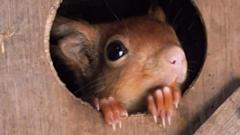
The headlines are always identical. They read like a copy-and-paste job from a well-funded PR machine. "First red squirrel kits born at sanctuary." Cue the soft-focus photography of blind, pink, thumbnail-sized mammals. Cue the quotes from smiling conservationists talking about a "monumental milestone" for biodiversity.
It is a heartwarming narrative. It is also an expensive, sentimental distraction from the brutal reality of ecological management.
We are addicted to the optics of rescue. We fall over ourselves to celebrate the birth of a few rodents in a controlled, idealized environment while ignoring the macroeconomic and biological forces that made them endangered in the first place. Captive breeding programs for red squirrels are the conservation equivalent of rearranging deckchairs on the Titanic. They look busy. They make the donors feel good. But they do absolutely nothing to stop the iceberg.
If we want to actually save Sciurus vulgaris, we need to stop treating conservation like an animal shelter and start treating it like a war zone.
The Myth of the Controlled Haven
The fundamental flaw of the sanctuary model lies in a total misunderstanding of habitat dynamics. Sanctuaries operate on the premise that if you build a high-enough fence and eliminate immediate threats, you can create a self-sustaining population that will eventually replenish the wild.
This is a fantasy.
When you breed animals in a sterile, managed environment, you are not preparing them for the wild. You are preparing them for a life of dependency. Wild red squirrels do not fail to breed because they lack romance; they fail to breed because their habitat is fragmented, degraded, and overrun by an aggressive competitor.
Putting a pair of squirrels in an enclosure with premium feed and veterinary care does not solve the structural issues of the British countryside. It bypasses them.
Worse, it creates a genetic bottleneck. In my decades tracking ecological projects across the UK, I have watched well-meaning organizations spend six-figure sums to maintain captive populations, only to find that successive generations lose the sharp edge of survival instincts. They become less wary of predators. Their foraging efficiency drops. You are not breeding the resilient, adaptable red squirrels of the ancient Caledonian forest. You are breeding expensive pets.
The Grey Elephant in the Room
Let us look at the data that the feel-good press releases conveniently omit. The decline of the red squirrel is not a mystery. It is a direct mathematical consequence of the introduction of the Eastern grey squirrel (Sciurus carolinensis) in the 19th century.
Grey squirrels outcompete reds on every measurable metric:
| Metric | Red Squirrel (Sciurus vulgaris) | Grey Squirrel (Sciurus carolinensis) |
|---|---|---|
| Average Weight | 250–350g | 400–600g |
| Dietary Efficiency | Struggles with green acorns (tannins) | Easily digests green acorns; strips resources early |
| Population Density | Low (requires large territories) | High (can survive in fragmented urban spaces) |
| Disease Status | Highly susceptible to Squirrelpox virus | Immune carrier of Squirrelpox virus |
The Squirrelpox virus is the real killer. When a grey squirrel enters a red squirrel territory, it carries a pathogen that is largely harmless to itself but fatal to the native species within weeks.
Now, apply basic logic to the sanctuary model. You breed twenty kits in a enclosed facility. You celebrate. You release them into a nearby woodland. If that woodland still contains grey squirrels, or is within traveling distance of a grey squirrel population, those twenty kits are not the vanguard of a species rebirth. They are virus fodder.
Releasing captive-bred red squirrels into an unmanaged landscape is not conservation. It is animal cruelty with a press release attached.
The Financial Distortion of Sentimentality
Public attention is a zero-sum game, and so is funding. Every pound sterling funneled into building bespoke enclosures, hiring captive-breeding specialists, and running marketing campaigns for newborn kits is a pound stripped away from large-scale landscape management.
I have watched local trusts burn through entire annual budgets on a single breeding facility that yields fewer than a dozen surviving individuals per year. Meanwhile, the surrounding forestry lacks the funds to carry out the aggressive, unglamorous habitat restoration required to give the species a permanent home.
Why does this happen? Because landscape management is ugly.
True conservation requires the systematic, large-scale culling of grey squirrels. It requires the targeted planting of specific conifer species (like Scots pine and Norway spruce) that give reds a competitive advantage over greys, who prefer large-seeded broadleaves like oak. It requires managing large swathes of land with chainsaws and traps, not clipboards and veterinary incubators.
But try asking a corporate sponsor to fund a massive grey squirrel trapping program. Try getting the public excited about culling. It is a marketing nightmare. A picture of a tiny, newborn kit, however, is a fundraising goldmine. We are letting public relations dictate ecological strategy, and the native wildlife is paying the price.
Dismantling the Frequently Asked Questions
People looking at this crisis often ask the wrong questions because they have been fed a diet of sanitized nature documentaries. Let us answer them honestly.
Can red and grey squirrels coexist if there is enough food?
No. This is the most dangerous piece of misinformation circulating in amateur wildlife circles. Even without the Squirrelpox virus, grey squirrels are vastly more efficient at foraging. They digest acorns before they are ripe, effectively starving out red squirrels before winter even begins. Coexistence is a biological impossibility in the current British ecosystem. One species inevitably replaces the other.
Will a vaccine for Squirrelpox save the red squirrel?
A vaccine is a tool, not a silver bullet. While research into an oral vaccine has been ongoing for years, the logistics of distributing it across millions of wild animals are staggering. Even if a vaccine becomes viable, it does not change the fact that grey squirrels are physically larger, more aggressive, and better suited to fragmented, broadleaf woodlands. Eliminating the disease does not eliminate the competition for food and space.
Should we stop all captive breeding immediately?
Not all, but 90% of it. Captive breeding has a legitimate role only as an absolute emergency measure—a genetic ark when a specific, isolated sub-population is on the brink of immediate extinction. It should never be used as a routine population-boosting measure. If the habitat is not ready, the animals should not be bred.
Shift the Strategy to Fortress Conservation
If we are serious about preventing the extinction of the red squirrel on the mainland, we must abandon the sanctuary mentality and adopt a strategy of "Fortress Conservation."
This means accepting that we cannot save the red squirrel everywhere simultaneously. We must draw lines on the map. We need to identify large, defensible geographic areas—such as Kielder Forest in Northumberland or specific highlands in Scotland—and turn them into absolute exclusion zones.
Imagine a scenario where we stop building breeding cages and instead build massive, continuous buffer zones around these strongholds. Within these buffers, grey squirrel eradication must be absolute and continuous. The focus must shift from breeding individuals to defending territory.
When you protect the territory and optimize the habitat, the red squirrels do not need our help to breed. They have been doing it successfully for thousands of years without human intervention. They are remarkably prolific when they are not being starved out or poisoned by an invasive species.
We must stop treating our native wildlife as fragile victims that need to be sheltered from the world. They are resilient organisms trapped in a broken system. Fix the system. Clear the competitors. Manage the forests.
Stop celebrating the birth of kits in cages. A squirrel born in a box is a symbol of our failure to manage the wild. Turn off the incubators, pick up the traps, and do the hard, unpopular work required to give these animals their forests back.