The air inside the laboratory of the Chinese Academy of Sciences’ Institute of Physics in Beijing smells of absolutely nothing. That is by design. For a decade, Lu Yaxiang has lived in these dry-room cells, spaces where the slightest hint of humidity can ruin a decade of math. If moisture touches the lithium cells we rely on to power our lives, the result is fire.
But Lu has spent her thirties ignoring lithium entirely. She is looking for salt. Recently making waves recently: Your Panic Over the Starship Pad Abort Proves You Know Nothing About Rockets.
To understand why a brilliant young scientist would spend her life's prime chasing sodium—the primary element in common table salt—you have to understand the quiet panic of the global battery supply chain. Lithium is scarce, concentrated in geopolitically volatile pockets of the South American Andes, and increasingly expensive. Sodium is everywhere. It is in our oceans, our salt flats, our very sweat.
The problem has always been size. On an atomic scale, a sodium ion is a clumsy giant compared to lithium. Imagine trying to force a softball into a slot designed for a tennis ball. Every time a sodium battery charges, those giant ions force their way into the anode, causing the material to swell, crack, and degrade. For decades, the scientific consensus was simple: commercially viable sodium-ion batteries were physically impossible. Additional details regarding the matter are explored by The Verge.
Lu Yaxiang did not accept the consensus.
Through thousands of iterations, her team engineered molecular "cages" capable of housing these bloated ions without collapsing. Her recent breakthrough has pushed sodium-ion energy density and lifespan to the threshold of mass production. It is a quiet, bloodless revolution. If she succeeds on the factory floor, the geopolitical chokehold on battery metals evaporates.
But human beings do not live in dry rooms, and they rarely care about molecular engineering until it changes the price of their electric car. They care about drama. They care about injustice. They care about the World Cup.
While Lu Yaxiang was quietly rewriting the laws of electrochemistry, millions of people were screaming at their screens.
Consider what happens next when the cold rationality of science meets the raw, unfiltered fury of six million football fans.
On an unofficial website titled "Argentina Out," a digital petition is ticking upward at a rate that defies comprehension. As of this week, more than six million people—a number now racing past ten million—have signed their names to a singular, desperate demand: kick Argentina out of the World Cup.
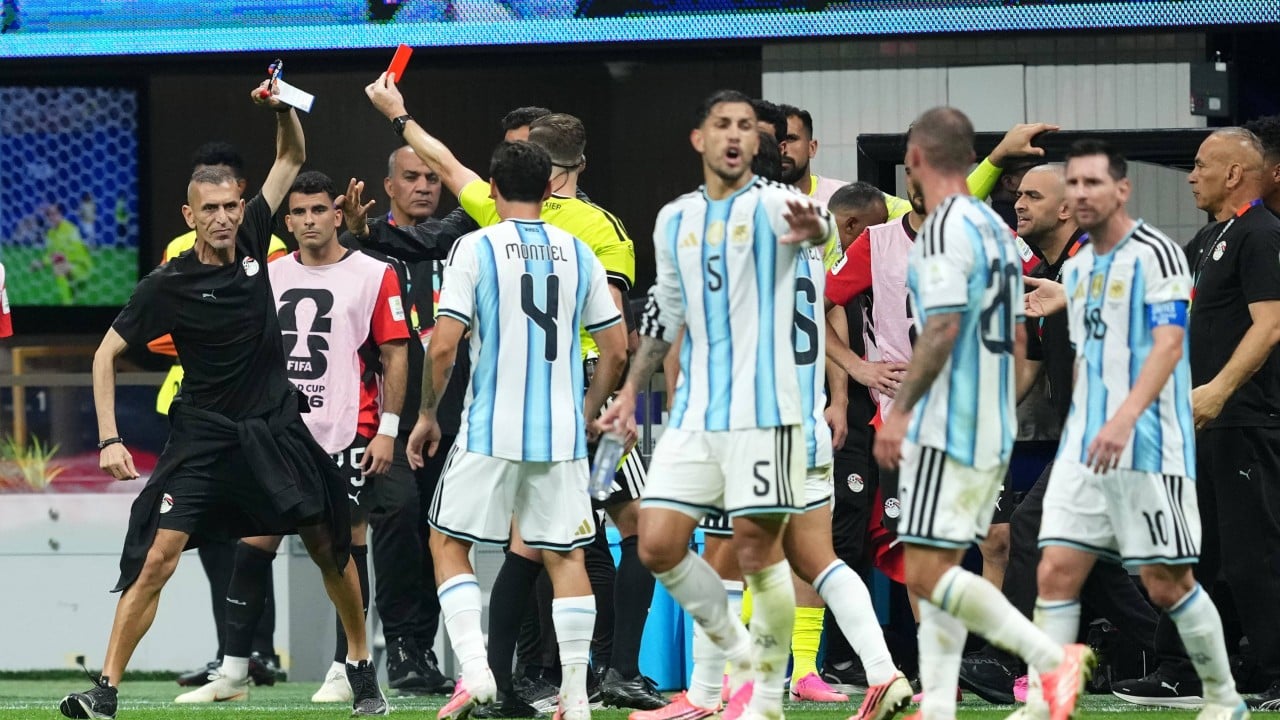
The spark for this digital wildfire occurred in the 58th minute of a round-of-16 clash between Argentina and Egypt. Egyptian forward Mostafa Zico found the back of the net, a beautiful, cathartic equalizer. Then, the whistle blew. A controversial foul was called in the buildup. The goal was wiped away. Later, Mohamed Salah went down in the box under a heavy challenge. No penalty.
Egypt’s manager, Hossam Hassan, did not hold back. "This match was clearly rigged," he muttered to reporters, his voice trembling with the quiet fury of a man who felt the system had decided the outcome before his players ever laced their boots. "If they want Argentina to win that badly, why invite other countries?"
We live in an era of absolute surveillance. Every angle of the pitch is tracked by high-definition cameras; every play is scrutinized by Video Assistant Referees (VAR) in isolated booths. We were promised that technology would bring objective truth to the beautiful game. Instead, it has only codified our suspicion.
Argentina’s manager, Lionel Scaloni, shrugged off the outrage with the weary patience of someone who has heard it all before. "With VAR, it is almost impossible to favor a team," he noted.
But logic has no currency in the currency of footballing grief. The petition is not really about the rules of the game. It is a manifestation of a deeper, more human anxiety: the fear that the game is rigged, that the giants will always win, and that the technology designed to save us is just another tool to keep us in our place.
It is easy to look at these two stories—the quiet breakthrough in a Beijing lab and the loud fury of millions of football fans—and see them as completely separate universes.
But they are bound by the same invisible thread.
Both are stories about the search for equity in a world of concentrated power. Lithium is a monopoly of geography; the footballing elite is a monopoly of legacy. In both arenas, we find ourselves looking for a wildcard—a common salt to level the playing field, or a digital petition to demand that the giants play by the same rules as the rest of us.
We build machines to find the truth, whether they are electron microscopes or VAR cameras. Yet, the real struggle remains entirely, stubbornly human.