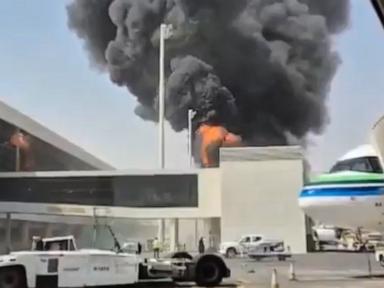
Airports are supposed to be fortresses. When a missile strikes a passenger terminal, that illusion shatters instantly.
The recent attack at Riyadh airport left multiple people wounded and turned international aviation security upside down. If you've flown recently, you know the routine. You take off your shoes, empty your pockets, and walk through a scanner. We built these systems to stop box cutters and hidden explosives. We didn't build them to intercept ballistic threats or advanced airborne projectiles targeting civilian infrastructure. If you found value in this piece, you might want to read: this related article.
That reality check is hitting aviation authorities hard right now.
The Vulnerability of Glass and Steel
Modern terminals are architectural masterpieces. They feature massive glass facades, open-air atriums, and sprawling check-in counters designed to process thousands of travelers efficiently. They aren't bunkers. For another perspective on this development, see the latest update from TIME.
When an explosive projectile breaches a facility like the Riyadh passenger terminal, the structural damage tells only half the story. The psychological impact travels faster than the shockwave. Travelers realize that civilian hubs sit squarely in the crosshairs of regional conflicts.
Security experts have warned about perimeter vulnerabilities for years. Most airport defenses focus inward. Metal detectors and baggage scans protect the planes from the inside out. But outer defense rings designed to detect airborne projectiles miles away? Those belong to military installations, not commercial hubs.
When a missile bypasses those defenses and hits a populated terminal, it exposes a massive gray zone in global security. Commercial aviation meets military geography in the worst possible way.
What Happens When the Skies Close
Chaos follows instantly. Flight cancellations ripple across continents within minutes. Airlines scramble to reroute aircraft, ground crews manage thousands of stranded passengers, and insurance premiums for Middle Eastern air routes skyrocket.
You can't just keep flying business as usual when a terminal becomes an active blast zone.
The operational fallout looks like this:
- Immediate airspace closures over the affected sector.
- Emergency diversions forcing long-haul flights to refuel at alternative airports.
- Weeks of heightened threat levels across neighboring regional aviation hubs.
Passengers bear the brunt of this disruption. Missed connections, lost luggage, and the sheer anxiety of navigating a crisis zone test the limits of modern travel resilience. Airlines hate uncertainty more than anything else. An attack on a primary hub like Riyadh forces carriers to re-evaluate risk matrices that haven't shifted this dramatically since past geopolitical crises.
Rethinking Terminal Defense
Governments and airport operators now face an expensive, complicated overhaul. You cannot turn a commercial airport into an underground bunker without destroying the very nature of international travel. People need to move freely. They need natural light. They need access to ground transportation.
Yet, ignoring the threat is no longer an option.
Expect to see rapid investments in localized anti-projectile technology around major international hubs in volatile regions. We're talking about point-defense systems integrated directly with national defense networks. Airports won't just rely on local police and standard metal detectors anymore. They will need active airspace monitoring right up to the tarmac.
Passengers also need to adapt. Travel advisories will become far more dynamic. Real-time risk assessments will dictate whether you book that layover or find an alternative route.
The strike in Riyadh serves as a stark warning. The boundaries separating civilian transit from geopolitical conflict zones have dissolved. Fixing this problem requires massive structural shifts in how we protect the places where the world meets.
Check your flight paths, stay aware of regional updates, and don't assume commercial airspace remains safe just because the departure board says on time.


