Water does not rush here; it drags. The current of the Congo River carries a heavy, terracotta weight, sweeping past muddy banks and thick walls of emerald vegetation that swallow the horizon. On a vessel tethered near the shoreline, time had fractured.
Silence can be louder than an engine.
For days, the people on board had lived inside that silence. They were names on a manifest, bodies confined to a floating perimeter while an invisible enemy hovered at the edges of perception. Every breath felt measured. Every glance toward the riverbank carried the heavy question of what waited in the villages downstream, and what might be hiding silently among the passengers themselves.
Then came the footsteps on the deck.
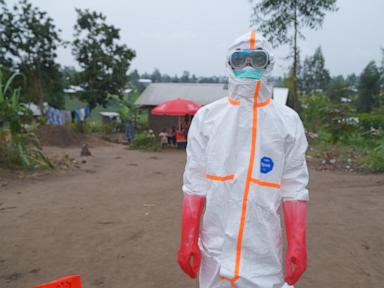
Health authorities in the Democratic Republic of Congo did not arrive with fanfare. They arrived with clipboards, protective gear, and the grueling, meticulous discipline required to stare down one of the most feared pathogens on Earth. They tested. They checked temperatures. They traced symptoms backward through days of humid heat and cramped quarters.
And then, the verdict dropped.
Negative.
No Ebola cases found.
To understand the magnitude of that simple sentence, you have to understand the geography of fear. The Congo River is not merely a body of water; it is a circulatory system for Central Africa, moving commerce, families, and news across vast, unforgiving distances. When a rumor of an outbreak touches a vessel on this artery, panic travels faster than the current.
Imagine standing on that deck. The air is thick enough to chew. Your shirt clings to your back. You have been isolated for days, cut off from markets, families, and certainty. The word Ebola carries a specific, visceral terror. It is a word born of isolation wards, protective suits, and sudden, devastating loss. It is a ghost story that happens to be entirely real.
When public health officials boarded the quarantined river boat, they were not just checking biological markers. They were checking the pulse of an entire region's resilience.
Epidemiology is often taught in cold, sterile classrooms through abstract charts and exponential curves. But on the ground, epidemiology is a human endeavor. It is sweat dripping down the inside of a latex glove. It is a tired nurse holding a thermometer steady against a trembling forehead. It is the agonizing wait between a swab and a laboratory result, where hours stretch into lifetimes.
Consider what happens next when a test comes back negative.
Relief does not arrive as an explosion of joy. It arrives as a collective exhalation, a long, ragged sigh that ripples through the crowd like wind through high grass. Shoulders drop. Eyes meet. The invisible weight lifts, leaving behind a profound, exhausted gratitude.
Yet, the danger that prompted the quarantine in the first place was never imaginary. Outbreaks in Central Africa are a constant, grinding reality for communities living alongside dense tropical ecosystems where viruses linger in animal reservoirs. The systems designed to catch these threats before they cascade into humanitarian crises rely on moments just like this one: swift reporting, strict containment protocols, and transparent communication.
When authorities announced that the river boat was clear, they did more than clear a single vessel. They interrupted a narrative of inevitable catastrophe. They proved that vigilance works. They showed that boundaries can hold without crushing the human spirit inside them.
The boat eventually cast off its lines. The heavy churn of the motor started up again, breaking the surface of the muddy water into frothy white foam. The passengers dispersed back into their lives, carrying the memory of a few suspended days when the world held its breath.
The river keeps moving. The forest remains watchful. But for today, the water runs clear.