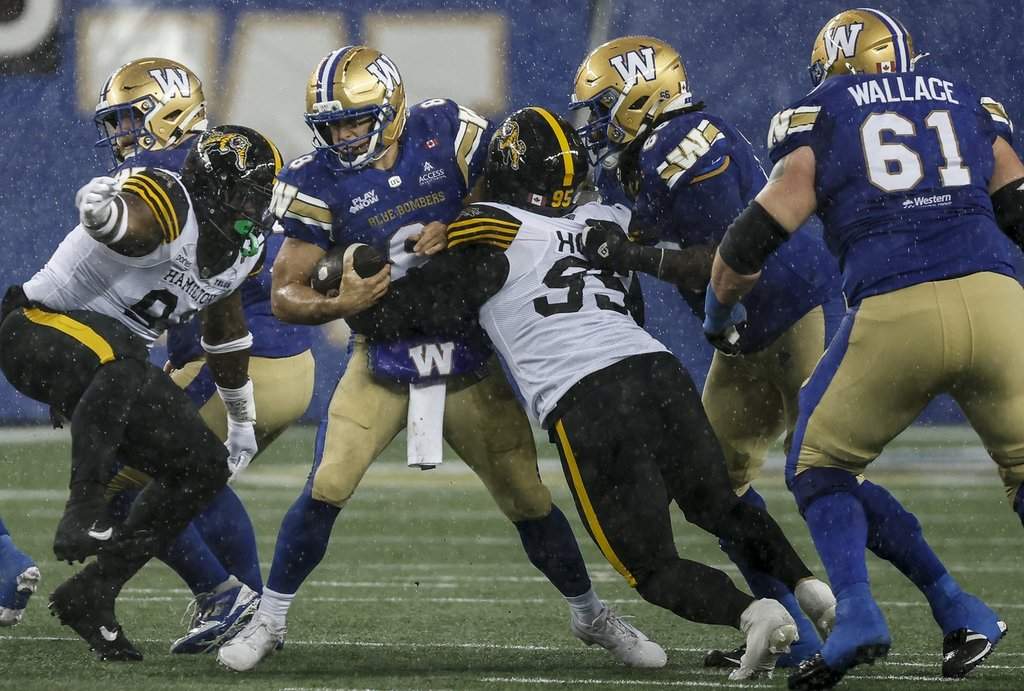
The availability of a franchise quarterback under physical duress is not merely a medical clearance issue; it is a complex operational calculus balancing asset preservation against immediate tactical imperatives. When the Winnipeg Blue Bombers face a high-stakes fixture with Zach Collaros listed as intent to play despite recent trauma, front offices and coaching staffs are forced to evaluate risk through a multi-variable framework. This situation exposes the fault lines between short-term win probability and long-term organizational equity.
To deconstruct this decision, we must analyze the structural mechanics of quarterback availability, the cost function of playing compromised assets, and the systemic ripple effects across offensive design.
The Cost Function of Sub-Optimal Quarterback Health
Every quarterback operates as the central processing unit of an offensive system. When that unit's physical integrity is compromised, the operational efficiency of every downstream component degrades. The decision to deploy Collaros is governed by an explicit risk-reward equation where variables interact non-linearly.
$$E(V) = P(\text{Win} \mid \text{Collaros}) \cdot V_{\text{game}} - C(\text{Injury Escalation}) \cdot V_{\text{season}}$$
In this framework, the expected value of playing a compromised starter depends heavily on the delta between his performance floor and the baseline performance of the backup quarterback, weighed against the probability of catastrophic injury amplification.
The Degradation Matrix
When a quarterback returns from an upper or lower-body issue under a compressed timeline, distinct performance metrics experience predictable decay:
- Time to Throw: Compensatory mechanics and protective instincts often shorten the internal clock, leading to premature throw-aways or forced checkdowns.
- Kinetic Chain Transfer: Lower-body stiffness or torso restriction alters rotational velocity, directly impacting deep-ball velocity and sideline tracking accuracy.
- Post-Snap Processing Load: Pain management consumes cognitive bandwidth, reducing the quarterback's capacity to diagnose complex defensive disguises pre-snap.
Tactical Mitigation Strategies
Coaches cannot simply drop a compromised player into a standard game plan and expect elite output. Structural adaptations are required to insulate the asset from high-exposure environments.
The primary mechanism for protecting a vulnerable quarterback is the reduction of dropback depth and time. By shifting the offensive architecture toward quick-game concepts, packaged plays, and maximum-protection schemes, the playbook shrinks to high-percentage horizontal distribution. However, this creates a secondary problem: predictability.
Defensive coordinators recognize the physiological constraints of an injured signal-caller. They respond by compressing intermediate zones, jumping short routes, and increasing blitz frequency to test the quarterback's mobility and pocket resilience. To counter this, the play-caller must weaponize the opponent's aggression through constraint plays, utilizing play-action bootlegs only if mobility permits, or relying heavily on running back release value to punish heavy interior pressure.
The Organizational Threshold of Risk
The decision to clear a player like Collaros involves three distinct stakeholders with conflicting incentives:
- The Medical Staff: Operates under a binary or threshold-based safety model. Their objective is zero catastrophic reinjury risk.
- The Coaching Staff: Operates under a temporal horizon limited to the current week's outcome. Their objective is maximizing win probability for the immediate fixture.
- The Front Office: Operates under a macro asset-management horizon. Their objective is protecting the long-term valuation of a multi-year contract and championship window.
When these incentives misalign, the final decision usually defaults to organizational risk tolerance. In elite sports ecosystems, veteran quarterbacks with deep institutional knowledge exert significant influence over this process, often successfully lobbying management by leveraging their deep understanding of the system's execution ceiling.
Operational Execution on Game Day
Managing a game with a compromised starting quarterback requires ruthless in-game calibration. The coaching staff must establish pre-determined performance and health thresholds before kickoff. If the quarterback's mobility fails to neutralize specific pressure packages within the first two offensive series, or if compensatory movement patterns begin to degrade throwing mechanics visibly, the contingency protocol must override competitive pride.
The ultimate strategic play in this scenario is not the initial decision to start, but the discipline of the exit strategy. Preserving the integrity of the broader competitive window requires accepting a diminished tactical output today to avoid a terminal structural failure tomorrow.