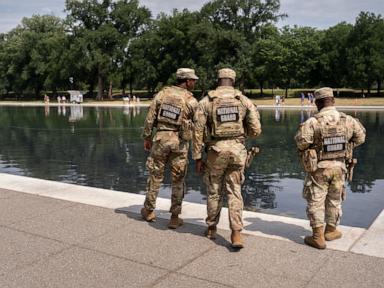
Politicians love a good property damage story because it offers a clean, binary narrative: bad actors broke a thing, and law enforcement caught them. When Donald Trump announced that six individuals were arrested for defacing the Lincoln Memorial Reflecting Pool, the media machine immediately fell into its predictable grooves. Outrage merchants decried the collapse of civic order. Civil libertarians questioned the surveillance apparatus.
Both sides missed the point entirely.
The obsession with physical vandalism on National Mall landmarks is a costly, archaic distraction. We are expending massive political capital and federal security resources protecting poured concrete and static water infrastructure while leaving the actual, high-value assets of modern governance completely exposed.
Capital asset protection strategies are fundamentally broken. Security experts and bureaucratic managers operate under a century-old playbook that treats physical monuments as high-value targets. They are not. They are easily reparable, highly redundant cultural symbols. The real damage to civic infrastructure doesn't happen with a can of spray paint at midnight; it happens via digital infrastructure infiltration, administrative inertia, and resource misallocation.
The Myth of the Irreplaceable Asset
Let’s dismantle the premise of the outrage. The Lincoln Memorial Reflecting Pool holds immense symbolic weight, but logistically, it is a massive basin of water. Defacing it or the surrounding granite walkway is a minor maintenance issue, not an existential crisis.
When a public figure elevates a vandalism arrest to a national security talking point, it creates a false sense of priority. Consider the operational cost of securing the National Mall. Millions of dollars are funneled into round-the-clock foot patrols, high-resolution cameras, and physical barriers designed to stop human beings from scratching stone.
Meanwhile, municipal water treatment facilities, local power grids, and regional traffic control systems across the country are running on legacy software with known vulnerabilities.
Imagine a scenario where a state-sponsored hacker group targets the industrial control systems of a major metropolitan water supply. They don't turn the water green with dye; they alter the chemical treatment ratios, rendering the water supply toxic for a population of four million. The cleanup cost for the Reflecting Pool is a few thousand dollars and a pressure washer. The cleanup cost—and human toll—of a critical infrastructure breach is catastrophic. Yet, public outrage and federal rhetoric remain anchored to the stone and water we can see.
Misunderstanding the Threat Matrix
The lazy consensus suggests that harsher penalties and visible security details at monuments deter broader lawlessness. This is fundamentally flawed risk management.
Security professionals categorize assets based on criticality, vulnerability, and threat level.
- Criticality: If this asset is destroyed, does the system function? (For the Reflecting Pool: Yes).
- Vulnerability: Is it easily accessible? (Yes, by design, it is a public space).
- Threat Level: Are sophisticated actors trying to destroy it? (No. Vandalism is almost exclusively opportunistic or low-level political theater).
By over-indexing on assets with high vulnerability but zero criticality, we create a theater of security. It looks impressive on the evening news when arrests are made, but it does nothing to harden the infrastructure that keeps society running.
I have watched public sector consultants bill millions to design "impenetrable" perimeters around federal office buildings and monuments while the employee payroll systems for those exact agencies are hosted on unencrypted servers. We are guarding the front gate with a tank while the back wall doesn't even exist.
The Financial Reality of Symbolic Security
To fix this, asset managers must adopt a corporate risk framework. If a private enterprise protected its brand-marketing assets (like a billboard or a lobby sign) with the same budget allocation it used for its proprietary source code, shareholders would fire the executive team by morning.
The downside to shifting our focus away from symbolic monuments is obvious: public spaces will occasionally look messy. There will be graffiti. There will be property damage. That is the cost of operating an open, democratic society. The alternative is turning every public park into a militarized zone, which destroys the very civic value we claim to protect.
Accepting a baseline level of aesthetic vulnerability allows for the redeployment of intelligence and security assets toward high-consequence targets. We need fewer park rangers monitoring tourists and more cybersecurity analysts auditing municipal SCADA (Supervisory Control and Data Acquisition) systems.
Stop Guarding the Stone
The six arrests at the Reflecting Pool are a statistical irrelevance. Treating them as a milestone in public safety is an admission that we prefer the illusion of control over actual systemic resilience.
Every dollar spent fortifying a monument is a dollar stolen from a electrical substation grid upgrade or an encrypted communication network. Stop measuring the safety of the nation by the cleanliness of its marble. Start measuring it by the resilience of its networks. The monuments can take care of themselves; our critical infrastructure cannot.