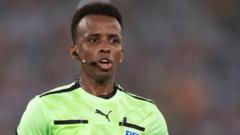
He sat in a windowless room at Miami International Airport for eleven hours. Outside, the Florida humidity was baking the tarmac, and a few miles away, the machinery of the 2026 FIFA World Cup was humming into motion. Inside, Omar Abdulkadir Artan was discovering the exact weight of a passport.
Artan is 34 years old. He possesses the lean, athletic build of a man who runs several miles a day just to keep up with world-class athletes, and he holds a whistle that can halt a stadium of eighty thousand people. He arrived in America with a diplomatic passport, a valid single-entry visa, and an official invitation from FIFA to become the first Somali referee in history to officiate a World Cup match. He had just been named Africa’s Men’s Referee of the Year for 2025.
None of it mattered to the border guards.
To the United States Customs and Border Protection agency, he was not a historic sporting pioneer. He was a vetting concern. After an interrogation that stretched through the night, American authorities barred him from entering the country, citing vague, unproven allegations of links to "suspected members of terror organizations." No evidence was offered. No trial was held.
Instead, the whistle was taken out of his mouth before the tournament even kicked off. He was loaded onto a return flight to Istanbul, his lifelong dream erased by a bureaucratic rubber stamp.
But football has a strange way of correcting its own tragedies.
The Geography of Belonging
Consider the sheer isolation of being turned back at a border. Imagine standing at the literal gates of your ultimate professional achievement, only to be told that your very identity is a threat. It is a quiet, deeply personal humiliation that plays out in the sterile corridors of international hubs every single day. Usually, it happens in silence.
But when Artan’s plane touched down in Mogadishu on Wednesday, the silence vanished.
Thousands of Somalis flooded the airport. There were flags, cheers, and tears. He was treated not as a rejected traveler, but as a returning conqueror. In a world that so often associates his homeland with strife, Artan had carried the Somali name to the absolute peak of global sports, only to have the door slammed in his face. The crowd felt that slam personally.
"Somalia belongs to us, whether it is in a bad state or a good state," Artan told the roaring crowd, standing tall despite the exhaustion of his ordeal. "That flag belongs to us, and that passport belongs to us."
It was a defiant statement of existence. Yet, back in the host cities of the World Cup, the football apparatus was busy washing its hands. FIFA President Gianni Infantino took to a podium in Mexico City, offering a shrug wrapped in diplomatic prose. "Chill, relax," Infantino told the media, attempting to defuse the growing anger. "We are not the kings of the world who can rule over governments and police forces. We are a sports organization."
It was the ultimate corporate retreat. FIFA had allowed its own elite official to be discarded, asserting that they were powerless against the immigration policies of the nations they choose to host their multi-billion-dollar tournaments.
Andrew Giuliani, leading the White House Task Force on the World Cup, was even more blunt, backing the border patrol's decision and reminding the world that the administration could not even guarantee that non-US citizens would be safe from immigration raids inside the tournament's own stadiums.
The message to the global south was crystal clear: You are welcome to entertain us, but your humanity is entirely conditional.
The Hand from Europe
Just as the door in Washington was locked and bolted, a window swung open in Nyon, Switzerland.
UEFA, the governing body of European football, watched the fallout. They saw a young, brilliant referee—the man who had flawlessly controlled the high-pressure second leg of the CAF Champions League final—cast aside by political posturing. They decided to rewrite the script.
On Thursday, UEFA announced that Omar Artan will referee the 2026 UEFA Super Cup.
On August 12, in Salzburg, Austria, Artan will step onto the pitch to command the clash between Champions League royalty Paris Saint-Germain and Europa League titans Aston Villa. It is one of the most prestigious single-match appointments in the global game.
"Football is made to connect people," UEFA President Aleksander Čeferin said, in a move that felt like a direct, albeit polite, rebuke to the American authorities. "UEFA wants to show its respect to Omar and his outstanding officiating skills."
By utilizing a newly minted cooperation agreement with the Confederation of African Football (CAF), UEFA bypassed the political gridlock. If the United States would not let Artan run his lines in Miami or New York, Europe would hand him the whistle in Salzburg.
The True Power of the Whistle
We often treat referees as invisible entities, or worse, as villains. We yell at them from the stands; we dissect their micro-decisions in slow motion on television. We forget that they are the thin line between order and chaos on a pitch.
To be a referee from a developing nation requires a level of psychological fortitude that most European or American officials will never have to summon. They do not just battle the players; they battle the infrastructure, the travel restrictions, and the inherent biases of a Western-centric sporting world.
Artan’s appointment to the Super Cup is more than just a consolation prize. It is a profound institutional pivot. It proves that while governments can control their borders, they cannot entirely control the meritocracy of the game.
The World Cup will continue without Omar Artan. The stadiums in America will fill, the lights will flare, and the matches will be played. But a shadow will linger over the tournament—a reminder of the official who was deemed too dangerous to hold a whistle, simply because of the birthplace printed on his documents.
Come August, however, the focus will shift to Austria. When Aston Villa and Paris Saint-Germain line up, they will not be looking at a political talking point or a security risk. They will be looking at a man who survived an eleven-hour cell, a man who returned home to the embrace of his people, and a man who refused to let his dream be confiscated at customs.
Omar Artan will blow his whistle. And the world will have no choice but to stop and listen.