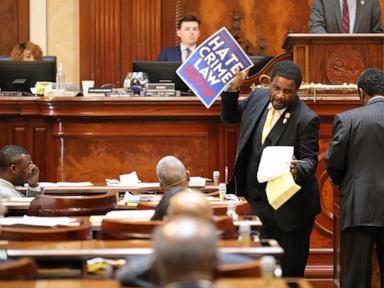
South Carolina is on the verge of eliminating its only Democratic-held congressional seat. Following an intense, 14-hour marathon legislative session that stretched past midnight, the Republican-led South Carolina House passed a radical mid-decade congressional map designed to give the GOP control of all seven of the state’s U.S. House seats.
Urged forward by Donald Trump, the state House voted to aggressively dismantle the 6th Congressional District, currently represented by veteran Democratic Representative Jim Clyburn. To push the line changes through before the upcoming elections, the passed legislation includes a provision to delay the state's congressional primaries until August and throw out thousands of overseas military and absentee ballots already cast for the original June primary date.
The strategy behind the House map marks a definitive break from decades of unspoken bipartisan equilibrium in the state. By attempting to pack and dilute the state's Black and Democratic voters across a rewritten map, the plan aims to hand national Republicans an ironclad seat in a closely divided federal chamber. But the ultimate fate of the map rests in a far more hesitant state Senate. Key Senate Republicans fear that spreading conservative voters too thin across new boundaries could spark an unforced electoral disaster.
The Breakdown of the Gentlemen's Agreement
For more than thirty years, South Carolina politics operated under a quiet, unspoken understanding. Following the 1990 census, a historic compromise emerged. Black leaders and state Republicans recognized a mutual alignment of immediate interests. Republicans wanted to secure safe majorities in suburban and rural districts, while Black voters demanded a district where they could realistically elect a candidate of their choice.
The result was the 6th Congressional District, drawn to consolidate Black voting strength across the Lowcountry and parts of the Midlands. It paved the way for Jim Clyburn to become the first Black representative elected from South Carolina since 1897.
Existing South Carolina Congressional Delegation
+-----------------------------------+
| GOP: 6 Seats                      | [R] [R] [R] [R] [R] [R]
+-----------------------------------+
| DEM: 1 Seat (6th District)        | [D]
+-----------------------------------+

Proposed South Carolina Congressional Delegation
+-----------------------------------+
| GOP: 7 Seats                      | [R] [R] [R] [R] [R] [R] [R]
+-----------------------------------+
| DEM: 0 Seats                      |
+-----------------------------------+
This structural dynamic systematically insulated neighboring Republican incumbents from competitive general elections. By packing the state’s most reliable Democratic base into a single, winding geographic footprint, the surrounding districts became safely, predictably conservative.
The map passed by the state House ends that era of mutual coexistence. Rather than protecting the status quo, the new proposal systematically unwinds the 6th District, distributing its constituent populations into neighboring districts to flip the entire state red.
Spreading the Red Paint Too Thin
The primary resistance to the new map is not coming from House Democrats, whose objections were easily overridden by the supermajority. Instead, the real pushback is materializing within the state Senate, where a cohort of practical Republicans is looking closely at the mathematics of survival.
Redistricting is a game of pure numbers. To erase a safe Democratic district, lawmakers must take chunks of reliable Democratic voters and place them into surrounding Republican districts. Simultaneously, they must extract reliable Republican voters from those safe areas and seed them into the newly redrawn territory.
State Senate Majority Leader Shane Massey has voiced sharp skepticism regarding this exact strategy. The mathematical danger is that by trying to secure all seven seats, the party risks diluting its margins in the six seats it already owns.
If the state experiences a high-turnout election or a shift in suburban voting behavior, districts that once enjoyed comfortable +15% Republican advantages could suddenly find themselves compressed into precarious +3% toss-ups. Instead of gaining a seventh seat, the party could inadvertently expose its flanks, opening the door for a well-funded Democratic surge to capture multiple districts in a favorable national cycle.
The Tactical Cost of the August Shift
Beyond the long-term structural anxieties, the immediate mechanics required to execute this mid-decade overhaul are creating operational chaos. Because early primary voting for the scheduled June elections is already underway, implementing an entirely new map requires an unprecedented bureaucratic intervention.
The House bill intentionally solves this by isolating the U.S. House races, pulling them out of the standard June primary cycle, and establishing a standalone special primary in August. The administrative and financial fallout of this maneuver includes several distinct liabilities:
- A $3 million taxpayer bill: Funding a completely separate, statewide primary election over the summer requires a direct appropriation of millions from state coffers.
- The invalidation of military ballots: Absentee and overseas military ballots that have already been legally filled out and returned for the June congressional races will be discarded.
- Deep primary fatigue: Voters will be forced to turn out for state legislative primaries in June, return to the polls for congressional primaries in August, and then vote a third time in November.
This chaotic timeline has generated profound frustration among local election officials, who must scramble to re-verify district lines, notify confused voters, and print entirely new ballots on a compressed operational schedule.
The Supreme Court Shadow
The timing of this legislative push is not accidental. The legislative aggression displayed by House Republicans is directly tied to recent legal shifts at the highest levels of the American judiciary.
State legislatures were previously constrained by the fear of federal intervention under the Voting Rights Act. However, the U.S. Supreme Court's ruling in Alexander v. South Carolina State Conference of the NAACP fundamentally altered the legal landscape of redistricting. In that decision, the court ruled that the state’s previous redrawing of the 1st Congressional District was an acceptable exercise of partisan gerrymandering rather than an unconstitutional racial gerrymander.
                    [ 2020 Census Population Shift ]
                                   │
                                   ▼
             [ State GOP Draws Highly Partisan 2022 Map ]
                                   │
                                   ▼
          [ Federal District Court Striking Down Map as Racial ]
                                   │
                                   ▼
         [ Supreme Court Reverses: Partisan Goals Take Precedence ]
                                   │
                                   ▼
       [ Current House Push: Complete Dismantling of 6th District ]
The Supreme Court established an exceedingly high burden of proof for plaintiffs, stating that courts must grant state legislatures a strong presumption of "good faith" when they claim their primary motivations are political rather than racial. Because race and voting patterns are deeply intertwined in the American South, the ruling effectively gave a green light to aggressive partisan map-making, provided lawmakers frame their goals purely around party advantage.
House map-makers designed this new proposal with that exact legal protection in mind. By explicitly stating that their objective is to secure a 7-0 partisan advantage for national Republicans, they are intentionally building a shield against future federal lawsuits.
The Senate Bottleneck
The legislation now moves to the state Senate, where the political math is far tighter. An earlier procedural vote to take up redistricting fell just short of the required two-thirds majority when five Senate Republicans defected, joining all chamber Democrats to block the measure.
While the House has forced the issue back into the spotlight through a special session, the internal strategic divide within the conservative caucus remains unresolved. The Senate's leadership views the house plan as a high-risk gamble driven by national political pressures rather than local electoral realities.
Jim Clyburn has publicly declared that he will seek re-election regardless of how the final lines are drawn, setting up a high-profile showdown. If the Senate caves to pressure and passes the House map, South Carolina will test whether a state can completely erase opposition representation without collapsing its own defensive walls.