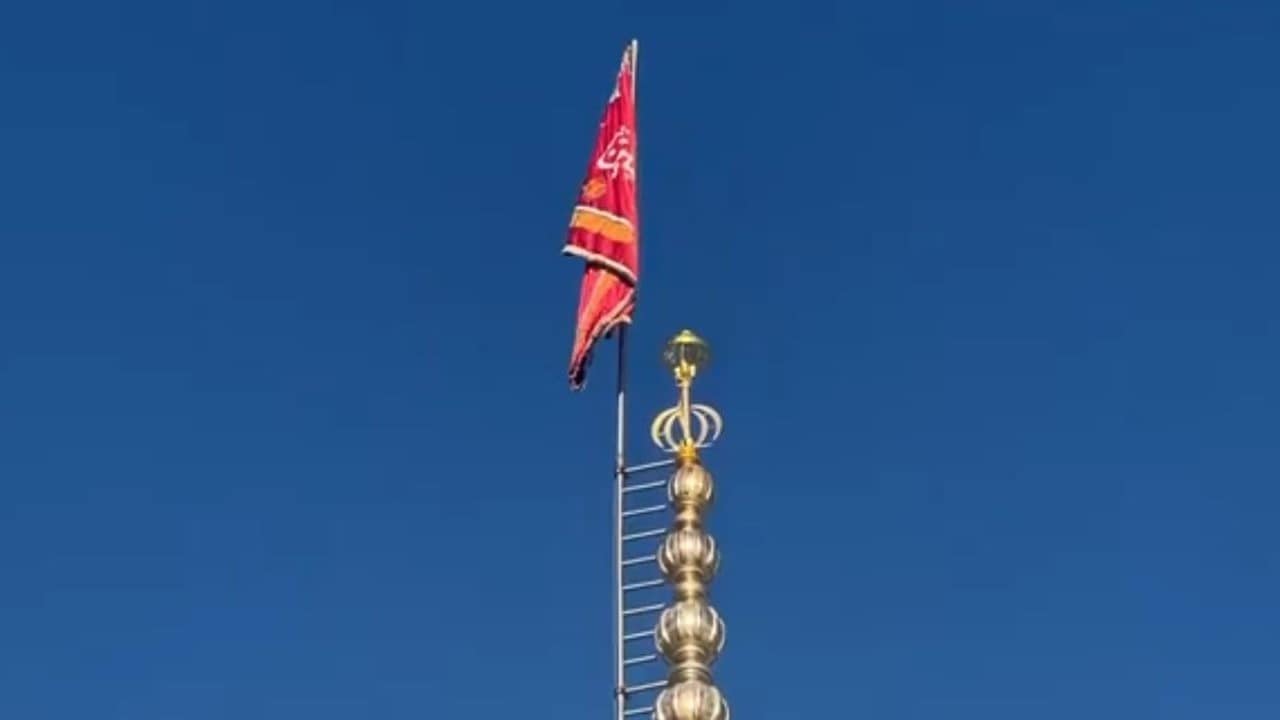
The red flag over the Jamkaran Mosque isn't a "declaration of war." It isn't a countdown to World War III. It isn't even a signal that an Iranian missile is currently leaving a silo. If you’ve spent the last 48 hours doom-scrolling through analysts who claim this ritual represents an unprecedented escalation in the Middle East, you’ve been sold a narrative built on orientalist tropes and a profound misunderstanding of Shiite iconography.
Western intelligence circles and click-hungry newsrooms love a good omen. The sight of a blood-red banner unfurling over a turquoise dome provides the perfect thumbnail for a "World on the Brink" segment. But looking at the red flag and seeing only "war" is like looking at a stop sign and thinking the road has ceased to exist.
The Logistics of Religious Symbolism vs. State Policy
Let’s dismantle the lazy consensus. The common argument suggests that because the red flag represents "unjustly shed blood" (the Ya Latharat al-Hussein), its raising is a binding legal mechanism for the Iranian state to launch an immediate kinetic strike.
It isn't.
Iran is a complex bureaucratic state with a dual power structure. The Islamic Revolutionary Guard Corps (IRGC) and the Supreme National Security Council do not check the weather vane atop a mosque in Qom before deciding on the flight path of a Fattah-1 hypersonic missile. The red flag is a liturgical tool, not a tactical one.
In Shiite tradition, the red flag is the banner of Hussein ibn Ali, the grandson of the Prophet Muhammad, who was killed at the Battle of Karbala. It signals that the "blood has not yet been avenged." It is a statement of perpetual grievance and spiritual readiness. To suggest it is a literal "war flag" in the Clausewitzian sense is to confuse a Catholic priest wearing purple during Lent with a declaration that the Vatican is about to invade Italy.
Why the "Unprecedented" Label is a Lie
The media loves to use the word "unprecedented" because it drives engagement. They claimed the flag raising was unprecedented after the 2020 assassination of Qasem Soleimani. They claimed it again after the 2024 Kerman bombings. They are claiming it now.
If something happens every time there is a significant national tragedy or assassination, it is—by definition—a precedent. It is a standard operating procedure for the clerical establishment to signal to its domestic base that the state acknowledges their pain.
I have watched regional "experts" fail to predict every major Iranian pivot for a decade because they focus on the theater rather than the ledger. The theater is red flags and chanting. The ledger is enrichment levels, proxy funding, and the Straits of Hormuz. The former is for the cameras; the latter is for the generals.
The Misunderstood Mechanics of "Vengeance"
When the red flag goes up, the Western public asks: "When will they attack?"
This is the wrong question. In the Iranian strategic mindset—rooted in the concept of Sabr-e Estratezhik (Strategic Patience)—vengeance is a dish served at a temperature so cold it’s practically frozen.
- Domestic Catharsis: The flag allows the regime to channel public anger into a controlled religious ritual. It provides an immediate visual "response" while the actual military planners take months, or years, to find a vulnerability.
- Psychological Deterrence: By signaling a "state of revenge," Iran forces its adversaries to spend millions on heightened alert levels, defensive positioning, and intelligence cycles. The flag is a low-cost way to keep the enemy’s blood pressure high.
- The Mahdi Narrative: The Jamkaran Mosque is specifically tied to the 12th Imam, the Mahdi. Raising the flag there isn't just about the person who was killed; it’s about framing the current geopolitical struggle within a cosmic, end-times framework. It’s about legitimacy, not just ballistics.
Stop Asking "What It Means" and Start Asking "Who It's For"
If you want to understand the red flag, stop looking at it from Washington or London. Look at it from Tehran and Mashhad.
The Iranian government faces a perpetual "expectation gap." After a high-profile assassination, the hardline base demands immediate, explosive retribution. If the IRGC doesn't provide it, they look weak. If they do provide it, they risk a total war that could topple the regime.
The flag is the escape valve.
It tells the loyalists, "We see the insult. We have marked the blood. We are in a state of mourning-as-war." It buys the Supreme Leader time. It converts a political failure—the inability to protect a high-value asset—into a religious mandate.
The Danger of Our Own Misinterpretation
The real risk isn't the flag itself; it's the Western reaction to it. When we misinterpret a religious symbol as a definitive military signal, we create a "false positive" in our own intelligence frameworks.
Imagine a scenario where a red flag is raised for a purely commemorative reason, but a jittery regional commander interprets it as a "Go" signal for a strike. The escalation ladder is climbed not because of Iranian intent, but because of Western illiteracy regarding Middle Eastern semiotics.
We are addicted to the "Mad Mullah" trope—the idea that Iran is an irrational, apocalyptic actor that will blow up the world the moment a banner is hoisted. This ignores 45 years of cynical, calculated, and highly rational survival by the Islamic Republic. They are many things, but they are not suicidal.
The Reality of the "Red Flag" News Cycle
Most articles you read on this topic are "placeholder journalism." They are written to fill the void between an event (the assassination) and the actual consequence (the eventual response). Because journalists cannot tell you what the IRGC's "Unit 8000" is planning in a darkened room, they tell you about the flag on the roof.
It’s easy to report. It’s visual. It’s scary.
But if you want to know if a strike is coming, don't look at the mosque. Look at the shipping lanes. Look at the movement of tankers. Look at the chatter on encrypted channels in Baghdad and Beirut.
The flag is a signal of "Who," "Why," and "How we feel." It is never a signal of "When."
Stop falling for the theater of the red flag. The most dangerous moves Iran makes are the ones they don't announce with a parade. When the real blow comes, there won't be a livestream of a banner being raised. There will just be the sound of the impact.
Learn the difference between a ritual and a radar signature, or stop pretending to analyze the Middle East.