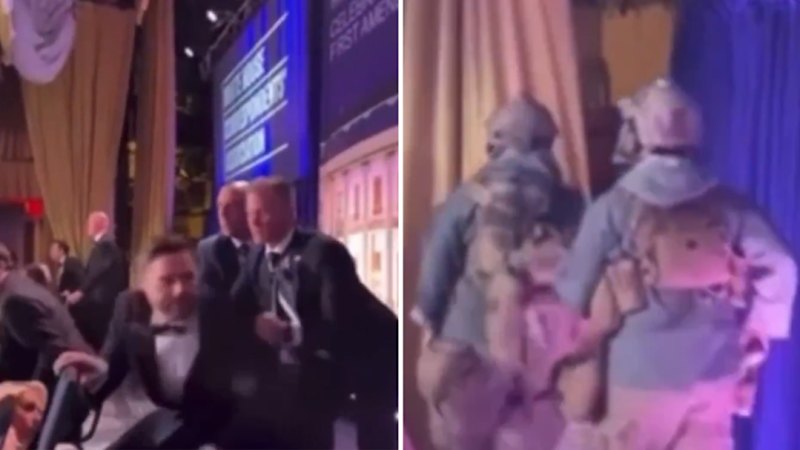
The prompt evacuation of President Donald Trump and Vice President JD Vance from the Washington Hilton on Saturday night was not a drill, nor was it a mere abundance of caution. It was a high-stakes kinetic response to a 31-year-old California man, identified as Cole Tomas Allen, who breached a security perimeter with a shotgun, a handgun, and multiple knives. As silverware clattered and journalists ducked under linen-covered tables, the Secret Service executed a "lift and shift" maneuver that physically removed the nation’s top leadership from a ballroom that had suddenly become a target rich environment.
While the immediate threat was neutralized by armed guards at a security checkpoint, the incident exposes a glaring vulnerability in the way high-profile "soft" events are secured. For decades, the White House Correspondents’ Dinner has been a glitzy mix of power and press, but Saturday’s breach suggests the security apparatus failed to account for a "lone wolf" adversary who had specifically scouted the venue’s logistical gaps.
The Three Minute Breach
The chaos began at 8:36 p.m. during the first course of the dinner. While guests were finishing their salads, Allen attempted to force his way through a secondary security screening area. Unlike the sterile, heavily fortified environments of a campaign rally or the White House, the Washington Hilton is a sprawling commercial maze.
The suspect had reportedly booked a room at the hotel, allowing him to bypass some of the external cordons established by the D.C. Metropolitan Police. This "inside-out" threat is the nightmare scenario for the Secret Service. By the time Allen reached the inner perimeter, he was already past the first layer of defense. He allegedly opened fire, striking a Secret Service agent in his ballistic vest. The agent survived, but the sound of gunfire echoing through the marble corridors triggered an immediate "Condition Red" inside the ballroom.
Order of Operations and the Vance Evacuation
One of the more jarring sights from the evening, captured in viral social media footage, was the speed at which Vice President JD Vance was removed. In several clips, agents are seen physically lifting Vance and whisking him toward a rear exit before the President had even fully cleared the stage.
This has sparked debate among security analysts regarding the evacuation priority protocols. Typically, the President (the "package") is the primary focus, but the sheer number of high-ranking officials in the room—including the First Lady, the Second Lady, and multiple Cabinet members—forced the Secret Service to split their tactical resources.
- Vance’s Detail: Acted with near-autonomous speed, identifying a clear path to the service elevators.
- Trump’s Detail: Formed a human shield around the President, who briefly tripped during the scramble but was quickly righted.
- Tactical Teams: Swarmed the ballroom floor with long guns drawn, a rare and sobering sight for a black-tie event.
The decision to evacuate Vance and Trump through separate routes is a standard "de-concentration" tactic designed to ensure that a single secondary explosive or shooter cannot take out both leaders at once.
A Security Designation Failure
The most troubling aspect of the night isn't just the shooter’s intent, but the classification of the event itself. According to federal officials speaking on the condition of anonymity, the 2026 White House Correspondents’ Dinner was not designated as a National Special Security Event (NSSE).
An NSSE designation—typically reserved for the State of the Union or a Presidential Inauguration—brings in the full weight of the Department of Homeland Security, including massive federal funding, advanced surveillance, and a "hard" perimeter that covers blocks of the surrounding city. Without this designation, the security of the Hilton was a patchwork of Secret Service protection for the President and private hotel security for the thousands of other guests.
Acting Attorney General Todd Blanche defended the response as a "success story," noting that the suspect never entered the ballroom. However, the suspect’s own writings, recovered after his arrest, explicitly mocked the "lax security" of the hotel’s guest wing. The fact that an armed individual could get within earshot of the President while carrying a shotgun reveals a perimeter that was porous at best.
Comparing Security Tiers
| Feature | Standard Event (Saturday Night) | NSSE Level (State of the Union) |
|---|---|---|
| Perimeter Control | Hotel staff and local police | Secret Service and National Guard |
| Guest Screening | Metal detectors at ballroom entrance | Multi-stage screening blocks away |
| Intelligence | Standard threat monitoring | Integrated multi-agency command center |
| Airspace | Standard TFR (Temporary Flight Restriction) | Combat Air Patrol and anti-drone tech |
The "Lone Wolf" Problem in the Digital Age
The suspect, Cole Tomas Allen, does not fit the profile of a typical political extremist. A mechanical engineering graduate from Caltech and a former teacher, Allen represents the "invisible" threat: an individual with no prior criminal record and a high degree of technical competence.
Law enforcement is currently scrubbing Allen’s digital footprint, which reportedly includes an "anti-Christian manifesto" and detailed notes on previous assassination attempts, including the 2024 Butler, Pennsylvania shooting. This obsession with "impact" is a recurring theme in modern political violence. As the President noted in his post-incident press conference, "When you’re impactful, they go after you."
The challenge for the Secret Service is no longer just organized plots; it is the radicalized individual who uses public information to find the one hotel door that isn't guarded by a federal agent. The Washington Hilton, the site of the 1981 attempt on Ronald Reagan, has once again proven that architectural history can repeat itself if the security posture remains static.
The gala will be rescheduled within 30 days, but the atmosphere in Washington has fundamentally shifted. For the Secret Service, the "success" of Saturday night was a narrow escape. The next step isn't just a debrief; it is a total reassessment of how the government protects the executive branch when they step out of their fortified bubbles and into the "soft" world of dinners and handshakes.
We can no longer afford to treat high-profile gatherings as social events first and security challenges second. The margin for error has evaporated.



