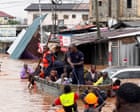
The catastrophic floods that recently tore through West Africa, displacing millions and submerging entire cities from Nigeria to Niger, were not just a natural disaster. They were a failure of systemic governance meeting an atmosphere supercharged by fossil fuels. While standard reporting points the finger squarely at global warming, the reality is far more complex and damning. Climate change acted as the ultimate accelerant, but decades of decayed infrastructure, unchecked urban sprawl, and failed early-warning systems poured the gasoline.
Understanding this crisis requires looking beyond the raw rainfall metrics to examine how a predictable meteorological shift became an regional humanitarian catastrophe.
The Atmospheric Engine Behind the Deluge
To understand why the rains of recent seasons have turned so destructive, we must look at the thermodynamic shifts in the tropical Atlantic. For every 1°C of warming, the atmosphere holds about 7% more moisture. This is the Clausius-Clapeyron relation, a fundamental law of physics that has ceased to be academic for the Sahel and West African coast.
During the monsoon season, the Intertropical Convergence Zone (ITCZ) shifted. It dragged massive, moisture-laden air masses from an unusually warm Gulf of Guinea deep into the interior.
When these air masses hit the cooler, dry air of the Sahara, they did not just produce rain. They triggered hyper-localized, high-intensity cloudbursts. In parts of Mali and Niger, areas that typically measure annual rainfall in mere inches received their entire yearly quota in a matter of days. The parched Sahelian soil, baked hard by prolonged heatwaves earlier in the year, acted like concrete. Instead of absorbing the water, it channeled it instantly into raging torrents.
The Dam Failure Scandal
While the sky provided the water, human decisions directed its path. The devastation in Maiduguri, Nigeria, offers a grim case study of how structural neglect transforms a hazard into a tragedy.
The collapse of the Alau Dam was not a sudden, unpredictable act of God. It was a slow-motion disaster years in the making. Built in the 1980s to control flooding and provide irrigation, the dam had been structural liability for over a decade. Local experts and engineers had repeatedly warned that the reservoir’s spillways were cracked and the main wall was suffering from severe erosion.
Governments frequently blame unprecedented weather for these catastrophes. Yet, budget allocations show a persistent pattern of funds diverted away from critical infrastructure maintenance toward flashier, short-term political projects. When the extreme rains came, the overfilled reservoir simply pushed past the compromised concrete. The resulting deluge did not just flood the city; it erased entire neighborhoods in a matter of hours.
+-----------------------------------------------------------------------+
|                       ANATOMY OF A MAN-MADE CRISIS                    |
+-----------------------------------------------------------------------+
|  1. Rising Sea Surface Temps -> 2. Severe Cloudbursts ->              |
|  3. Hardened, Unreceptive Soils -> 4. Neglected Infrastructure        |
|  (e.g., Alau Dam) -> 5. Catastrophic Urban Flooding                   |
+-----------------------------------------------------------------------+
Unchecked Urbanization and the Concrete Trap
West Africa is home to some of the fastest-growing cities on earth. Driven by conflict, economic necessity, and rural agricultural collapse, millions of people have migrated to urban centers like Niamey, Bamako, and Lagos.
This rapid expansion has occurred largely without zoning laws or master planning.
Natural floodplains, wetlands, and mangrove forests that historically acted as giant sponges for seasonal runoff have been paved over. Concrete and asphalt now cover areas that once absorbed millions of gallons of water. Informal settlements, built from flimsy timber and corrugated iron, have crept directly into dry riverbeds (wadis) and drainage channels. When the rivers burst their banks, these communities stood directly in the line of fire.
In many of these metropolitan areas, colonial-era drainage systems designed for populations a tenth of their current size are completely choked with plastic waste. Without functioning municipal waste management, trash becomes a damming agent. The water has nowhere to go but up, spilling into homes and businesses, carrying waterborne diseases like cholera along with it.
The Myth of Effective International Aid
Following every major flood event, the same script plays out. Western nations express deep concern, pledge millions of dollars in emergency humanitarian aid, and promise to help build resilience.
This model is fundamentally broken.
The vast majority of international climate finance is earmarked for mitigation—reducing carbon emissions—rather than adaptation, which involves building the dykes, drainage canals, and early warning systems needed to survive the current climate reality. West Africa contributes less than 2% of global greenhouse gas emissions, yet its people are paying the highest price.
"We are offered blankets and biscuits after we lose everything, but we are never given the resources to reinforce our riverbanks before the clouds gather."
— A civil engineer based in Niamey, Niger
The promised Loss and Damage fund, celebrated at successive UN climate summits, remains largely an empty shell bogged down by bureaucratic red tape. The funds that do trickle through are often swallowed by international consultancy firms or caught in the web of local political corruption, rarely reaching the municipal engineers who actually know how to fix the problem.
Rebuilding for a Wetter Continent
The weather patterns of the past fifty years are gone. They are not coming back. If West Africa is to survive the coming decades without seeing its economic progress washed away annually, the approach to water management must be entirely overhauled.
First, the region must move away from a reliance on massive, centralized concrete dams. These structures are expensive to build, prone to corruption during procurement, and catastrophic when they fail. Instead, cities must adopt nature-based solutions. This means restoring degraded wetlands, mandating green spaces in urban planning, and replanting cleared forests along river basins to naturally slow the flow of water.
Second, the transboundary nature of West African rivers demands unified action. The Niger River basin spans nine countries. What happens upstream in Guinea and Mali directly impacts communities downstream in Nigeria. Currently, data sharing between these nations is fragmented, occasional, and plagued by diplomatic friction. A unified, real-time hydrological monitoring network is essential to give downstream populations days, rather than hours, of warning before a surge arrives.
Finally, local governments must prioritize the mundane, unglamorous work of clearing and expanding municipal drainage networks. It is not as politically rewarding as building a new highway, but keeping drains free of silt and plastic is the single most effective way to prevent localized urban flooding.
The floods in West Africa are often framed as a tragedy of natural proportions. But nature only supplied the water. The disaster itself was entirely designed by human neglect, political apathy, and a global financial architecture that treats adaptation as an afterthought. Without a drastic shift toward systemic infrastructure investment and honest governance, the next rainy season will simply wash away whatever fragile recovery has been made since the last.