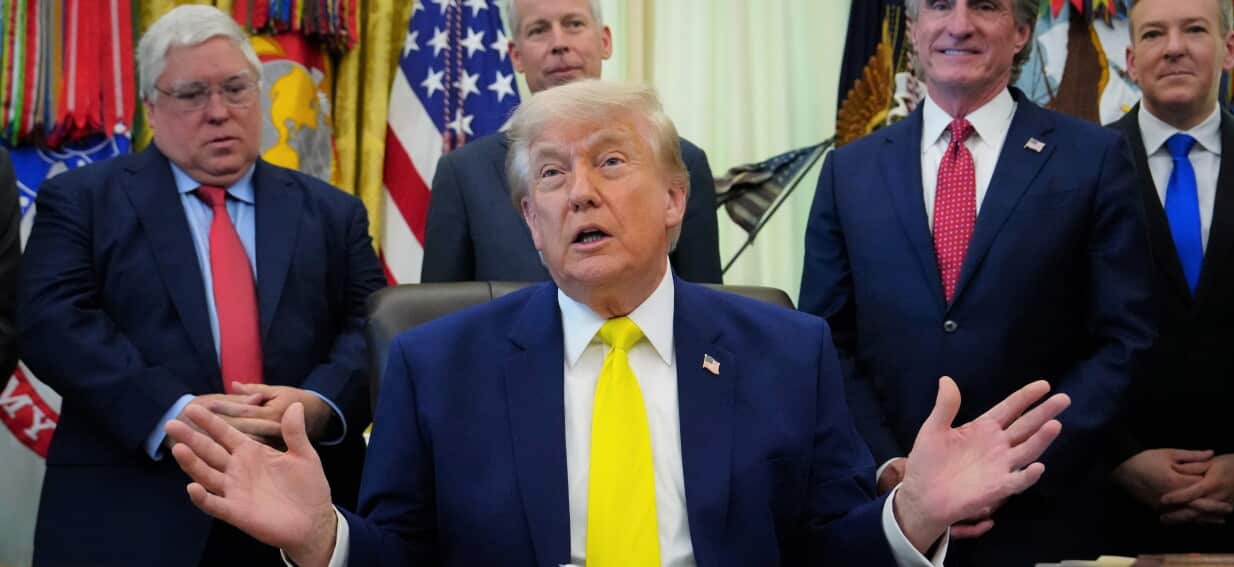
Donald Trump wants a deal with Iran, and he does not care how much blood has been spilled to get it.
Just months after a joint U.S.-Israeli bombardment killed Iran long-time Supreme Leader Ali Khamenei and threw the Islamic Republic into a tailspin, Trump has completely flipped the script on Tehran. Speaking on a podcast, the U.S. president declared he would be "honored" to sit down with the newly minted Supreme Leader, Mojtaba Khamenei, provided the two nations can hammer out a diplomatic agreement. This represents a staggering pivot from March, when Trump publicly dismissed the 56-year-old successor as an unacceptable "lightweight" and demanded veto power over who runs Iran.
The sudden shift reveals the core mechanism of Trumpian foreign policy. It is not dictated by ideology, human rights, or long-term institutional strategy. It is driven by the theater of the personal breakthrough. By treating the reclusive new Ayatollah as a legitimate power broker who is "giving approval" behind the scenes, Trump is attempting to bypass a grinding regional conflict through raw, top-down transactional diplomacy.
The Art of the Autocrat Pivot
Career diplomats have spent decades analyzing the theological and bureaucratic power structures of Iran. Trump simplifies it to a single variable: who is the boss?
Despite persistent rumors regarding Mojtaba Khamenei's failing health following the air strikes that killed his father, Trump confirmed that U.S. intelligence sees the younger Khamenei as actively managing indirect negotiations. "He’s involved. Absolutely," Trump noted, adding that the two sides seem to be "getting along quite well."
This language is intimately familiar to anyone who watched Trump’s first term. It is the exact playbook used with North Korea's Kim Jong Un. First comes the maximum pressure campaign, characterized by devastating military action and economic strangulation. Then comes the sudden offering of an olive branch, framed as an exclusive opportunity for two strongmen to reshape history.
By stating he would be "honored" to meet the new Ayatollah, Trump is offering Mojtaba something the isolated leader desperately needs: international legitimacy at a moment of extreme domestic vulnerability.
What Trump Wants from Tehran
- A grand nuclear bargain that goes beyond the parameters of the discarded 2015 JCPOA.
- An immediate cessation of proxy attacks hitting U.S. military assets across the Middle East.
- A definitive foreign policy win to showcase his self-proclaimed mastery of negotiation.
The Dangerous Illusion of the Reasonable Successor
The fatal flaw in this personal approach to diplomacy is that it ignores the institutional inertia of the Iranian regime. Western analysts have long debated whether Mojtaba Khamenei would play the role of a modernizer, akin to Saudi Crown Prince Mohammed bin Salman. That hope vanished the moment U.S. bombs dropped on Tehran.
Mojtaba took power under fire. He is surrounded by hardline elements of the Islamic Revolutionary Guard Corps (IRGC) who demand retaliation, not capitulation. Just this week, the IRGC claimed responsibility for missile and drone strikes targeting U.S. military facilities in Kuwait and Bahrain.
Trump's public pleasantries ignore this regional reality. He is operating on the assumption that Mojtaba can simply command the IRGC to halt its regional aggression. But the Iranian security state is a fractured landscape of competing factions. A sudden, unearned summit with an American president could backfire spectacularly, alienating the hardline commanders Mojtaba relies on for survival.
       [ U.S. MAXIMUM PRESSURE ]
                   │
                   ▼
     [ Decapitation of Leadership ]
                   │
                   ▼
  [ Sudden Offer of High-Level Summit ]
                   │
        ┌──────────┴──────────┐
        ▼                     ▼
[Regime Legitimacy]   [Proxy Escalation]
The Red Line in the Sand
While Trump talks of honor and future summits, the underlying threat of violence remains the dominant currency of U.S.-Iran relations. Asked what would happen if Iranian forces killed American troops during these delicate indirect talks, Trump did not hesitate to return to form.
"It would be a good reason," Trump said regarding a resumption of intense military operations. "I’d be honest with you, if they killed U.S. troops, I think I would do that very quickly."
This creates a highly volatile diplomatic environment. The administration is pursuing high-stakes engagement while simultaneously keeping its finger on the trigger. It is a high-wire act where a single miscalculation by a rogue proxy commander in Lebanon, Yemen, or Iraq could instantly transform a potential peace summit into a full-scale regional war.
For the veteran observer, this dual-track strategy looks less like calculated statecraft and more like a high-stakes gamble. Trump is betting everything on the belief that the new Ayatollah is rational enough to choose a face-saving deal over an asymmetric war of survival.
De-escalation or Distraction
The real reason Trump is flirting with the Ayatollah is simpler than any grand geopolitical theory. The war with Iran has drained immense U.S. military resources and drawn global attention away from other critical theaters. America's allies in the Gulf are demanding a unified, cohesive response to Iranian aggression, yet Washington is clearly looking for an exit strategy.
By signaling an openness to meet Mojtaba Khamenei, Trump is trying to force a conclusion to a conflict that has threatened to become an intractable quagmire. He is offering the Iranian regime a choice: sit across from him at a mahogany table, or face the return of the B-2 stealth bombers.
But history shows that Iran's leaders rarely negotiate effectively under public ultimatums. By dangling the prestige of a presidential meeting so early in Mojtaba's tenure, Trump may find that instead of buying peace, he has merely shown his cards to an adversary that has mastered the art of survival through chaos.