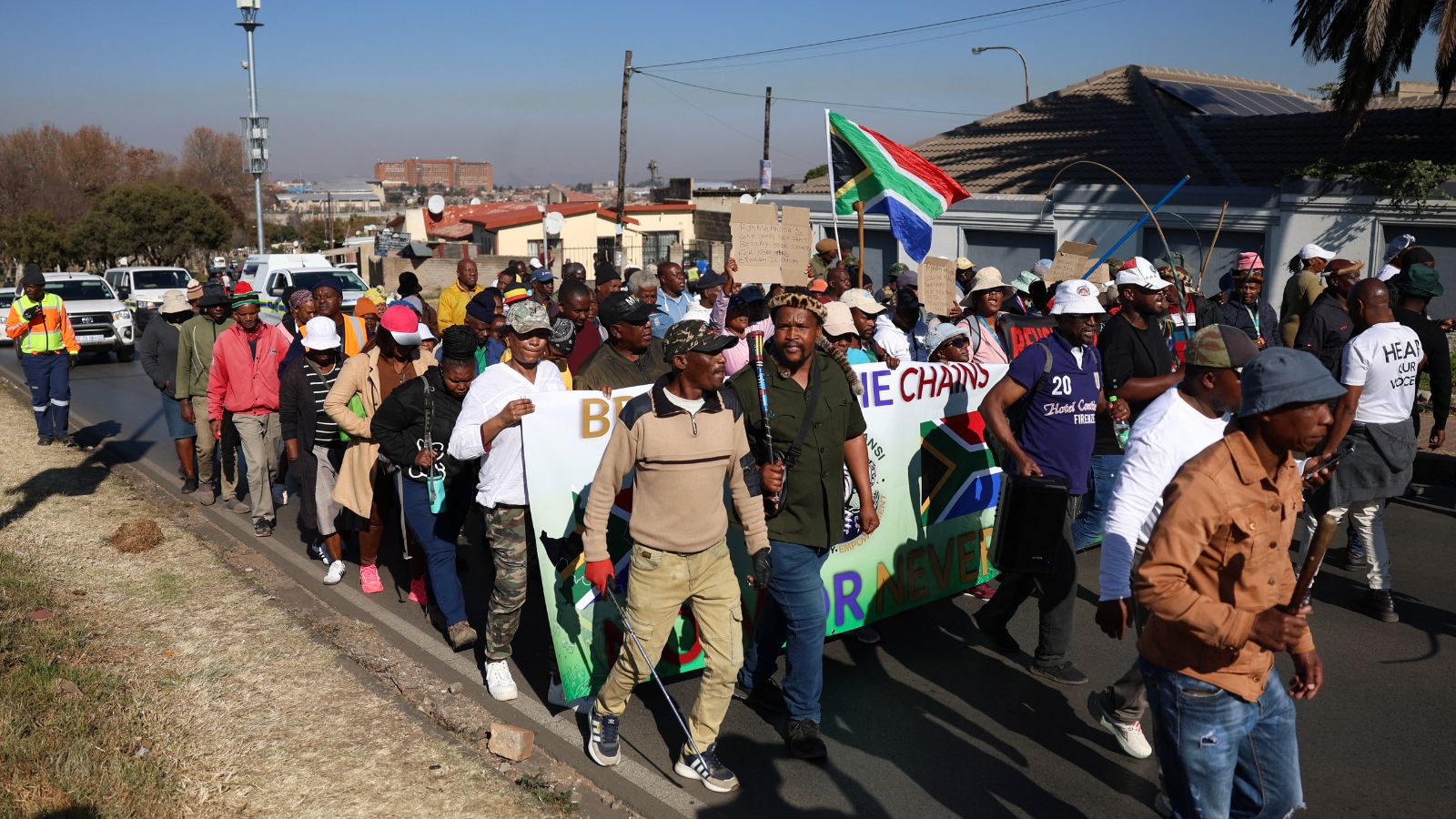
The narrative driving South Africa’s latest wave of anti-migrant protests is built on a straightforward, politically potent premise: ejecting foreign nationals will immediately free up millions of jobs and restore economic prosperity to citizens. It is a compelling pitch in a country where the official unemployment rate hovers near 32%, leaving over 8 million people without formal work. However, the economic reality is precisely the opposite. Mass anti-migrant demonstrations, spearheaded by groups like Operation Dudula and the March and March movement, are actively self-inflicting deep wounds on the continent's most industrialized economy by choking off essential low-cost logistics, paralyzing informal retail networks, and triggering an institutional capital flight that South Africa cannot afford.
The nationwide demonstrations that paralyzed logistics and commercial hubs in Johannesburg, Pretoria, and Durban have escalated from localized street friction into a systemic macro risk. While political populists weaponize public anger over collapsing municipal services and a stagnant economy, corporate boardrooms are pricing in a long-term breakdown of public order.
The Logistics Stranglehold
South Africa’s economic lifeblood depends entirely on its freight corridors. The N3 highway, a critical ribbon of tarmac connecting the industrial heartland of Gauteng to the port of Durban, handles hundreds of millions of dollars in domestic cargo and international exports every single day. Recent anti-migrant actions have targeted this specific artery, forcing logistics conglomerates to shift from standard operations to active crisis management.
Trucks have been stopped, supply lines broken, and drivers vetted by unauthorized groups demanding proof of citizenship. For transport firms, this is no longer a temporary disruption. It is an operational tax. Freight companies are now forced to allocate millions of rands toward private tactical security escorts, secondary routing, and extensive tracking technologies.
When transport routes face unpredictable blockades, the entire supply chain fractures. Margins in the freight sector are notoriously thin. The added cost of running a fleet under constant threat of civil unrest does not simply vanish; it flows directly into the wholesale price of everyday goods, worsening the inflation crisis that poorer South Africans blame on foreigners in the first place.
Paralyzing the Spaza Economy
Away from the major highways, the immediate damage is felt most acutely in the township informal economy. The baseline infrastructure of local commerce rests on spaza shops—informal convenience stores operating out of shipping containers, garages, and small storefronts. Foreign nationals manage a massive share of these micro-enterprises.
When protests flare, these shops close instantly to avoid looting. The immediate casualty is not just the migrant storekeeper, but the entire local economic ecosystem that relies on them. Spaza shops are primary customers for South African wholesale distributors. They pay rent to local South African landlords, often providing families with their only steady source of monthly income. When these micro-businesses are shuttered or burned out, property yields in the townships collapse and distribution networks lose millions in volume.
Furthermore, corporate logistics have built dependencies on foreign labor that cannot be instantly replaced by local workers. Major commercial delivery platforms, such as retail grocery apps, saw severe delivery bottlenecks during recent protests because fewer than 25% of their active delivery drivers were South African citizens. Ejecting these workers does not automatically hand the keys to a citizen; it simply stops the delivery engine entirely, cutting off revenue for the retail parent companies and the domestic suppliers who stock their shelves.
The Delusion of Scarcity
The core political mistake is treating the job market as a static pie. Populist movements operate under the assumption that if a foreign national holds a job, a South African has been deprived of one. Empirical economic research repeatedly debunks this theory.
Data compiled by the Organisation for Economic Co-operation and Development (OECD) alongside the International Labour Organisation (ILO) demonstrates that foreign-born workers contribute roughly 9% to South Africa’s total gross domestic product. More critically, the research reveals a complementary relationship: as immigrant participation in the local workforce grows, the net employment opportunities for native-born South Africans actually increase. Foreign entrepreneurs regularly establish small retail or manufacturing hubs that employ local citizens, injecting competition that lowers prices for consumers.
The current economic stagnation is not a product of migrant labor, but a direct outcome of prolonged institutional structural failure. A decade of minimal public infrastructure spending, sky-high interest rates, and systemic electricity grid instability has suppressed growth to a projected 1.0%. The state is suffering from an artificial scarcity created by bad policy. Xenophobia serves as a convenient political deflection from this reality, but it offers zero structural fixes.
The Cost of Capital Flight
The timing of this social instability could not be worse for South Africa’s financial standing. The country recently clawed its way back into international favor, achieving positive updates from global credit rating agencies and working to escape international financial gray lists. International investors were beginning to look at South African debt and equities with renewed confidence.
Street vigilantism and a perceived breakdown in the rule of law destroy that momentum instantly. Foreign portfolio managers do not invest in countries where the state cannot guarantee the safety of property or personnel. If global executives perceive that their staff, operations, or distribution routes are subject to the whims of xenophobic mobs, they will relocate regional headquarters to more stable commercial hubs on the continent, such as Nairobi or Cairo.
Standard Bank Group’s leadership recently warned that this collective policy failure on migration has eroded the nation’s moral and political high ground across Africa. It actively harms the ability of major South African multinationals—from banking to telecommunications—to expand and trade securely within the wider continent under the African Continental Free Trade Area.
The government's current strategy of passive law enforcement and rhetorical condemnation is failing. Dealing with undocumented migration requires professional, un-corrupted border management and efficient labor law enforcement to penalize employers who exploit vulnerable workers by paying below minimum wage. Leaving immigration policy to be settled by street violence ensures that the very economic collapse protestors are trying to escape will only accelerate.