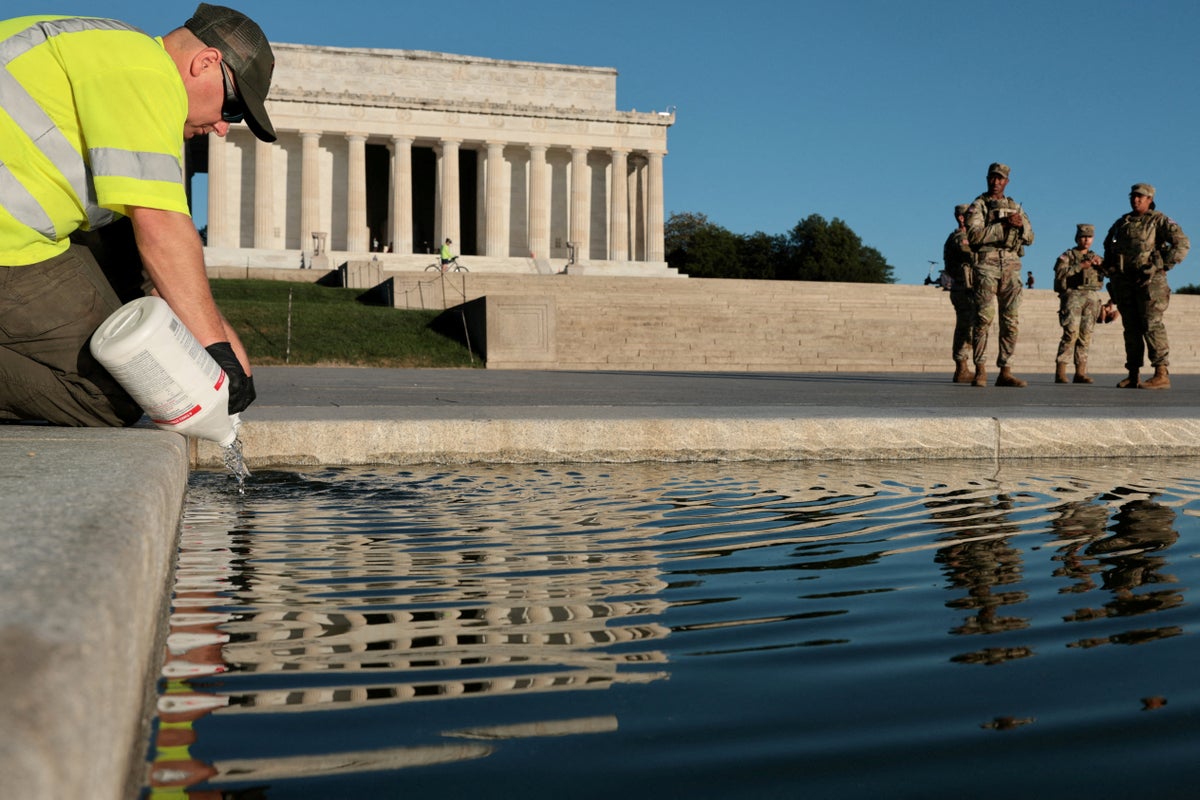
The Trump administration attempted to solve the chronic algae problem at the Lincoln Memorial Reflecting Pool by treating the water with high-concentration chemical bleach, just days after completing a rushed $14.2 million cosmetic resurfacing project. National Park Service workers were captured on camera dumping 12 percent concentration hydrogen peroxide directly into the historic 300,000-square-foot basin. The abrupt chemical intervention exposes a fundamental failure in engineering. By treating one of America’s most iconic water features like a backyard swimming pool, the project inadvertently created a perfect incubator for organic growth, rendering its brand-new "American flag blue" finish a murky green.
The Chemistry of a Quick Fix
The decision to pour massive quantities of hydrogen peroxide into the National Mall’s center piece is a short-term triage tactic disguised as advanced maintenance.
A 12 percent concentration of hydrogen peroxide is highly reactive. It kills algae on contact by oxidizing cell walls, which causes the organic matter to die, clump, and float to the surface. The Department of the Interior quickly declared victory, asserting that specialized "nanobubbler technology" had destroyed the bloom and that the dead material was merely being vacuumed away.
The underlying science paints a far less triumphant picture.
Hydrogen peroxide breaks down rapidly into pure water and oxygen. While this makes it less persistently toxic to the environment than chlorine bleach, it leaves behind no residual sanitizing footprint. The moment the chemical reaction finishes, the water is left entirely unprotected.
Even worse, the treatment process unlocks a major biological accelerator. Dead algae cells rupture and release massive amounts of phosphorus and nitrogen directly into the water. This sudden surge of nutrients acts as a high-potency fertilizer for whatever microscopic algae survived the initial chemical dump.
When a Monument is Treated Like a Backyard Pool
The crisis stems from a basic misunderstanding of civil engineering. The President explicitly noted that he approached the project using his background as a real estate developer, consulting commercial pool contractors to bypass a traditional $300 million granite replacement project. The administration opted instead to scrub the historic 1922 stone basin, grout the seams, and roll on an industrial-grade swimming pool coating.
A swimming pool relies on a closed, highly controlled environment. It requires continuous high-turnover filtration, automated chemical feeding, and a lack of external organic inputs to stay clear.
The Reflecting Pool is a completely different mechanism.
- Massive Volume: The basin holds approximately 4 million gallons of water spread over an area equivalent to 12 Olympic swimming pools.
- Shallow Depth: With an average depth of only two feet, sunlight penetrates completely to the bottom, heating the water rapidly.
- Environmental Exposure: The open design invites duck droppings, leaves, soil runoff, and heavy pedestrian debris.
Stagnant, shallow water combined with intense summer sunlight and a sudden influx of organic nutrients creates an ideal environment for rapid biological growth. No amount of manual chemical dumping can outpace this natural cycle without a continuous, industrial-scale water treatment infrastructure.
The No-Bid Contract and the Nanobubbler Gamble
The rapid decline of the pool has renewed scrutiny on how the project was executed. The contract for the waterproofing and resurfacing was handed out on a no-bid basis to Atlantic Industrial Coatings. This firm had previously worked on a private swimming pool at one of the President's golf clubs.
Bypassing the standard federal procurement process eliminated the rigorous engineering reviews that typically govern national landmarks. A standard review likely would have flagged the predictable biological consequences of painting a shallow, sun-exposed basin a vibrant blue without upgrading the core circulation systems.
To counter the immediate backlash, administration officials pointed to the deployment of "nanobubbler" systems. This technology injects microscopic bubbles of oxygen into the water to increase dissolved oxygen levels and combat anaerobic bacteria.
[Image diagram showing how nanobubbler technology oxygenates water]
While nanobubblers are effective tools for pond management and wastewater treatment, they are not a silver bullet for a shallow concrete basin facing heavy nutrient pollution.
The system simply cannot circulate water efficiently enough in a two-foot-deep, 2,000-foot-long pool to prevent localized stagnant zones. When the water temperature rises, the rate of algae reproduction easily outpaces the clarifying capacity of the bubbles.
The Cost of Surface Level Solutions
The financial trajectory of the project reflects its structural issues. What was initially pitched to the public as a quick, $1.5 million cosmetic upgrade quickly surged past $14.2 million as workers encountered the realities of sealing a century-old, leaking stone structure.
This is not the first time the Reflecting Pool has faced engineering challenges. In 2012, a comprehensive $34 million modernization project replaced the pool's dirt floor with concrete and tied it into a domestic water filtration system. Yet even that system required regular maintenance and periodic draining to handle the heavy load of organic waste.
The current approach attempted to bypass these systemic requirements with a fast cosmetic coat and aggressive chemical treatments. The resulting neon-vested work crews dumping boxes of chemicals into the water under the gaze of the Lincoln Memorial highlights the limits of treating complex public infrastructure through the lens of private real estate cosmetics.
A glossy layer of industrial paint cannot alter the fundamental laws of aquatic biology.
The administration now faces a difficult operational reality. To maintain the promised "American flag blue" aesthetic for the upcoming Independence Day celebrations, the National Park Service will be forced to run an expensive, continuous cycle of chemical shock treatments and manual vacuuming.
This creates an ongoing logistical burden and introduces high concentrations of hazardous chemicals to a public space frequented by wildlife and millions of tourists. The green tint reappearing in the basin confirms that short-cut engineering on the National Mall yields predictable, stubborn results.