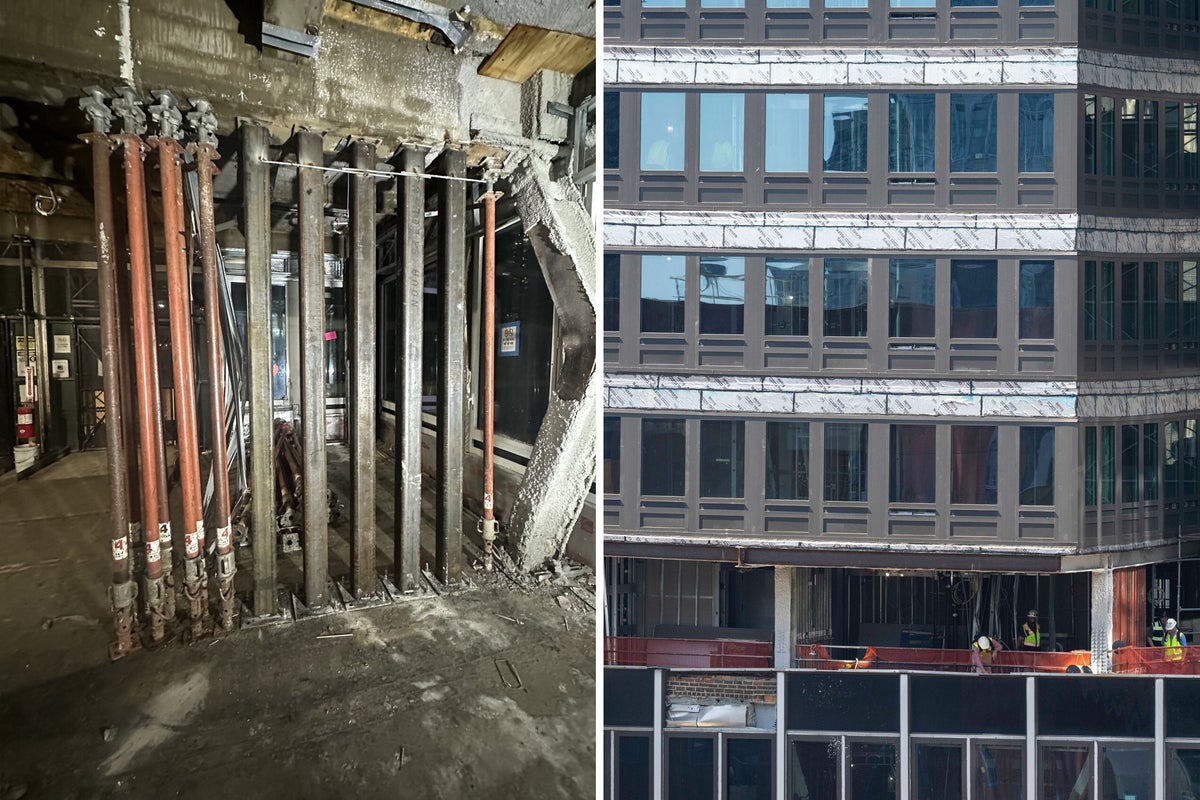
A standard New York City sidewalk protest usually follows a predictable script. Placards wave, chants echo, and a few dozen people demand accountability from a distance. But when community organizers and frustrated residents gathered outside a compromised multi-story building in Manhattan to brand it an official crime scene, the theater masked a much more urgent reality. The city had just scrambled emergency crews to stabilize the shifting foundation and prevent a catastrophic collapse. This was not an isolated incident of architectural bad luck. It was the public manifestation of a broken oversight system where speed and profit regularly outpace structural safety.
The immediate panic subsided once steel shoring towers were erected, but the underlying rot remains unaddressed. Municipal agencies frequently treat these near-misses as freak occurrences. They are nothing of the sort. Across the five boroughs, an aggressive push for rapid development has collided with an aging, fragile urban footprint, creating a predictable pipeline of structural emergencies. Read more on a related issue: this related article.
To understand how a building reaches the brink of sudden failure, you have to look past the cracked drywall and dig into the regulatory environment that allowed it to stand in the first place.
The Illusion of Rigorous Municipal Oversight
The public assumes that when a major construction project receives a certificate of occupancy, a team of independent city experts has thoroughly vetted every pillar and beam. That assumption is dangerously wrong. The Department of Buildings relies heavily on a process known as professional certification. This mechanism allows private architects and engineers to self-certify that their plans comply with all applicable codes, effectively bypassing a comprehensive review by city plan examiners. Additional analysis by Al Jazeera highlights similar views on this issue.
It saves time. It slashes bureaucratic backlogs. It also removes the primary firewall between public safety and corner-cutting developers.
When a private engineer is hired directly by a real estate developer, a fundamental conflict of interest takes root. The pressure to keep a project on schedule and under budget is immense. If an engineer insists on costly soil stabilization or thicker retaining walls, they risk being replaced by someone more compliant. The city steps in only after a crisis occurs, transitioning from a proactive regulator to a reactive cleanup crew.
How Subsurface Shortcuts Create Above Ground Disasters
Every massive structure relies entirely on what lies beneath it. In a dense urban environment, digging a foundation is an invasive surgical procedure. You are not just dealing with dirt and rock. You are disrupting a complex subterranean ecosystem of water tables, subway tunnels, utility mains, and the foundations of adjacent, century-old buildings.
Underpinning is the delicate process of strengthening the foundation of an existing building when an excavation next door goes deeper than the original footings. It requires meticulous execution. Unfortunately, it is also one of the first places where reckless contractors look to shave days off the timeline.
- Improper Dewatering: Pumping water out of an excavation site too quickly can wash away the fine soil beneath neighboring foundations, leaving them suspended over hollow voids.
- Inadequate Shoring: Failing to install sufficient lateral support allows the earth walls of a pit to shift, causing the ground under adjacent structures to slough inward.
- Vibration Damage: Heavy pile-driving equipment used without proper monitoring can liquefy loose soils and rattle old masonry joints until they fail.
When these shortcuts are taken, the laws of physics do not wait for a convenient time to assert themselves. Gravity wins. The soil shifts, the foundation settles unevenly, and the building above begins to tear itself apart.
The Mathematical Reality of Differential Settlement
When a building settles uniformly, the entire structure drops by a fraction of an inch without major incident. The danger lies in differential settlement. This occurs when one side or corner of a structure sinks faster than the rest, introducing massive, unintended twisting forces into the framing.
Consider a standard concrete beam designed to handle vertical loads. When the support on one side drops, that beam is subjected to intense shear stress.
$$\tau = \frac{V}{A_c}$$
Where $\tau$ represents the nominal shear stress, $V$ is the shear force amplified by the uneven settlement, and $A_c$ is the cross-sectional area of the concrete. Once this stress exceeds the tensile strength of the concrete and its internal rebar reinforcement, structural failure begins. Cracks zipper up the facade. Doors jam in their frames. Windows shatter under the unyielding pressure of a morphing building envelope.
By the time the public notices the damage, the internal skeleton of the building is already compromised.
The Multi Layered Cost of Emergency Intervention
When a building threatens to tip into a busy thoroughfare, the financial and social costs are staggering, and they are rarely borne by the people who caused the mess. The city must deploy emergency response units, close transit lines, and evacuate hundreds of nearby residents. Local businesses lose foot traffic and revenue while a perimeter is maintained.
Stabilizing a shifting structure is an exercise in high-stakes engineering triage. Crews must inject polyurethane grout into the shifting soil to bind it together, or rapidly weld massive structural steel braces to the exterior walls to arrest the movement. These are temporary band-aids applied at astronomical expense.
The legal battles that follow these interventions can drag on for a decade. Developers hide behind web-like networks of limited liability companies (LLCs) created specifically for a single project. If a building fails, the specific LLC declares bankruptcy, leaving neighboring property owners, insurers, and taxpayers to untangle the financial wreckage. The actual individuals who pocketed the profits walk away unscathed, free to form a new entity and break ground on the next block.
The High Risk Neighborhoods Left Unmonitored
The threat is not distributed evenly across the city. Neighborhoods experiencing intense gentrification and rapid rezoning face the highest concentration of structural near-misses. In these zones, historic low-rise brick buildings are suddenly flanked by deep-pocketed developers digging multi-story basements for luxury towers.
Old masonry structures possess almost no structural flexibility. They rely on the weight of their thick walls and the lateral support of their neighbors to stay upright. When an adjacent plot is cleared and excavated carelessly, the equilibrium that kept a 19th-century tenement stable for 140 years vanishes in an afternoon.
The current system relies on self-reporting and passive monitoring. Vibration sensors are placed on neighboring walls, but they are only useful if someone is actively checking the data and empowered to halt work immediately when thresholds are breached. Too often, alarms are ignored as nuisance warnings until the pavement outside begins to buckle.
Real accountability requires a fundamental shift in how the city manages its vertical growth. Relying on the honor system for high-rise construction is a proven failure. Until independent, city-employed structural engineers are embedded at every deep excavation site, the public will continue to watch blocks cordoned off by yellow tape, wondering which building will be the next to turn into a crime scene.