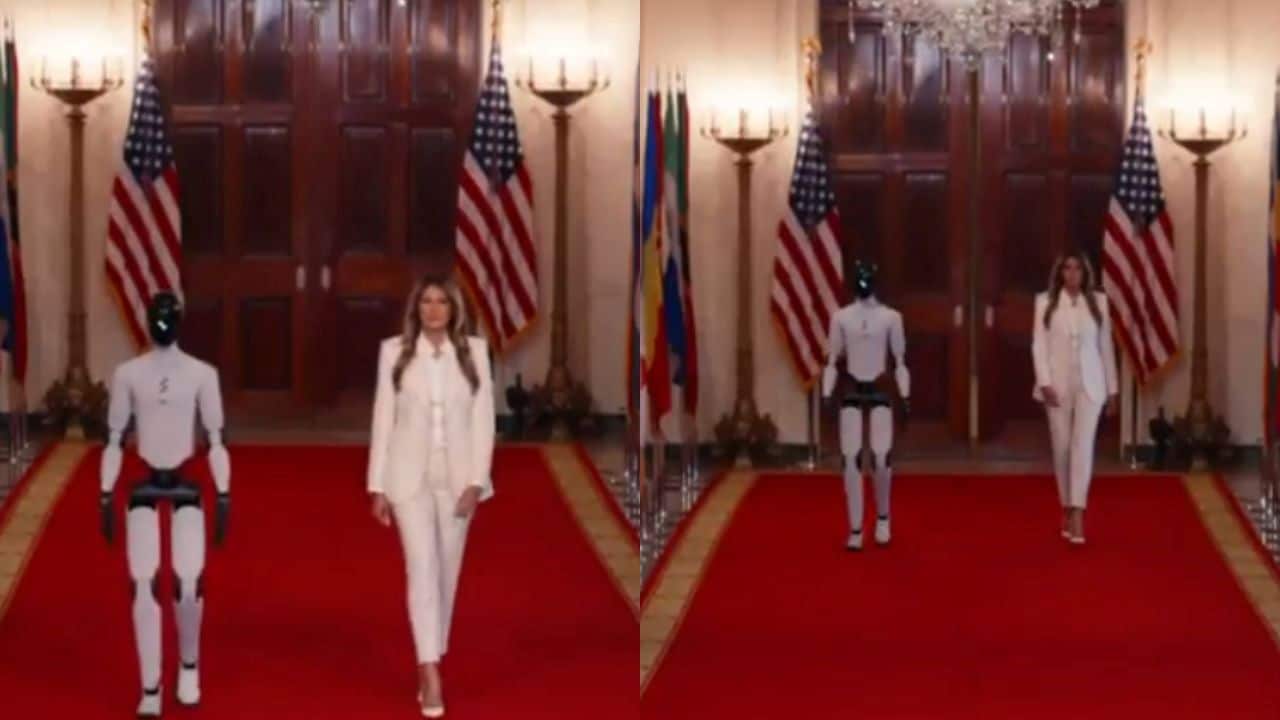
On March 25, 2026, a 160-pound mass of sensors, actuators, and carbon fiber walked down the red-carpeted Cross Hall of the White House. It didn’t stumble. It didn’t hesitate. Walking alongside First Lady Melania Trump, the "Figure 03" humanoid robot represented more than a mere photo opportunity for the "Fostering the Future Together" summit. It was a calculated signal to the Silicon Valley elite and global adversaries alike that the current administration is no longer viewing artificial intelligence as a software problem, but as a physical one.
While the public fixates on the spectacle of a machine greeting world leaders in 11 languages, the true story lies in the policy shift happening behind the scenes. This wasn't just about a robot. It was about "Plato"—a theoretical, AI-driven humanoid educator that the First Lady pitched to an audience of 45 international spouses. The premise is simple: a personalized, tireless tutor for every child. The reality is a complex web of industrial policy, a desperate race for "technological fluency," and a direct challenge to China’s burgeoning robotics sector.
The Hardware Pivot
For years, the conversation around AI was trapped in the cloud. We talked about chatbots and large language models as ethereal entities living on servers in northern Virginia or Iowa. By bringing a Figure AI humanoid into the East Room, the First Lady signaled that the era of "disembodied AI" is ending.
Figure 03 is the third generation of the Sunnyvale-based startup’s platform. Unlike its predecessors, which were largely confined to controlled laboratory environments or pilot programs in BMW manufacturing plants, this model is designed for "utility" in human spaces. It utilizes a vision-language-action model called Helix, which allows the machine to perceive a room, understand a spoken command, and execute a physical task without needing a developer to hard-code every individual movement.
The First Lady’s endorsement of "Plato" suggests a future where these machines move from the factory floor to the living room. She described a system that doesn't just download data into a child's head but adapts to their "emotional state." This is a high-stakes gamble on affective computing—the ability of a machine to recognize and respond to human emotion. If a machine can tell when a student is frustrated with a geometry proof and shift its tone to encourage them, the traditional classroom model begins to dissolve.
Economic Superiority as Educational Policy
The rhetoric used during the summit was notably hawkish for an education initiative. Melania Trump explicitly linked the adoption of humanoid AI to "long-term economic superiority." This is the language of a tech-cold war.
- Strategic Competition: China has already integrated humanoid robots into public displays and nationalistic narratives. By framing Figure 03 as the "first American-made humanoid guest" in the White House, the administration is staking a claim to the physical manifestation of AI.
- The Labor Gap: With US unemployment sitting at 4.4% in early 2026 and a chronic shortage of educators, the "Plato" concept is being positioned as a fix for a broken system.
- Market Distribution: The First Lady called on capital markets to "finance the distribution" of these technologies. This isn't a suggestion; it’s an invitation for venture capital to flood the robotics sector with the same fervor once reserved for SaaS startups.
Critics, however, are pointing to the obvious friction. The idea of replacing a human teacher—a profession built on empathy and social nuance—with a machine named after a philosopher who championed the "leading of a soul" is, at best, tone-deaf. At worst, it is an admission that the government has given up on the human element of the American workforce.
The Silicon Valley Alliance
The summit wasn't just a political gathering; it was a corporate summit. The presence of leadership from OpenAI, Palantir, xAI, Nvidia, and Meta underscores a tightening alliance between the executive branch and the "Magnificent Seven" of the AI era. Earlier that same day, President Trump appointed Mark Zuckerberg, Larry Ellison, and Jensen Huang to a new council on AI policy.
This is the "Age of Imagination" the First Lady frequently references—a term that sounds soft but carries a hard edge. In this framework, "imagination" is the only thing humans have left when machines handle the "intellectual progress." By encouraging children to use AI for everything from fashion design to film production, the administration is betting that the next generation will be a class of "prompt engineers" and creative directors rather than laborers or technical specialists.
The Risks of a Personified Future
Despite the polished presentation, the path to a robot in every home is littered with technical and ethical landmines. Figure 03 may have walked the red carpet perfectly, but the reality of humanoid robotics remains messy. Only hours before the summit, reports surfaced of similar models in commercial settings malfunctioning—smashing plates and requiring physical restraint by staff.
There is also the question of data sovereignty. If "Plato" is monitoring a child’s learning speed and "emotional state," where does that data go? A humanoid robot is, essentially, a mobile 360-degree surveillance suite. The First Lady’s "Fostering the Future Together" initiative claims to prioritize child safety, yet the integration of private-sector AI into the home creates a privacy vacuum that current legislation—like the Take It Down Act—is ill-equipped to fill.
Furthermore, the "Plato" model assumes that education is a solo endeavor. It ignores the social-emotional development that happens between peers in a physical classroom. If the American education system pivots to a decentralized, robot-led model to save money or gain "economic superiority," it risks creating a generation that is technologically fluent but socially bankrupt.
Beyond the Spectacle
The "Figure 3" appearance was a masterclass in optics. It transformed a dry policy discussion about education into a global headline. But once the robot retraces its steps back down the Cross Hall and the cameras are packed away, the real work begins. The administration is pushing for a total overhaul of how American children interact with information.
They are moving toward a world where the interface isn't a screen, but a face. Whether that face belongs to a human or a machine named Plato is the central tension of the next decade. The White House has made its choice clear: the future is personified, programmed, and built in Silicon Valley.
Would you like me to analyze the specific economic impact of the proposed "Plato" humanoid rollout on the US public school system?