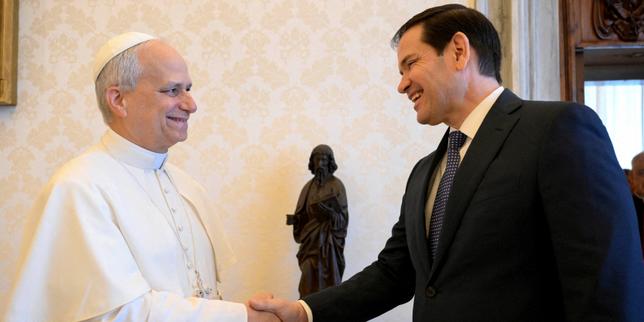
U.S. Secretary of State Marco Rubio is arriving in Rome for a high-stakes, two-day diplomatic mission to the Vatican, tasked with repairing a fractured relationship between Washington and the Holy See. Outwardly, the State Department frames the trip as a routine bilateral discussion on religious freedom and humanitarian aid. In reality, Rubio is stepping into a geopolitical firestorm. Relations between President Donald Trump and Pope Leo XIV—the first American-born pontiff—have deteriorated to an unprecedented low following the administration's military campaign in Iran, forcing Rubio to play the role of damage control officer before domestic political fallout cripples the administration ahead of the midterm elections.
The friction reached a boiling point in recent weeks after Pope Leo issued sharp, specific condemnations of the U.S.-Israeli war on Iran, denouncing the use of God's name to justify military violence. The president reacted with characteristic aggression, publicly labeling the pontiff weak on crime and foreign policy, while questioning the legitimacy of his papacy. Vice President JD Vance added fuel to the fire, publicly warning the Vatican to stick to matters of morality rather than defense strategy. Don't forget to check out our previous coverage on this related article.
For Rubio, a devout Catholic, the assignment is fraught with personal and political peril. He must project the administration's unyielding stance on Iran while placating a deeply offended Catholic electorate at home.
The Domestic Political Calculation
The administration's public warfare with the Holy See is not just a foreign policy headache. It is an immediate domestic liability. Republican strategists are quietly sounding the alarm over the potential alienation of conservative Catholic voters, a demographic vital to maintaining the party's congressional majorities in the upcoming midterms. To read more about the background here, NPR offers an excellent breakdown.
Vatican observers note that while American Catholics are politically diverse, direct and coarse attacks on the papacy by a sitting president do not sit well with the faithful, regardless of their ideological leanings. Rubio’s trip is a calculated effort to signal respect to Catholic voters without walking back the administration's military objectives. By emphasizing shared concerns over Christian persecution in Africa and humanitarian aid delivery in Cuba, Rubio is attempting to shift the narrative away from the smoke of the Middle East toward safer, traditional areas of cooperation.
The Broken European Coalition
The fallout from the administration's rhetoric has extended far beyond the walls of the Apostolic Palace, fracturing Washington’s alliances within Europe. Italian Prime Minister Giorgia Meloni, previously one of the president's most dependable allies on the continent, broke sharply with Washington following the attacks on the pope. Meloni publicly defended the pontiff, declaring the administration's insults unacceptable and affirming the pope's right to preach peace.
The response from the White House was swift and punitive. The president openly questioned Meloni’s courage, criticized Italy for failing to support the strikes on Iran, and threatened to withdraw U.S. troops from Italian soil.
This cross-Atlantic spat has complicated Rubio’s itinerary. While the Secretary of State secured audiences with Vatican Secretary of State Pietro Parolin and Italian Foreign Minister Antonio Tajani, his request for a direct meeting with Meloni remained unconfirmed until the final moments of his departure. The diplomatic freeze highlights a stark reality. The administration's aggressive posturing has managed to alienate the very European leaders it needs to enforce maritime blockades in the Strait of Hormuz.
A New Era of Vatican Prophecy
The administration appears to have misjudged the character of the man sitting on the Chair of St. Peter. Elected last year, Chicago-born Pope Leo XIV was initially viewed by some Washington insiders as a figure who might understand, or at least tolerate, the nuances of American political theater. That assumption proved entirely incorrect.
Instead of retreating under pressure, Leo has escalated his rhetoric. In mid-April, he condemned the demonic cycle of evil driving the Iran conflict, transforming from a traditional dispenser of generalized platitudes into a highly specific, prophetic critic of American foreign policy.
The Holy See's resistance is not merely rhetorical. The Vatican has actively engaged in backchannel diplomacy to counter Washington's war footing. Tensions spilled into the open last month during an unusual and highly charged meeting at the Pentagon, where the then-Vatican ambassador to the United States, Cardinal Christophe Pierre, was summoned for a blunt confrontation over the Holy See's opposition to the military campaign.
The Straitjacket of Public Relations
During a press briefing immediately preceding his departure, Rubio attempted to project an aura of calm, insisting that the trip was planned long before the president's public outbursts. He tried to pivot the conversation toward the global leverage of the Catholic Church, noting its presence in over a hundred countries and its utility as a partner in distributing aid.
Yet, when pressed on the core disagreement regarding Iran, Rubio’s defensive posture revealed the structural limits of his mission. He argued that the administration could not understand why anyone, including the pope, would oppose their efforts to prevent Iran from acquiring nuclear weapons.
This line of argument intentionally mischaracterizes the Vatican's position. Pope Leo has never supported a nuclear-armed Iran; rather, he has consistently advocated for strict non-proliferation through rigorous international diplomacy rather than pre-emptive warfare. By framing the dispute as a simple misunderstanding about nuclear security, Rubio is attempting to mask a fundamental philosophical divide. Washington views the Middle East through the lens of kinetic deterrence and absolute military dominance. The Vatican views it as a humanitarian catastrophe in the making.
Rubio’s mission to Rome cannot resolve this fundamental schism. The Secretary of State may succeed in lowering the rhetorical temperature for a few days, providing conservative media with reassuring images of an American diplomat engaging respectfully with church leadership. He may even patch up relations with the Italian defense ministry over shared security protocols. But as long as U.S. missiles continue to fall and the American president views geopolitical dissent as a personal insult, the bridge between Washington and the Vatican will remain fundamentally broken.