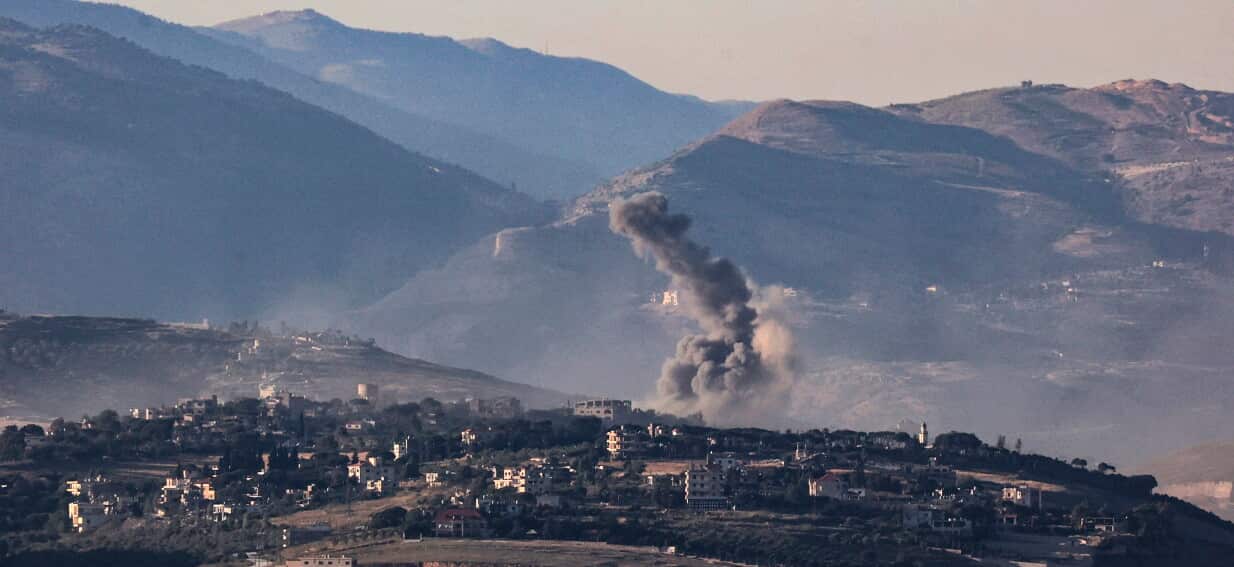
Israel has ordered its ground forces to advance further into southern Lebanon following an intense escalation of cross-border rocket and drone fire from Hezbollah. While official military communiqués frame this expansion as a temporary tactical maneuver to neutralize immediate launch sites, the reality on the ground points to a much larger, high-stakes gamble. The primary objective is no longer just degrading Hezbollah’s immediate infrastructure; it is an attempt to forcibly redraw the geopolitical map of the Middle East and establish a permanent, depopulated buffer zone. This shift risks turning a localized counter-terrorism operation into an open-ended war of attrition that could destabilize the region for a generation.
The Illusion of the Limited Incursion
When Israeli tanks first crossed the Blue Line, the public was assured the operation would be localized, targeted, and brief. History suggests otherwise. Military campaigns in this specific geography have a well-documented tendency to expand under their own momentum.
By pushing past the initial line of border villages, the Israel Defense Forces (IDF) are entering a vastly more complex terrain. Southern Lebanon is a labyrinth of rocky ridges, deep ravines, and fortified underground networks that Hezbollah has spent nearly two decades perfecting. The tactical justification for moving deeper is always the same: to push enemy artillery out of range of northern Israeli towns. However, as Israeli forces move north, Hezbollah simply utilizes longer-range assets from deeper within the Beqaa Valley and northern provinces, rendering the initial buffer zone obsolete before it is even fully secured.
This creates a dangerous feedback loop. Every mile the IDF advances to secure its perimeter expands the front line it must defend. It requires more troops, more supply lines, and more exposure to guerrilla tactics. Hezbollah is not fighting a conventional war; they do not need to hold territory to claim a strategic victory. They only need to inflict a steady stream of casualties and maintain their ability to fire into Israel.
The Strategic Miscalculation of Depopulation
The cornerstone of the current Israeli strategy appears to be the systematic displacement of populations in southern Lebanon. By ordering entire districts to evacuate, the military aims to create a free-fire zone where anyone remaining is classified as a hostile combatant. This removes tactical constraints, but it introduces massive strategic liabilities.
- The Refugee Crisis as a Radicalization Engine: Over one million Lebanese citizens have been displaced from their homes. This mass migration into Beirut and northern provinces is putting an unsustainable strain on an already collapsed Lebanese economy. History shows that displacement breeds deep-seated resentment, providing Hezbollah and other militant factions with a fertile recruiting ground for decades to come.
- The Erosion of International Legitimacy: While western allies initially supported Israel's right to defend itself against Hezbollah's relentless rocket attacks, the images of flattened villages and fleeing civilians are rapidly eroding that diplomatic capital.
- The Vacuum of Authority: Even if the IDF succeeds in clearing the border region, the question of who governs it remains unanswered. The Lebanese Armed Forces lack the capacity or the political will to police the area against Hezbollah, and international peacekeeping forces have proven largely toothless.
Hezbollah's Asymmetric Endurance
To understand why a deeper ground invasion is unlikely to achieve its stated goals, one must look at the internal architecture of Hezbollah. The group is often analyzed as a standard militia, but it functions more like a decentralized military bureaucracy with deep roots in the local population.
The recent loss of high-ranking leadership, including long-time figures at the very top of the command structure, undoubtedly disrupted the group's operations. Yet, it did not paralyze them. Hezbollah's command structure is built to survive decapitation. Local commanders operate with a high degree of autonomy, meaning a unit in a southern village does not need direct orders from Beirut to launch a drone or ambush an advancing armored column.
Furthermore, the group's arsenal remains formidable. While Israeli airstrikes have successfully targeted thousands of launch sites and storage facilities, a significant portion of Hezbollah's precision-guided munitions and long-range ballistic missiles remain hidden in deeply buried silos scattered across northern Lebanon and Syria. An IDF advance of five or ten miles into the south does nothing to eliminate these strategic threats. Instead, it places Israeli infantry directly into the crosshairs of short-range anti-tank guided missiles, an area where Hezbollah possesses significant technical proficiency.
The Hidden Economic Toll
Wars are won as much by treasuries as they are by battalions. The economic dimension of this expanded campaign is a critical vulnerability that receives far too little scrutiny.
Israel’s economy is facing unprecedented pressure. Mobilizing hundreds of thousands of reservists pulls highly productive workers out of the tech and agricultural sectors, stalling domestic growth. The cost of ammunition, particularly the interceptors used by the Iron Dome and David’s Sling systems, is astronomical compared to the cheap rockets and drones fired by Hezbollah. A single interceptor can cost anywhere from tens of thousands to millions of dollars; a Hezbollah drone can be manufactured for a fraction of that amount.
On the other side of the border, Lebanon is already a failed state. Its financial system collapsed years ago. The destruction of its southern agricultural heartland and the tourism infrastructure in its coastal cities means the country is facing total economic annihilation. A completely destabilized Lebanon is not a safer neighbor for Israel; it is a lawless zone where radical actors thrive without the constraints of a functioning state apparatus.
The Geopolitical Endgame That Does Not Exist
The ultimate flaw in the strategy of ordering troops further into Lebanon is the absence of a viable political exit strategy. Military force is a tool to achieve a political outcome, but currently, the military action itself seems to be the entire plan.
There are three potential scenarios for how this deeper push plays out, and none of them lead to lasting stability.
The Permanent Occupation Option
If Israeli forces remain in southern Lebanon to maintain the buffer zone, they will find themselves trapped in a mirror image of the 1982–2000 occupation. That eighteen-year campaign resulted in a steady drain of Israeli lives and resources, ultimately leading to a unilateral withdrawal that allowed Hezbollah to claim victory and rise to its current position of dominance.
The Quick Withdrawal Option
If Israel conducts a deep raid, demolishes infrastructure, and promptly withdraws, a power vacuum will be created. Hezbollah will simply walk back into the vacated ruins, rebuild their tunnels, and resume their positions. The border will return to the status quo ante within months, making the sacrifice of soldiers and civilians entirely futile.
The International Peacekeeper Mirage
The third option relies on diplomacy to insert a robust international force to enforce UN Resolution 1701, which mandates that Hezbollah stay north of the Litani River. This is a diplomatic fiction. No Western or regional power is willing to deploy its own troops into southern Lebanon with a mandate to forcefully disarm Hezbollah. Any international force will be just as restricted and ineffective as the current UNIFIL mission.
The Reality of the Northern Front
The heavy fire exchange that prompted this deeper push is a symptom of a systemic geopolitical deadlock. For over a year, northern Israel has been unlivable, with tens of thousands of citizens displaced from their homes due to daily rocket barrages. The political pressure on the Israeli government to solve this crisis is immense, and public patience has worn entirely thin.
But tactical aggression should not be confused with strategic clarity. Moving troops further up the Lebanese ridges provides the illusion of decisive action to a frustrated domestic audience, but it fundamentally misjudges the nature of the enemy. You cannot shoot an ideology, and you cannot permanently bomb a non-state actor into submission when they view martyrdom as a strategic victory.
The deeper the IDF marches into Lebanon, the more they play into Hezbollah’s long-term strategy of exhaustion. The war is moving exactly where the militants want it: away from high-tech airstrikes and into the brutal, close-quarters combat of the southern valleys, where technological superiority is flattened by geography, and the costs of occupation grow heavier by the day.