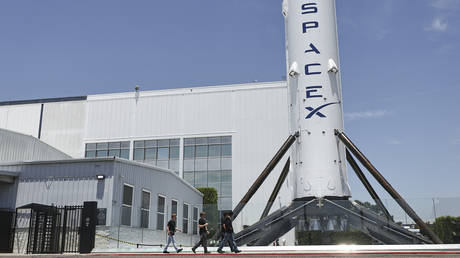
Google is buying up to $30 billion in artificial intelligence computing capacity from SpaceX because the search giant cannot build data centers fast enough to keep its own AI models competitive. Under a newly disclosed Securities and Exchange Commission filing, Alphabet will pay Elon Musk’s rocket company a staggering $920 million per month from October 2026 through June 2029. The deal secures Google access to a massive cluster of roughly 110,000 Nvidia graphics processing units (GPUs). This transaction, revealed just one week before SpaceX’s scheduled June 12 initial public offering, exposes a critical vulnerability in the tech sector: the desperate scramble for physical infrastructure.
Silicon Valley’s elite like to talk about algorithms, software, and weightless digital intelligence. The reality is much heavier, dirtier, and constrained by the laws of thermodynamics.
To train and run platforms like Gemini Enterprise, hyperscalers require mountains of silicon, miles of copper, and dedicated electrical substations. Google possesses some of the most sophisticated engineering minds on earth and its own proprietary Tensor Processing Units (TPUs). Yet, it is writing a billion-dollar monthly check to a company built on rocket propulsion.
This is a structural emergency rescue. The artificial intelligence boom has outrun the electrical grid and the real estate market, forcing traditional tech giants to buy raw horsepower wherever it stands ready.
The Illusion of Cloud Supremacy
For over a decade, Amazon Web Services, Microsoft Azure, and Google Cloud divided the digital universe among themselves. They built the data centers, laid the undersea cables, and rented virtual space to everyone else. The SpaceX transaction flips this power dynamic entirely.
Google is entering this arrangement not as a provider, but as a desperate tenant.
The terms of the SEC filing reveal the leverage SpaceX held at the negotiating table. The contract runs for 33 months, but features an aggressive implementation timeline. SpaceX must deliver the full committed capacity of 110,000 GPUs by September 30, 2026. If it fails, Google can terminate the deal immediately after a brief grace period.
However, once the system is fully active past December 31, 2026, either party can cancel the arrangement with a mere 90 days' notice.
A 90-day escape hatch on a $30 billion contract is highly unusual. It signals that this is a temporary bridge for Google, an emergency valve while it struggles to bring its own lagging infrastructure online.
It also means SpaceX can claw that compute back the moment its internal AI ambitions, through xAI and the Grok ecosystem, require the silicon.
SpaceX AI Infrastructure Revenue Streams (Mid-2026)
┌──────────────────┬──────────────────────────┬─────────────────────────┐
│ Client           │ Monthly Commitment       │ Primary Asset Involved  │
├──────────────────┼──────────────────────────┼─────────────────────────┤
│ Anthropic        │ $1.25 Billion            │ Colossus 1 (Memphis)    │
│ Google           │ $920 Million             │ Unspecified GPU Clusters│
└──────────────────┴──────────────────────────┴─────────────────────────┘
The sheer size of these numbers fundamentally rewrites the financial profiles of both entities. By combining the Google commitment with the $1.25 billion monthly deal signed with Anthropic in May, SpaceX is pulling in over $2.1 billion a month solely from leasing compute.
That translates to a $25 billion annualized run rate from an infrastructure business that barely existed two years ago.
Why Google Couldn't Build Its Way Out
Building a modern AI data center from scratch takes anywhere from 18 to 24 months under ideal conditions. Conditions today are far from ideal.
The global supply chain for high-voltage transformers, backup generators, and industrial liquid-cooling systems is severely backed up. Lead times for critical electrical grid components have stretched past three years in major North American markets.
Google’s internal pipeline for its TPU v7 chips and traditional GPU clusters cannot keep pace with the exponential growth of Gemini Enterprise workloads. Large enterprise clients are demanding agentic AI features that consume vastly more compute than simple chat boxes. If Google tells a Fortune 500 client to wait 18 months for capacity, that client moves to Microsoft or Amazon.
SpaceX possessed the inventory because of Musk’s aggressive consolidation of xAI and SpaceX hardware pipelines earlier this year.
When the two entities merged, the true prize was not the software code of Grok. It was the physical deployment of massive GPU supercomputers, like the Memphis Colossus facility, assembled with land, power, and permits already secured.
SpaceX moved with the speed of a startup unfettered by corporate bureaucracy, buying up Nvidia allocation and securing power rights while traditional tech firms were still evaluating environmental impact reports.
The IPO Valuation Equation
The timing of this disclosure is not accidental. SpaceX is preparing to list on the Nasdaq under the ticker SPCX, targeting a historic $1.77 trillion valuation. Skeptics wondered how a company dependent on government launch contracts and consumer satellite internet subscriptions could justify a valuation that rivals Alphabet itself.
The answer lies in this filing. SpaceX is no longer just a transportation company. It is a massive merchant cloud provider.
Monetizing excess capacity protects SpaceX from the immense capital expenditures it currently endures. In the first quarter alone, the company logged $10.1 billion in capital outlays, with $7.7 billion poured directly into AI infrastructure. Its AI division suffered a $2.5 billion operating loss during those same three months.
Securing $30 billion from Google and $45 billion from Anthropic transforms those speculative capital investments into guaranteed, high-margin cash flows right as institutional investors look at the balance sheet.
SpaceX Q1 Capital Allocation Breakdown
│
├── AI Infrastructure & Compute: $7.7 Billion (76.2%)
└── Starlink, Rockets, & Other: $2.4 Billion (23.8%)
This arrangement carries mutual benefits for Google's financial optics as well. Alphabet holds a substantial historic investment stake in SpaceX.
By signing a contract that inflates the valuation of SpaceX ahead of its public debut, Google is directly lifting the value of its own balance sheet assets. It is a cyclical ecosystem where cash spent on operational capacity returns as ballooning investment value on the corporate ledger.
Power, Silicon, and the New Geopolitics of Tech
The transaction underscores a brutal truth that the tech sector has attempted to ignore. The bottleneck in AI is no longer clever engineering. It is power generation.
A cluster of 110,000 Nvidia GPUs, along with the accompanying storage, CPUs, and cooling systems, draws roughly 100 to 150 megawatts of continuous electricity. That is enough to power a medium-sized American city.
Finding a single site that can supply that level of juice without collapsing the local municipal grid is an extraordinary logistical challenge. Tech companies are finding that traditional data center hubs like Northern Virginia are completely tapped out.
SpaceX succeeded by looking at alternative regions, striking deals with local industrial providers, and exploiting the fast-tracked infrastructure models used by the aerospace industry.
Google explicitly noted in its official commentary that it retains full intellectual property rights, data ownership, and model isolation throughout this lease. They are treating SpaceX as a dark, silent utility provider.
They do not want Musk’s engineers looking at Gemini’s proprietary weights or training sets.
Yet, the dependency remains. The company that commands global search and web browsing is now reliant on a direct competitor’s hardware facilities to keep its core enterprise platform functional.
The Structural Fragility of the Bridge
This entire $30 billion apparatus balances on a knife's edge. The 90-day termination clause means that either company can pull the plug if the strategic calculus shifts.
If Google brings its custom data centers online ahead of schedule in 2027, it can walk away from the $920 million monthly bill with minimal penalty. Conversely, if SpaceX decides it needs those 110,000 GPUs to train a sovereign, next-generation model that leapfrogs Gemini, it can evict Google from the silicon with three months' notice.
This creates an environment of intense, underlying instability. Enterprise customers building their long-term automation strategies on Google Cloud are unknowingly relying on a hardware substrate owned and managed by Elon Musk.
It is an arrangement born of absolute necessity, a shotgun marriage between the king of web software and the titan of heavy industrial hardware.
The traditional cloud ecosystem has been cracked open. The companies that own the physical power and the immediate silicon allocation now dictate terms to the software empires that once ruled the valley.