Record high temperatures and prolonged droughts across Southern Europe are turning seasonal wildfires into unmanageable megafires. In Spain and neighboring countries, blazes are scorching tens of thousands of hectares in single events, consuming vast swathes of pine forests and threatening rural communities. While headlines focus almost exclusively on extreme weather, the root cause extends far deeper into systemic land abandonment, flawed forestry management, and an over-reliance on emergency response rather than prevention. Without a drastic shift toward long-term land management, European fire crews will remain hopelessly outmatched against flames that now outpace modern suppression technology.
For decades, public debate surrounding Mediterranean blazes has followed a predictable pattern. A prolonged heatwave strikes, temperatures climb past 40 degrees Celsius, an ignition occurs—via lightning or human negligence—and water-dropping aircraft race against time to extinguish the inferno. Emergency declarations follow, accompanied by promises of larger containment fleets and increased regional aid. Yet, each passing summer yields larger burnt footprints and more aggressive flame behavior.
The underlying mechanics of this failure are rarely examined in depth. Fire intensity is not determined by air temperature alone. It depends heavily on fuel availability, structural forest composition, and regional land use history. By ignoring these structural elements, policy choices have unintentionally primed Southern Europe for catastrophic megafires.
Fire Suppression Has Backfired Across Southern Europe
Europe suffers from a paradox of success. For nearly half a century, regional emergency services have perfected early fire detection and rapid initial attack tactics. Small ignitions were caught quickly and put out within hours, protecting homes, timber resources, and infrastructure.
That success created a hidden hazard.
By suppressing every low-intensity surface fire, natural fire regimes were removed from Mediterranean forest ecosystems. In a natural cycle, small, frequent fires burn off dry brush, leaf litter, and fallen branches without destroying mature trees. When humans prevent those minor burns year after year, dead plant material accumulates on the forest floor.
The Accumulation of Forest Fuel
Walk through an unmanaged forest in central Spain or interior Portugal today, and you will tread on layers of dry pine needles, resinous shrubs, and dense undergrowth several feet deep. Foresters refer to this material as fuel load. When drought settles over the region, this accumulated layer dries out completely, turning entire mountain ranges into massive tinderboxes.
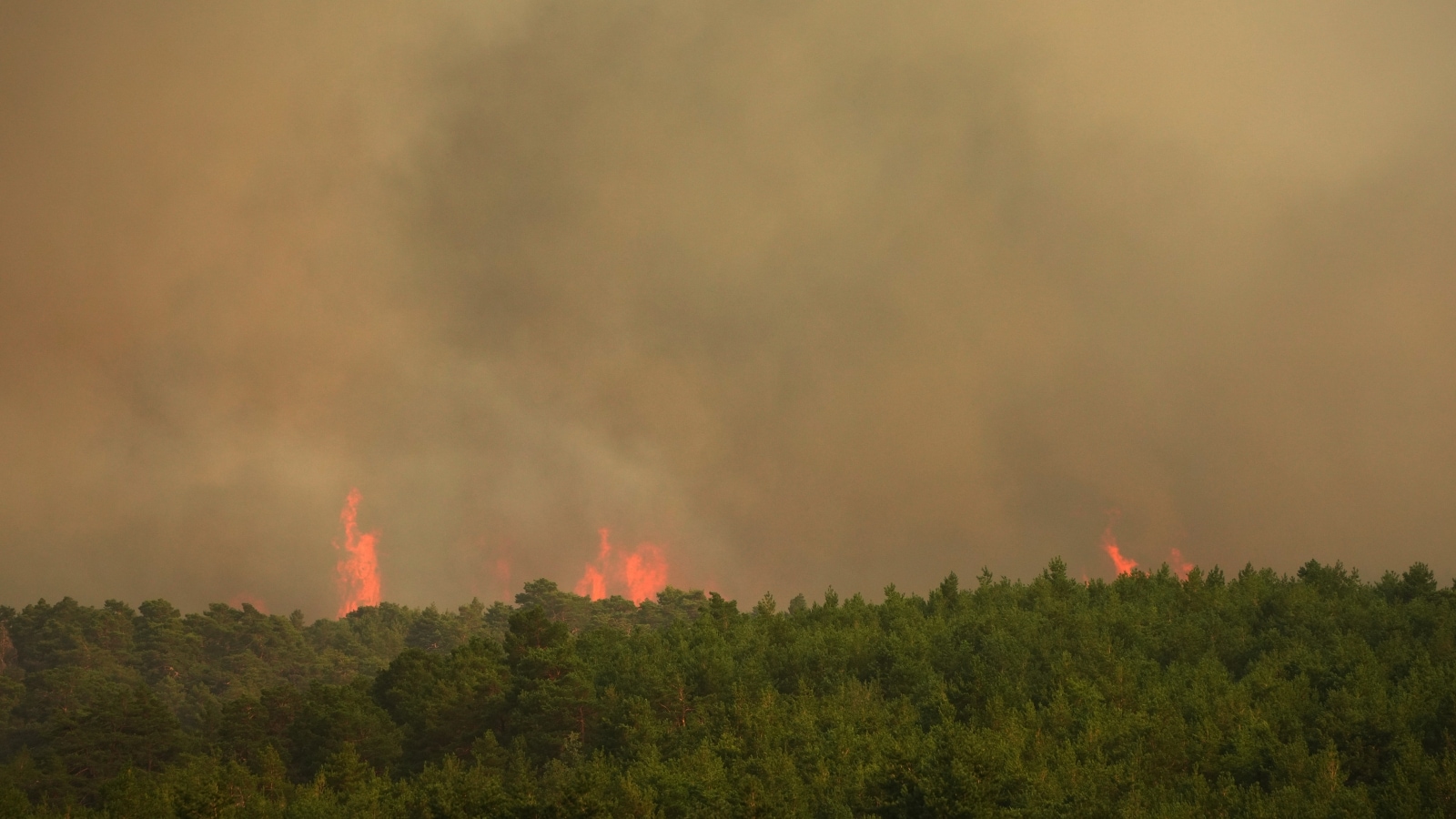
When an ignition finally slips past initial firefighting teams during an extreme heat event, it no longer stays on the ground. The massive accumulation of underbrush acts as a ladder, carrying flames upward into the tree crowns.
Crown fires represent a fundamentally different category of threat. They generate their own localized weather systems, creating powerful updrafts that pull in fresh oxygen and throw burning embers miles ahead of the main fire front. At that stage, standard suppression techniques fail entirely. Direct attack becomes impossible, and water drops from aircraft evaporate before reaching the base of the flames.
Rural Depopulation Left the Woods Unmanaged
The fuel problem was exacerbated by a massive socio-economic shift across Southern Europe over the last sixty years. The rapid exodus of population from countryside villages to coastal cities transformed the rural interior.
Historically, rural populations managed the land naturally through daily economic survival. Farmers grazed herds of goats and sheep, which kept forest undergrowth cleared along ridges and valleys. Local villagers collected firewood, cleared brush for agriculture, and harvested resin from pine stands.
"When traditional land use vanished, natural fuel breaks disappeared with it. Wild terrain once segmented by pastures and cultivated fields merged into continuous, dense thickets."
This process, known as passive rewilding, allowed brush and dense scrubland to reclaim abandoned agricultural terraces. Without active livestock grazing or selective timber clearing, the barrier zones that historically halted or slowed advancing fires ceased to exist.
Climate Realities Threaten Firefighting Capacity
Extreme weather serves as the immediate accelerator for these underlying land conditions. Higher average summer temperatures lengthen the fire season by extending dry spells from early spring well into late autumn.
The physics of fire behavior change dramatically when air temperatures spike and relative humidity drops below fifteen percent. Under these conditions, live vegetation loses its internal moisture content, effectively transforming living plants into standing fuel.
Heat Waves Break Traditional Containment Strategies
Firefighting strategy relies on predictable operational windows. Traditionally, firefighters capitalized on nighttime temperature drops and humidity recovery to construct containment lines, drop retardant, and conduct controlled burnouts.
Those nighttime windows are closing.
Nighttime temperatures in interior Spain increasingly remain above 25 degrees Celsius, accompanied by dry mountain winds. Instead of dampening down after sunset, contemporary wildfires maintain high intensity through the night. Fire crews working multi-day shifts are deprived of the cooler periods that previously allowed them to secure perimeters.
When wind speeds exceed thirty kilometers per hour alongside these low humidity levels, airborne suppression assets face severe operational limits. Strong winds distort water drops, dispersing the payload before it hits target zones. Dense smoke plumes reduce visibility to zero, grounding aircraft for safety reasons precisely when their intervention is needed most.
Aerial Firefighting Reaches Its Thermal Limits
Public perception heavily equates fire containment with heavy aircraft. News broadcasts show large amphibians dropping thousands of liters of water over burning ridges, reinforcing the belief that aerial technology can solve any blaze.
This reliance is a strategic trap.
Airplanes and helicopters do not extinguish megafires; they merely retard flame intensity along specific sectors so ground crews can physically cut containment lines through vegetation. When thermal radiation from a wildfire exceeds specific intensity thresholds, ambient temperatures near the flame front become too severe for low-altitude flight operations. Aircraft must pull back to protect aircrews, leaving ground forces exposed without air support.
| Fire Category | Average Surface Temperature | Typical Behavior | Firefighting Capabilities |
|---|---|---|---|
| Low-Intensity Surface Fire | Under 400°C | Slow moving, confined to leaf litter and small brush | Direct ground attack, hand tools, standard water drops |
| Moderate Crown Fire | 400°C to 800°C | Consumes lower branches, climbs into treetops | Indirect lines, heavy machinery, tactical retardant drops |
| High-Intensity Megafire | Over 1,000°C | Self-generating winds, long-range ember spotting | Withdrawal to safety zones; direct attack impossible |
Relying on bigger planes to handle larger fires misses the core physical limits of suppressive equipment. Spending public funds strictly on emergency aviation assets creates a false sense of security while ignoring the land management failures that make fires untamable in the first place.
The Financial Illusion of Emergency Fire Control
Regional and national budgets in Southern Europe allocate hundreds of millions of Euros annually to emergency services. Heavy suppression hardware—such as specialized water-scooping planes, high-capacity pumper trucks, and tactical command centers—dominates public spending disclosures.
Prevention receives a fraction of those resources.
Budgeting for fire response rather than fuel management is politically expedient. A fleet of bright red firefighting aircraft parked at an airfield offers tangible proof of government readiness. Controlled winter burning, subsidizing rural pastoralism, and clearing brush lines along mountain highways are quiet, labor-intensive tasks that do not generate dramatic news coverage.
Millions Spent on Helicopters While Prevention Budgets Shrink
Consider the operational costs involved. Operating a heavy dual-engine firefighting helicopter can cost thousands of Euros per flight hour in fuel, maintenance, and specialized crew compensation. A single major wildfire event lasting two weeks easily consumes tens of millions of Euros in direct response costs, excluding infrastructure destruction and timber losses.
By contrast, seasonal clearing programs and controlled winter burns cost a small fraction per hectare compared to emergency response operations. Yet forestry departments across Mediterranean Europe remain chronically underfunded, understaffed, and bogged down by bureaucratic regulation.
Policy Inertia Traps Governments in Reactive Cycles
Reversing this dynamic requires challenging established administrative habits. Regional governments often face political opposition when attempting to implement controlled burns during winter months. Local communities express concern over localized smoke drift or fear that controlled burns might escape containment.
Environmental protection policies have also, in some instances, unintentionally hampered proactive forestry. Regulations aimed at preserving wild flora and fauna sometimes restrict the removal of dead wood or limit clearing operations during nesting seasons. While well-intentioned, these blanket restrictions allow massive fuel loads to accumulate unchecked within protected natural parks. When a wildfire eventually hits these protected reserves, the resulting high-intensity crown fire destroys the very ecosystems the regulations were designed to preserve.
Rebuilding Forestry Infrastructure Before the Next Ignition
Addressing Europe's expanding wildfire threat requires abandoning the belief that technology and emergency response alone can control nature. A serious solution demands structural changes to how land is managed long before smoke appears on the horizon.
Fire prevention must be integrated into rural economic policy.
Rather than treating forestry as an isolated environmental sector, governments need to re-engage with rural land use as an active safety buffer. That means providing direct financial support to livestock farmers who maintain active grazing corridors along high-risk mountain ridges. Animals eating dry grass and brush represent a continuous, zero-emission fuel reduction system that operates year-round.
+-----------------------------------------------------------------------+
|                       RESTORING FIRE RESILIENT LAND                   |
+-----------------------------------------------------------------------+
|  Traditional Fire Suppression          Integrated Land Management     |
|  ----------------------------          --------------------------     |
|  • Continuous fuel accumulation        • Managed fuel breaks via stock|
|  • High-cost aerial response           • Controlled winter burns      |
|  • Uncontrollable crown blazes         • Diversified mosaic landscapes|
|  • Reactive emergency spending         • Proactive rural subsidies    |
+-----------------------------------------------------------------------+
Selective logging and commercial biomass harvesting must also be expanded. Removing dead trees, thinning dense pine plantations, and converting woody residue into clean energy provides a dual benefit: it reduces fire hazards while supporting localized green economies.
Breaking Up Monoculture Forests
Large portions of the Iberian Peninsula and Southern Europe were replanted during the mid-twentieth century with single-species timber stands, primarily fast-growing eucalyptus and dense pine. These monocultures burn with extreme heat and speed due to the natural oils contained within their foliage.
Replacing these inflammable monocultures with mosaic landscapes—where native broadleaf species like cork oak and chestnut are interspersed with open pasture and agricultural fields—creates natural firebreaks. Broadleaf trees contain higher moisture levels and burn far less readily than resinous conifers. When a fire encounters a mosaic landscape, its intensity drops, giving ground crews a realistic chance to gain control.
Community-level planning must adapt as well. The wildland-urban interface, where residential housing expands into forest edges, continues to grow across coastal and mountain areas. Strict building codes must enforce defensible space around structures, requiring landowners to clear vegetation within thirty meters of homes. Municipalities that fail to enforce brush management guidelines around residential developments leave their citizens directly in the path of inevitable disasters.
The flames sweeping across Spain and Southern Europe are not an unpredictable mystery. They are the predictable outcome of decades of land abandonment combined with a suppression strategy that deferred small fires only to guarantee larger ones. Until governments prioritize active fuel management and rural restoration over reactive crisis spending, every summer will bring larger blazes, higher costs, and more destructive outcomes.