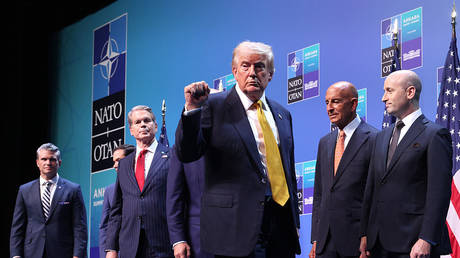
The NATO Ankara summit just locked Europe into a massive long-range missile arms race, but the real story isn't the headline-grabbing $50 billion in defense deals. It is the quiet, structural decoupling of European defense from American personnel. By purchasing Tomahawk cruise missiles outright instead of hosting American troops to fire them, Germany and its continental neighbors are scrambling to build a sovereign strike capability to survive Washington’s structural pivot away from Europe. This shift represents a desperate gamble to plug critical defense gaps before American protection vanishes entirely.
For decades, European security relied on a simple arrangement: Washington provided the nuclear and conventional shield, while Western Europe underfunded its militaries to balance domestic budgets. That arrangement is dead. The geopolitical reality of a second Trump administration has forced European capitals to confront an uncomfortable truth. They are largely on their own. While public communiqués from the Ankara summit spoke of solidarity and deterrence, the underlying policy changes tell a story of profound panic. The continent is rapidly realizing that it can no longer rely on the promise of American blood to deter foreign aggression. Also making headlines lately: The Strategic Mechanics of Chokepoint Enforcement in the Persian Gulf.
The Illegitimate Comfort of the Transatlantic Umbrella
The strategic panic stems from a stark mathematical calculation. The United States has signaled its intention to reduce its European troop presence, slash its stationed fighter jet count by a third, and redeploy naval assets toward the Pacific theater. This leaves the European continent exposed. The initial plan hatched in late 2024 involved deploying a US military battalion equipped with long-range Tomahawk missiles directly to German soil. That was a dependency model. It meant that if Berlin needed to deter an adversary, it relied entirely on an American officer receiving an order from a president in Washington who might view European security as a secondary concern.
Chancellor Friedrich Merz’s sudden announcement that Germany will instead purchase these Tomahawks and their accompanying Typhon ground-based launchers changes the entire dynamic. Germany is buying the hardware to operate it independently. This is not an act of triumphant militarism. It is an emergency purchase driven by the fear that the American security umbrella is being permanently folded. More insights on this are detailed by The Guardian.
The military reality dictates this urgency. If a conflict breaks out, static airfields are the first targets to disappear under a barrage of enemy fire. Germany possesses the highly capable Taurus KEPD 350 cruise missile, but it has a fundamental flaw in a modern high-intensity conflict: it must be launched from a fighter jet. If your runways are cratered and your hangars are burning, your air-launched cruise missiles are useless steel tubes. Ground-based launchers change the equation. The Typhon system can be hidden in forests, moved along civilian highways, and operated deceptively, giving Germany a survival-oriented strike asset that does not depend on air superiority.
The Billion Dollar Procurement Illusion
We are seeing a massive influx of cash into defense balance sheets. The UK is leading a 12-nation coalition to fund the Deep Precision Strike project, pledging over $50 billion over the next decade to develop domestic European long-range missiles. Lockheed Martin and Germany’s Rheinmetall are setting up production lines for ATACMS ballistic missiles within German borders. These numbers look impressive on a press release. They satisfy the political demand to show action.
However, money cannot immediately manufacture rocket motors. Industrial capacity cannot be willed into existence by signing a memorandum of understanding. The planned Rheinmetall facility in Unterlüß will not even begin producing missile components and rocket engines until 2027 at the earliest. This means Europe faces a dangerous multi-year window of vulnerability where its domestic manufacturing base cannot meet its defensive requirements.
The procurement strategy is therefore split into two conflicting tracks. On one track, Europe is writing massive checks to American defense firms for immediate, off-the-shelf weaponry like the Tomahawk Block V to survive the immediate future. On the other track, it is attempting to build a sovereign industrial base that will take at least a decade to mature. It is a dual-track approach that exposes how unready the continent truly is. The reliance on American hardware continues even as Europe tries to buy its independence.
Germany and the Sovereign Strike Illusion
The Tomahawk missile is a highly sophisticated piece of technology. It flies at extremely low altitudes, uses terrain contour matching, and alters its course to evade radar networks. With a range exceeding 1,600 kilometers, a Tomahawk launched from eastern Germany can strike deep into adversarial territory, target command centers, and disrupt supply lines long before ground forces clash. This is a major change for a country that has spent decades avoiding offensive military capabilities.
Yet, true sovereignty over these weapons remains an illusion. The Tomahawk is deeply integrated into the American military ecosystem. It relies on the Global Positioning System, specialized mission planning software, and top-tier satellite intelligence to execute its precision strikes. If Washington decides a conflict is not in its national interest, it can easily restrict access to the data streams required to guide these weapons effectively. Berlin may own the launchers, but the Pentagon still holds the digital keys.
This structural dependence explains why the Ankara agreements also included plans to explore a European service center for Patriot PAC-3 missiles and expanded joint space infrastructure. European leaders recognize that buying the missile is only ten percent of the problem. Building the orbital networks, the radar chains, and the maintenance facilities to support them without American interference is the real challenge. Until Europe achieves autonomy in military space architecture and digital targeting, its new long-range strike capabilities will remain tethered to the whims of the White House.
The Industrial Realities of Deep Precision Strike
The war in Ukraine exposed the fragility of Western defense manufacturing. Artillery shells were consumed in weeks that took months to produce. High-tech missiles are even harder to replace. A single Tomahawk or Patriot interceptor requires complex electronics, specialized chemical propellants, and precision-engineered guidance systems that rely on fragile global supply chains.
Europe's defense industry is highly fragmented. Each nation protects its own national champions, leading to duplicated efforts and incompatible systems. France, Italy, and the UK have historically pursued separate missile programs, driving up costs and reducing the overall volume of weapons available. While the new 12-nation Deep Precision Strike initiative aims to fix this by creating a unified purchasing and development coalition, the historical record of pan-European defense projects is filled with delays, cost overruns, and political infighting.
The immediate consequence of this fragmentation is that European taxpayers are paying twice. They are paying American contractors to buy immediate protection, and they are subsidizing local defense firms to build future alternatives. This financial strain comes at a time when European economies are struggling with sluggish growth, aging populations, and high debt loads. Convincing voters to sustain this level of military spending over the next decade will require significant political capital.
The arms race Europe just signed up for is not a choice born of strategic ambition. It is a forced march driven by the reality of a shrinking American footprint and an aggressive regional security environment. The deals signed in Ankara are a recognition that the post-Cold War era of cheap security is over. Europe is buying time with American missiles, but the clock is ticking down to a future where it must be ready to fight alone. Total defense autonomy is no longer a theoretical debate for Brussels; it is a matter of basic survival.