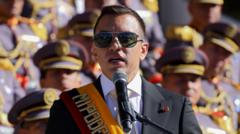
Ecuadorian President Daniel Noboa shattered diplomatic protocol on the eve of Colombia's presidential election by weaponizing a multi-million dollar border tariff to boost right-wing opposition candidate Abelardo De La Espriella. While Quito framed the abrupt elimination of its crippling 100 percent import tariff as a breakthrough in bilateral security cooperation, the reality is a calculated act of foreign interference designed to undermine the legacy of outgoing leftist President Gustavo Petro and tip the scales for his successor. The move triggered immediate condemnation from Bogota, exposing how trade policy is being hijacked as a tool for regime preference in the Andes.
By cutting a unilateral trade deal with a foreign candidate instead of a sovereign state, Noboa bypassed the established channels of international diplomacy. The Colombian Foreign Ministry blasted the maneuver as a flagrant violation of non-intervention principles. Underneath the rhetoric of border security and anti-narcotics coordination lies a deeper economic truth. The Andean Community of Nations had already ordered both countries to dismantle their retaliatory trade barriers, meaning Ecuador was legally obligated to drop the tariffs regardless of who won the vote.
The Backyard Shadow Diplomacy
International trade pacts are traditionally negotiated between sitting governments, not political campaigns. Noboa upended this norm by announcing on social media that Ecuador would completely lift its punitive tariffs on June 1, explicitly citing a private agreement reached with De La Espriella. The conservative candidate, representing the Defenders of the Homeland movement, has built his platform on hawkish border security and an aggressive stance against criminal syndicates. Noboa justified the sudden policy reversal by claiming De La Espriella demonstrated a genuine willingness to launch a joint offensive against narcoterrorism and facilitate the extradition of Ecuadorian fugitives.
This parallel diplomacy acts as a direct intervention in a highly polarized electoral race. Weeks earlier, a similar playbook unfolded when Noboa trimmed the tariff from 100 percent to 75 percent following a strategic phone call with another hard-right Colombian candidate, Paloma Valencia. By doling out economic concessions exclusively to right-wing figures, Quito created a transactional narrative. The message to Colombian voters was unmistakable. Elect a conservative leader, and the devastating trade blockade vanishes; elect Petro’s ideological successor, Iván Cepeda, and the economic strangulation continues.
Bogota was quick to pierce this narrative. The Colombian government pointed out that the rollback was not an act of neighborly goodwill or a victory for opposition diplomacy. The Andean Community of Nations, the regional trade bloc governing both nations, had already ruled that the tariff war violated free-trade agreements and mandated the elimination of the reciprocal barriers. Noboa used a mandatory legal compliance deadline to manufacture a political favor for an ideological ally.
Evolution of an Economic Blockade
The dispute did not materialize overnight. It began in January when Noboa introduced a 30 percent security fee on Colombian goods, citing an annual 1 billion dollar trade deficit and accusing Petro's administration of failing to control drug trafficking corridors along their 586-kilometer border. When Bogota dismissed the allegations, Quito escalated. The tariff climbed to 50 percent in March and surged to a staggering 100 percent by May, effectively freezing Colombian imports and crippling border commerce near trade hubs like Ipiales.
Petro retaliated with equal force. Colombia halted critical electricity exports to Ecuador, exacerbating severe power shortages caused by prolonged droughts in the neighboring country. Bogota then slapped counter-tariffs of up to 75 percent on Ecuadorian products, bringing cross-border trade to a virtual standstill and forcing both nations to recall their ambassadors.
Ecuador-Colombia Tariff Escalation (January - May)
==================================================
[Jan] 30% Security Fee Imposed by Quito
  |
[Mar] 50% Tariff Hike
  |
[May] 100% Total Import Blockade
  |
[End of May] 0% Unilateral Rollback Tied to Opposition Talks
The underlying friction stretches beyond trade balances. Colombia remains the primary producer of cocaine globally, a systemic crisis that has plagued the region for decades. Noboa, aligned with conservative regional coalitions, frequently echoed international critiques of Petro's softer, reform-minded approach to drug policy. Tensions spiked to dangerous levels following allegations from the Colombian intelligence agency suggesting that foreign entities were attempting to manufacture criminal charges against Petro to destabilize his administration.
The Failure of Regional Integration
The weaponization of tariffs exposes the profound fragility of Latin American trade blocs. The Andean Pact, conceived in the 1960s to foster regional solidarity and economic integration, has instead become a casualty of ideological warfare. When states ignore institutional arbitration in favor of score-settling, the predictability required for international commerce evaporates.
Exporters on both sides of the border have borne the brunt of this volatility. Agricultural producers, transport firms, and small businesses in the border departments watched their livelihoods vanish in a matter of weeks as logistics chains were choked by political edicts. While the immediate removal of the tariffs offers relief to these sectors, the precedent established by Noboa leaves commercial ties vulnerable to the whims of foreign electoral cycles.
The strategy carries significant risks for Ecuador. By tying a major trade decision to a specific candidate, Noboa gambled on an opposition victory. If the ruling-party candidate Iván Cepeda secures the presidency, Quito will be left with a collapsed diplomatic relationship, a hostile neighbor, and no leverage to address the very real security challenges along the shared border. True border security requires institutional continuity and intelligence sharing between sovereign states, realities that cannot be substituted by social media agreements with political campaigns.