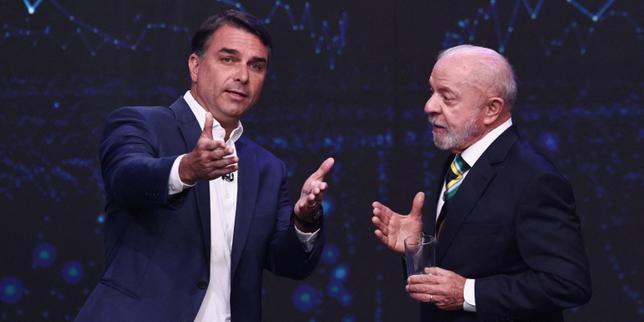
When Luiz Inácio Lula da Silva and Flávio Bolsonaro squared off in their televised runoff confrontations, voters did not get a debate on fiscal policy or institutional reform. They got a loud, structural breakdown of political dialogue. Lula struggled under the weight of an inflation-weary economy and unfulfilled promises, while Flávio Bolsonaro ducked direct inquiries regarding family corruption probes by pivoting to populist talking points on the cost of living.
This noise is not an accident of television production. It is the predictable outcome of a political architecture designed for spectacle over substance.
The Structural Breakdown of the Brazilian Runway
Television debates in Latin America's largest democracy were originally framed as democratic tests. Candidates were expected to defend four years of governance or lay out granular fiscal projections. That dynamic has eroded completely.
In the head-to-head exchanges, the mechanisms of accountability collapsed into theatrical posturing. When challenged on household purchasing power and everyday food costs, the incumbent administration fell back on historical legacy arguments rather than presenting concrete macroeconomic adjustments. Conversely, when pressed on specific investigative findings and legal scrutiny around family-linked ventures, the challenger side-stepped accountability through tactical deflection.
The incentives of modern campaign strategy actively penalize detailed policy answers. In a hyper-polarized electorate split down the middle, giving a precise answer on tariff strategy or state spending creates immediate surface area for attack. Evasion, background noise, and counter-accusation carry zero political cost on the debate floor—and production formats continue to accommodate the strategy.
Polarization as a Shield Against Accountability
For decades, political coverage treated debates as moments where uncommitted voters made up their minds based on competence. Data from recent polling cycles tells a different story. Voters tune in largely to watch their chosen side land blows, while campaign teams treat the live broadcast as a raw material factory for social media clips.
The deliberate avoidance of substance operates across both flanks:
- Incumbent vulnerability: Defending economic metrics during global inflationary pressure requires nuanced explanations about interest rates and supply chains. Nuance fails on live television, leading incumbents to retreat into generalities about national sovereignty.
- Challenger immunity: Opposition candidates can highlight immediate voter pain points—such as grocery prices and urban security—without ever detailing how their legislative program would fund or execute solutions.
- Family baggage and legal shields: Unresolved judicial probes and nepotism questions are neutralized simply by refusing to answer and shifting focus to the opponent's past legal entanglements.
This environment turns serious governance questions into an endless loop of mutual delegitimization. When both sides treat corruption probes and economic indicators as mere rhetorical weapons, voters are left with no baseline of objective facts.
Restructuring the Format Before the Next Cycle
If debate broadcasts are to serve any public purpose beyond entertainment ratings, the structural format requires immediate reform. Relying on voluntary compliance from candidates who benefit from chaos is a proven failure.
First, live fact-checking integration must move from secondary digital streams onto the main broadcast feed with direct microphone management. When a candidate presents misleading figures or evades a direct question about official investigations, moderators need the technical capability to pause the clock and require a response before moving forward.
Second, the structural layout must shift away from open-ended free-for-all blocks toward single-topic segments with fixed follow-up rounds. Allowing candidates to wander across five different topics within a single response guarantees that hard questions on governance, judicial independence, and trade relations remain unanswered.
Without fundamental format intervention, presidential debates will continue to degrade into noisy televised theater while the real work of national policy happens entirely out of public view.
To understand how these televised showdowns played out on screen, watch entre Lula et Flavio Bolsonaro, un débat télévisé stérile et violent. This coverage highlights the clash of styles and non-answers that defined the runoff stage.